WEBVTT
00:00:00.000 --> 00:00:02.560
Hello everybody, welcome to the Fire Science Show.
00:00:02.720 --> 00:00:12.960
It's the New Year's Eve in here, the last day of the year, which means it's a good time for reflecting back over the things that happened during the year.
00:00:13.119 --> 00:00:21.839
And the things that happened were obviously fires, and unfortunately, there was a lot of them and there were some big and horrible ones during the year.
00:00:22.079 --> 00:00:33.759
And uh given the chance and a good date for reflecting on the past, I would like to spend this episode discussing how I perceive the role of our industry in light of those disastrous fires.
00:00:33.920 --> 00:00:46.399
We started the year with uh Palisades fire, and this was already discussed in some way directly and in some ways indirectly, where we had a lot of episodes on hardening structures and response to wildfires.
00:00:46.640 --> 00:00:56.079
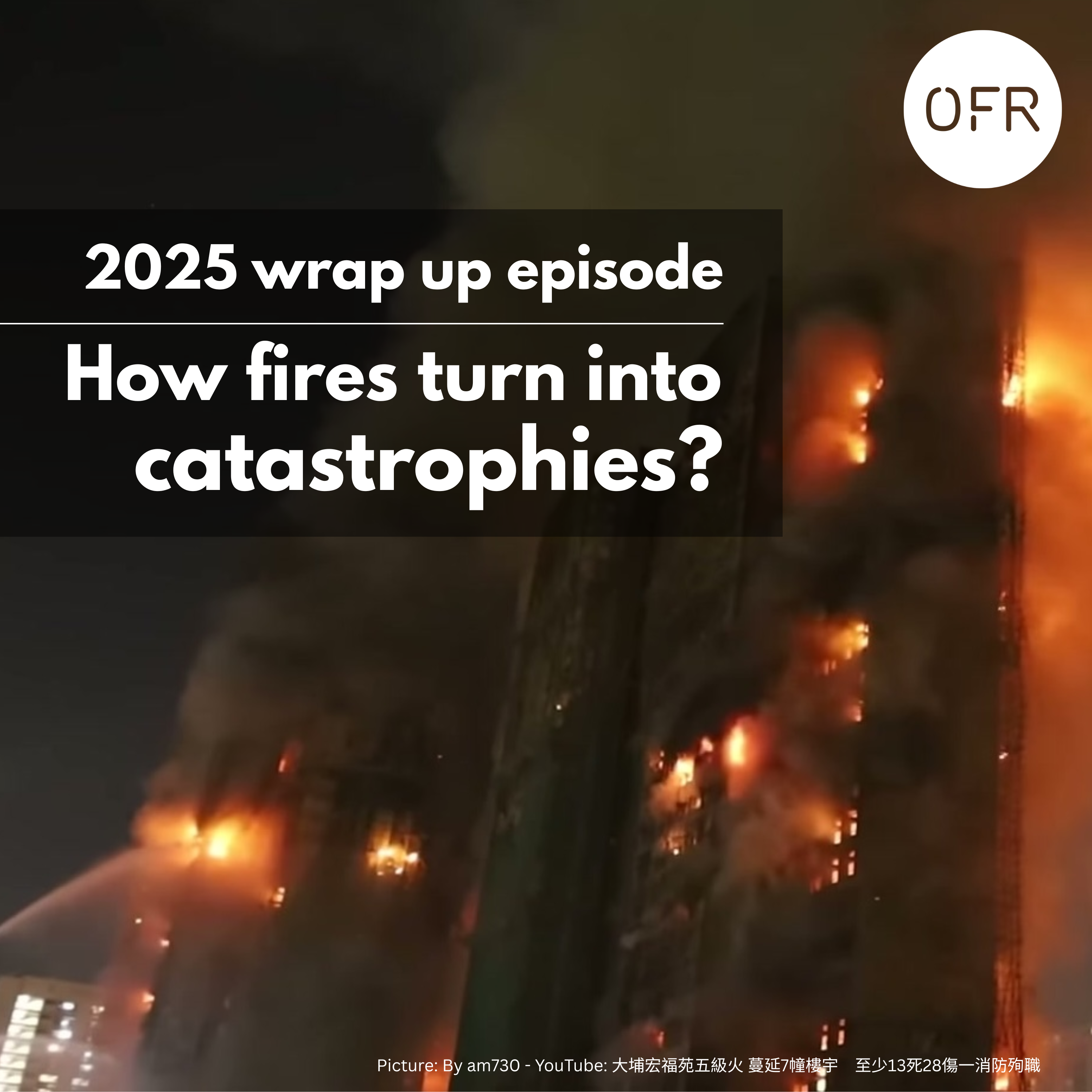
And at the end of the year, just a few weeks ago, we also had a fire that's gonna kind of define this year in the history books, the Hong Kong Fire in the Wang Fu court.
00:00:56.399 --> 00:01:06.079
I have not had a chance to comment on that yet, so I'll use this fire as an example in today's episode to discuss, to give you some of my perspectives on our discipline.
00:01:06.400 --> 00:01:13.840
We will talk about fire as a part of risk analysis, we'll talk about fire engineering and what we actually can do, what we cannot do.
00:01:13.920 --> 00:01:26.560
Uh we will talk about fire physics and how how sometimes our classical approach to fire dynamics is not enough and how fires scale up to monstrous sizes and what causes that.
00:01:26.799 --> 00:01:31.120
I'll at least I try to give you my impression on what causes that and I hope it's a good one.
00:01:31.280 --> 00:01:42.000
And finally we'll think about uh being able to prevent such tragedies and and being able to learn from those lessons and with hindsight think if if this could have been prevented.
00:01:42.159 --> 00:01:44.959
What could we do as fire engineers to prevent those fires?
00:01:45.120 --> 00:01:51.760
I mean lessons like like the ones we've learned this year, uh it's the best to think we can do is to learn from them.
00:01:52.000 --> 00:01:53.519
Hopefully not repeat them.
00:01:53.680 --> 00:01:59.519
It's unlikely we'll gonna change the world overnight and unlikely we'll prevent all of those catastrophes.
00:01:59.599 --> 00:02:06.480
But if we understand what turns a fire into the catastrophe, I think we will be much better off.
00:02:06.640 --> 00:02:07.680
I think that's that's the theme.
00:02:07.760 --> 00:02:09.759
That's the theme I wanted to find for this episode.
00:02:09.919 --> 00:02:13.039
What turns a fire into a catastrophe?
00:02:13.199 --> 00:02:17.360
Illustrated by the unfortunate events of year 2025.
00:02:17.599 --> 00:02:19.840
Let's spin the intro and jump into the episode.
00:02:24.159 --> 00:02:26.080
Welcome to the Fires Show.
00:02:26.319 --> 00:02:29.759
My name is Voyage Vingzhinski, and I will be your host.
00:02:45.199 --> 00:02:59.039
The Firescience Show is into its third year of continued support from its sponsor OFR Consultants, who are an independent multi-award-winning fire engineering consultancy with a reputation for delivering innovative safety-driven solutions.
00:02:59.199 --> 00:03:12.800
As the UK leading independent fire consultancy, OFR's globally established team have developed a reputation for preeminent fire engineering expertise with colleagues working across the world to help protect people, property, and the planet.
00:03:13.039 --> 00:03:29.039
Established in the UK in 2016 as a startup business by two highly experienced fire engineering consultants, the business continues to grow at a phenomenal rate with offices across the country in eight locations from Edinburgh to Bath and plans for future expansions.
00:03:29.199 --> 00:03:37.759
If you're keen to find out more or join OFR consultants during this exciting period of growth, visit their website at OFRConsultants.com.
00:03:38.240 --> 00:03:39.840
And now back to the episode.
00:03:40.400 --> 00:03:44.960
I always like this part of the year when something kind of ends, something kind of starts.
00:03:45.120 --> 00:03:48.719
I mean, if you think about it, it's episode 232.
00:03:48.879 --> 00:03:51.280
Next week there's gonna be episode 233.
00:03:51.520 --> 00:04:17.120
There's no significant value in those episode numbers, but in some way the ending year allows us to close up uh to compartmentalize the experiences gained into one uh book of 2025, put it on the shelf and read from it, learn from it, uh turning continuous time flow into discrete uh elements, kind of.
00:04:17.279 --> 00:04:20.720
And within this team I thought what to do for the last episode of the year.
00:04:20.879 --> 00:04:22.000
Last year I skipped it.
00:04:22.160 --> 00:04:31.759
That was not a bad decision to be honest, because this year has been overwhelming and uh definitely rest is something I need a lot.
00:04:31.920 --> 00:04:38.399
But to be honest, it's it's real fun and joy to record those episodes, so it does not feel like work at all.
00:04:38.639 --> 00:04:49.120
Therefore I'm happy to be here, and if there's anyone listening interested in what I have to say at the end of the year or at the beginning of the new year, you're very welcome to be on this journey with me.
00:04:49.360 --> 00:04:57.360
I told you we will talk about uh events of this year and notably the Wang Fu Court Fire in Hong Kong that happened a few weeks ago.
00:04:57.600 --> 00:05:00.720
But that was not the only thing that happened during the year.
00:05:00.800 --> 00:05:05.120
There was like this year was really, really intense in terms of fires.
00:05:05.279 --> 00:05:14.720
I think we'd see less and less of that in media because it's just boring news if you have the news about the biggest fire every week.
00:05:14.959 --> 00:05:16.959
But this year was kind of like that.
00:05:17.279 --> 00:05:20.000
This wildfire season was ridiculous.
00:05:20.160 --> 00:05:24.560
There there was, I think, one million hectares burned in the Americas.
00:05:24.800 --> 00:05:28.079
There was like one million hectares burned in the EU in wildfires.
00:05:28.160 --> 00:05:30.160
That's the biggest on on the record.
00:05:30.399 --> 00:05:33.680
That was the worst Mediterranean region year of the year.
00:05:33.920 --> 00:05:36.720
We had the biggest wildfire happening in Japan.
00:05:36.959 --> 00:05:40.639
We had the biggest wildfire happening in South Korea.
00:05:40.879 --> 00:05:52.560
Actually, uh in Japan, there was a fire in Kyushu Prefecture, Oita fire, where they had the largest in 50 years urban conflagration not caused by an earthquake.
00:05:52.720 --> 00:05:54.000
This is insane.
00:05:54.079 --> 00:06:01.839
Like we have been past the age of urban conflagrations, and here we we had a fire that burned 170 plus buildings.
00:06:02.000 --> 00:06:15.040
It really scares me because I I thought that the age of conflagrations is gone, but apparently they may be just on halt, which is a terrifying, terrifying news for fire science and fire safety engineering.
00:06:15.120 --> 00:06:18.720
And this is actually what what we need to discuss in this podcast episode.
00:06:19.040 --> 00:06:35.199
Because I think while our everyday job is to provide safety to the typical buildings that we do, you know, we we have this pathway of fire safety engineering, the goals, what we want to achieve, provide safe evacuation, provide for firefighting, compartmentalize, etc.
00:06:35.600 --> 00:06:37.519
We're quite good at doing those.
00:06:37.759 --> 00:06:45.279
And this is the product of fire safety engineering, and this is the fire safety engineering that is much, much, much needed by the society.
00:06:45.360 --> 00:06:50.160
This is something that you can see in the yearly statistics of deaths in fires.
00:06:50.399 --> 00:06:56.480
This is the reason the fire safety engineering is the reason why if you compare the last hundred years they're going down.
00:06:56.720 --> 00:07:03.759
Because of the great work that we do at the fundamentals protecting society from the general risk of fire.
00:07:03.920 --> 00:07:08.639
However, while we do that, there are some boundaries in which we do that.
00:07:08.720 --> 00:07:10.639
There are some boxes in which we work.
00:07:10.800 --> 00:07:15.920
And fires definitely do not respect those boundaries or boxes.
00:07:16.079 --> 00:07:24.720
They do not care about the great work that we have done and the boundaries that we set for ourselves, and they're happy to grow beyond that.
00:07:24.800 --> 00:07:30.800
And there are also many actors, stakeholders, which are not fully compliant with what we tell them.
00:07:30.959 --> 00:07:36.160
And yeah, they create pathways for those fires to escape our boundaries we've created for them.
00:07:36.399 --> 00:07:45.040
And there's also monetary optimization, risk considerations, societal acceptance, uh other goals, other needs, etc.
00:07:45.279 --> 00:07:48.560
etc., which make our job so, so, so much harder.
00:07:48.720 --> 00:07:53.360
But regardless, I think we're doing a great job as uh as fire safety engineers.
00:07:53.519 --> 00:07:58.319
And now we go into the Hong Kong uh Wang Fu Court Fire.
00:07:58.639 --> 00:08:02.639
I learned about the fire from a chat with fellow firefighters.
00:08:02.800 --> 00:08:09.040
There was a lot of noise in my uh WhatsApp seeing firefighters discuss this ongoing event.
00:08:09.120 --> 00:08:20.160
There was a live stream of the fire at some point, and I remember sitting down on my computer working on a project, and on another screen I had the live stream of the one who caught fire.
00:08:20.319 --> 00:08:22.560
Like looking at that, it was insane.
00:08:22.720 --> 00:08:29.839
There was like multiple buildings on fires, and you could see it's a collection of multiple compartment fires.
00:08:29.920 --> 00:08:36.799
Like you could see on the pictures on the videos that it was not like a single continuous facade fire or something.
00:08:36.879 --> 00:08:39.120
No, it was a collection of compartment fires.
00:08:39.279 --> 00:08:41.120
You could like distinguish them.
00:08:41.200 --> 00:08:47.600
I've counted, I think, like 30 something on the video feed that I was watching at the point where I was watching it.
00:08:48.000 --> 00:08:49.120
Horrible tragedy.
00:08:49.200 --> 00:08:51.360
Like so many compartment fires.
00:08:51.600 --> 00:08:58.480
It means that this is very, very bad, and it was immediately obvious this is uh probably the worst fire of a year.
00:08:58.720 --> 00:09:02.399
At that point, there was no real knowledge about how the fire started.
00:09:02.559 --> 00:09:20.720
However, later uh someone uploaded videos of the very early stage of the fire, which are quite interesting to see because you can see the fire growing from a very little fire in uh in the bottom of the building to a really, really massive fire in the in the building cavity, and it's uh within the span of one TikTok video, which is ridiculous.
00:09:20.879 --> 00:09:24.559
And at that point we also had no idea how bad the losses uh will be.
00:09:24.799 --> 00:09:34.879
The the news uh came later, uh after a few days we've learned that there was 161 fatalities, including one firefighter.
00:09:35.120 --> 00:09:36.399
This is ridiculous.
00:09:36.639 --> 00:09:39.279
So many lives lost in in a single fire.
00:09:39.519 --> 00:09:41.840
But beside that, there was eight buildings.
00:09:42.000 --> 00:09:45.279
Eight buildings with thousands of uh units.
00:09:45.440 --> 00:09:50.559
Uh from what I've learned, there was like nearly 2,000 houses in that complex.
00:09:50.879 --> 00:09:52.080
And they're all lost.
00:09:52.240 --> 00:09:54.320
2,000 houses lost.
00:09:54.559 --> 00:09:58.639
So many people that have lost their household.
00:09:58.879 --> 00:10:07.039
Well they are happy probably they survived it, but still this is something that will influence their lives for many, many years.
00:10:07.360 --> 00:10:08.480
Horrible tragedy.
00:10:08.639 --> 00:10:17.120
And uh immediately after, like immediately after the fire happened, there was this massive media attention given to the fire.
00:10:17.200 --> 00:10:25.200
I've seen colleagues giving uh interviews everywhere, BBC, CNBC, whatever international televisions you have.
00:10:25.360 --> 00:10:31.279
There seems to be an immediate interest of the society in fires after a tragedy like this.
00:10:31.440 --> 00:10:36.720
I mean, I don't blame my colleagues, it's it's good that we try to uh answer the society.
00:10:36.799 --> 00:10:46.399
We're here to do that actually, and uh we need to provide them with some information, some context on what happened.
00:10:46.559 --> 00:10:54.080
It's just you know, in tragedies like this, it's not a single cause, it's not a single issue, it's not a single problem that resulted in this tragedy.
00:10:54.399 --> 00:11:04.159
And uh actually to understand the complex interactions between all the actors, that's that's a hell of a job, and that that's probably gonna follow.
00:11:04.399 --> 00:11:09.679
Immediately after the fire, like the first culprit was the bamboo, it was the bamboo uh scaffolding.
00:11:09.759 --> 00:11:12.799
Then it was no, there there was a net on the scaffolding.
00:11:12.960 --> 00:11:19.759
There were expanded polystyrene bolts covering the windows, like the firefighter response was in in inadequate.
00:11:20.000 --> 00:11:32.799
There was a strong wind, there were firebands, why the sprinklers did not contain the fire, were the alarms turned off, like a lot of a lot of things that were said about the fire in the media shortly after it.
00:11:32.879 --> 00:11:35.440
I I'm I'm unsure how to feel about this.
00:11:35.519 --> 00:11:39.600
I I have not commented on that at all in in the social media.
00:11:39.919 --> 00:11:53.200
While it's it's an opportunity to get some attention and and catch on the the theme and and answer to the interests of many people, obviously, when when you comment on a on a recent tragedy like that.
00:11:53.519 --> 00:12:01.279
I don't see the great value of you know participating in this media mix of opinions.
00:12:01.360 --> 00:12:06.240
It's because it's not the most popular or most or strongest-worded opinion.
00:12:06.320 --> 00:12:07.360
That's the most important.
00:12:07.600 --> 00:12:10.159
We need to figure out the complexity of stuff that happened.
00:12:10.399 --> 00:12:17.679
Therefore I took a step back to reflect, and here I am a month later discussing uh this fire with you.
00:12:17.840 --> 00:12:20.399
And to discuss this, uh let's let's ask some questions.
00:12:20.480 --> 00:12:25.200
And the first one I would like to ask is uh is fire preventable?
00:12:25.519 --> 00:12:30.960
And I'm not talking about this particular I'm I'm talking about fire as a concept, as a phenomenon in general.
00:12:31.200 --> 00:12:33.840
Is there a possibility we get rid of a fire?
00:12:34.000 --> 00:12:36.320
If there's no fire, there's no fire problem, right?
00:12:36.559 --> 00:12:38.000
So can we get rid of fire?
00:12:38.080 --> 00:12:39.600
And the obvious answer is no.
00:12:39.919 --> 00:12:42.960
It's impossible to get rid of a fire.
00:12:43.279 --> 00:12:53.120
It's such a complex uh phenomenon, so many pathways that lead to a fire, that uh actually we embrace this way of thinking as fire safety engineers.
00:12:53.360 --> 00:13:04.799
We often consider the probability of fire, but while doing our fire safety design for buildings where when we perform our fire engineering, we just assume the probability of fire is one.
00:13:04.960 --> 00:13:06.799
It is going to happen.
00:13:07.120 --> 00:13:22.960
And uh given the amount of buildings that we have, given the amount of you know ongoing operations over the uh over the world, even if a fire is a very unlikely low probability event, it will happen somewhere.
00:13:23.200 --> 00:13:27.440
And that means there's no simple answer of yeah, we could get rid of a fire.
00:13:27.600 --> 00:13:34.320
If you think about batteries, batteries is a very interesting case because the probability of a fire inside a battery is is ridiculously low.
00:13:34.480 --> 00:13:38.080
Like I'm not sure the number, but I think it was like 10 to minus 9.
00:13:38.480 --> 00:13:46.000
If battery experts correct me, if I'm rock, apologies for butchering your field of knowledge, but it is it's very, very low.
00:13:46.240 --> 00:13:54.639
But yet, with trillions and trillions of batteries around the world, that probability means there will be a lot of fires daily all over the world.
00:13:54.720 --> 00:14:03.759
We would have to like improve this by a factor of a thousand to actually expect there will be no fire over a year from a battery source.
00:14:03.840 --> 00:14:07.840
That that's the levels at which we are getting rid of a fire.
00:14:08.000 --> 00:14:19.600
And that's only part of the equation because we're talking here about the uh fires that originate in the battery, but uh battery can be a victim of abuse and other stuff that that actually triggers fire, and probably it's very difficult to prevent that.
00:14:19.840 --> 00:14:27.279
So while in some cases it would be like if we could get rid of it, that would be the easy solution, right?
00:14:27.440 --> 00:14:31.440
But unfortunately, there is no uh there is no button to turn off fire.
00:14:31.519 --> 00:14:44.480
We we had one, the halons, the gas uh that uh take the hydrogen radicals out of the flame chemistry, basically preventing the chemical pathways for energy generation and miraculously turning fire off.
00:14:44.559 --> 00:14:45.440
That that's a great one.
00:14:45.679 --> 00:14:55.519
Unfortunately, they're also really good at destroying the ozone layer in the atmosphere, which we kind of need, so uh we are not allowed to use it after the Montreal protocol.
00:14:55.600 --> 00:15:02.639
Uh but yeah, there's no way we can get rid of fire, and the probability of fire we need to assume is one.
00:15:02.799 --> 00:15:07.759
So now we enter this world where we are aware a fire will happen.
00:15:07.919 --> 00:15:09.039
There will be fire.
00:15:09.279 --> 00:15:11.600
What how do we prevent against it?
00:15:11.679 --> 00:15:13.679
And what actually we prevent for?
00:15:14.000 --> 00:15:19.919
And I think there is some sort of societal consensus of how fire protection should look like.
00:15:20.080 --> 00:15:37.360
It's defined in many legislation systems in many countries in very similar ways, like you should provide safe evacuation, you should provide for firefighting, you should limit the fire spread, you should compartmentalize, you should provide technical systems in your buildings, etc.
00:15:37.519 --> 00:15:37.919
etc.
00:15:38.240 --> 00:15:51.600
To achieve this fire safety, we set up a framework, legislative framework, we tell what the buildings should have, what they should be built of, how should they should be made, what should be installed in them.
00:15:51.759 --> 00:15:58.240
And society accepts that they have to spend money to install those things to keep those buildings fire safe.
00:15:58.480 --> 00:16:05.440
Now, if you think about fires like the Palisades or the Wang Fu Court fire, what happened there?
00:16:05.519 --> 00:16:09.600
It like it's difficult to consider this as a single fire.
00:16:10.080 --> 00:16:17.600
It's easy for me to consider a single fire compartment as like an individual cell in which a fire event happens.
00:16:17.840 --> 00:16:21.519
And this is my classical approach as a fire safety engineer.
00:16:21.679 --> 00:16:28.720
That's what I have been taught, that there's one fire in my building and I have to provide for that one single fire in my building.
00:16:28.960 --> 00:16:40.960
Now, if you have a fire that spreads into so many compartments or so many buildings, it kind of escapes this level at which the fire safety engineering can interact with it.
00:16:41.120 --> 00:16:45.440
Perhaps from the society point of view, we should be acting on that level.
00:16:45.519 --> 00:16:58.639
But from the fire safety engineering, this is the first box we put on ourselves, the first bound we've put on ourselves that the fire should not be present in more than one fire compartment at a time.
00:16:59.120 --> 00:17:01.600
And in that case, like what else?
00:17:01.759 --> 00:17:04.240
Well, we'll come back to that in in a second.
00:17:04.400 --> 00:17:06.079
But I I wanted to put it further.
00:17:06.319 --> 00:17:15.359
Like when we put ourselves in this box of fire safety engineering in those legislative systems, the fire does not spread, the the walls provide you fire resistance of whatever minutes.
00:17:15.519 --> 00:17:20.480
It's not just this clause of the law that defines what we need to do.
00:17:20.799 --> 00:17:32.640
The way how we provide for this is either through fire safety engineering, performance-based engineering, or through prescriptive engineering, clauses of codes, classes, etc.
00:17:33.200 --> 00:17:40.160
And for those we need testing systems set up, and those testing systems allow us to give the classes to products.
00:17:40.400 --> 00:17:57.519
And those testing systems, they are built to kind of mimic some kind of worst or possible fires that could happen and expose those elements to those hazards to show if they can respond to them correctly or not.
00:17:57.759 --> 00:18:03.119
And uh in in performance-based design, we we go with design fires, we go with plausible fire scenarios, etc.
00:18:03.279 --> 00:18:12.160
We also set up, you know, kind of an expectation on what the fire would be that we wish to react to.
00:18:12.319 --> 00:18:22.000
In both cases, these conditions are as much the part of the system as the requirement to limit the fire spread is.
00:18:22.240 --> 00:18:27.440
Because in reality, you say you the fire should not spread between the buildings.
00:18:27.599 --> 00:18:37.440
In practice, what you say is that this particular building product under irradiation of 50 kilowatts per square meter achieves this kind of performance.
00:18:37.759 --> 00:18:49.200
Or you say that assuming a design fire of 30 megawatts, the radiation in 15 meter proximity is lower than needed to ignite an element that is present there.
00:18:49.440 --> 00:18:51.119
A massive simplification.
00:18:51.759 --> 00:18:57.759
If in reality the fire gives you higher radiation than the one you had in a concolorimeter, what's gonna happen?
00:18:57.920 --> 00:18:59.039
It's gonna be different.
00:18:59.359 --> 00:19:09.200
If there's an intermediate object between the buildings that allows the fire to hop, and suddenly we're not talking about self-ignition, but we have a pilot ignition scenario, oh snap.
00:19:09.519 --> 00:19:10.640
It's not as planned.
00:19:10.720 --> 00:19:22.079
So while the regulatory system we have fundamentally should prevent us from those catastrophes, because if you think about it, look at the Wanka food court fire.
00:19:22.240 --> 00:19:24.799
The fire should not spread through the building.
00:19:25.359 --> 00:19:36.319
If this word magically meant that the fire cannot spread through the building, there we would not have uh a few hundred compartments on fire, and probably the the damage would be much less severe.
00:19:36.480 --> 00:19:48.000
In reality, even if we do our job the best, if we do the whole fire safety engineering as we are supposed to do, the regulatory system only gets us that far.
00:19:48.400 --> 00:19:59.759
And what's even worse, due to the massive complexity of the system, we sometimes, even unwillingly, take you know, some specific fire scenario.
00:20:00.319 --> 00:20:03.440
And assess hazards that are completely unrelated.
00:20:03.599 --> 00:20:09.279
Like the best one I can I can think about immediately is the SBI testing method and the facades.
00:20:09.440 --> 00:20:14.240
We use SBI to assess the flammability of materials, and then we put those materials on facades.
00:20:14.319 --> 00:20:24.000
SBI is kind of like simplified room corner, and room corner is a test to assess whether the materials contribute to flashover in compartment, which is not a facade scenario.
00:20:24.240 --> 00:20:38.720
So the regulatory system in which we practice bias safety engineering puts us in a box and in a way when a fire happens that does not respect this box, it it kind of turns into a catastrophe.
00:20:38.960 --> 00:20:56.400
And it's really sad because given all the you know uh potential uh criminal issues happened in one Kfuq court fire, because I know there will all there were already arrests, there is like uh some allegations of of the netting not meeting the fire performance, etc.
00:20:56.720 --> 00:21:16.240
Even if we assume that everything was correct and such a scenario happened, there was an external fire spread, and the systems we've designed were designed to protect us from a single fire inside the compartment, and suddenly you have multiple fires in the same buildings, we would still have a catastrophic failure of the safety system.
00:21:16.559 --> 00:21:30.880
So that's that's a that's a sad thought that a a well-engineered, successful from the perspective of fire safety engineering system can actually be exposed to a scenario where there's a catastrophe and they they stop working.
00:21:31.119 --> 00:21:32.640
Another example, think about sprinklers.
00:21:32.799 --> 00:21:35.039
Uh, the sprinklers were present in that building.
00:21:35.200 --> 00:21:38.720
I've actually had the privilege to visit Hong Kong in November.
00:21:38.799 --> 00:21:40.319
You you heard about it in the podcast.
00:21:40.400 --> 00:21:46.160
I was super excited to be there on a battery conference, but uh this visit was much more than just a battery conference.
00:21:46.240 --> 00:21:49.200
I've met with a lot of friends from Hong Kong Polytechnic University.
00:21:49.359 --> 00:21:54.720
Um my student Waiki Chung took me to the Fire Academy in Hong Kong.
00:21:54.799 --> 00:22:08.079
We had a private tour of the fire academy, we had to talk with uh with the people uh in that academy and asked the question how they they deal with the high-rise building fires, because it's obvious high-rise building fires are difficult for firefighters.
00:22:08.240 --> 00:22:10.720
They told me they rely strongly on sprinklers.
00:22:10.799 --> 00:22:26.079
And sprinkler is something that works if you have one compartment of fire, maybe two, well, it's already beyond the standardized uh use of sprinklers, but if you have multiple compartments on fire, this the water will not reach the top floors.
00:22:26.160 --> 00:22:28.960
It's it's impossible from the hydraulic perspective.
00:22:29.119 --> 00:22:38.799
And if you wanted to design a system that could at the same time provide water for all the compartments in the building, that building would be just one massive pipeline.
00:22:39.200 --> 00:22:43.599
The cost for society would be absolutely unacceptable.
00:22:43.839 --> 00:22:48.880
Therefore, yeah, the fire safety engineering is done with some constraints.
00:22:49.200 --> 00:22:52.640
And beyond those constraints, it's not gonna work.
00:22:52.880 --> 00:23:04.559
And I think the moment fire turns into a catastrophe is when the physics of the phenomena make the fire outgrow those constraints.
00:23:04.799 --> 00:23:19.680
And unfortunately there's a like a domino effect, like a nuclear reaction, chain reaction effect, with every element failing, adding to the fire and creating more of these uh elements to be outside of the compartment.
00:23:19.759 --> 00:23:20.880
I I hope you follow me.
00:23:21.200 --> 00:23:36.480
It's kind of convoluted, but but indeed, while most of our engineering provides a safety and allows those scenarios to not spiral into those uh chain reactions, sometimes the fires breach those.
00:23:36.559 --> 00:23:41.359
And those are the worst fires that we end up seeing in the front pages of media.
00:23:41.519 --> 00:23:48.400
So now let's discuss some fire physics because I think it's an important thing to consider with this uh horrible fire in Hong Kong.
00:23:48.640 --> 00:24:20.400
There's a saying that sufficiently advanced technology is indistinguishable from magic, and uh I would say uh following that trend I would say that sufficiently complex phenomenon is uh indistinguishable from a divine power, and perhaps the complexity of fire and the difficulty in understanding what actually is happening within the fire is a reason why it was given almost a divine attention in our past as a humankind.
00:24:20.559 --> 00:24:24.799
And in indeed uh I'm doing this for what twenty years?
00:24:25.039 --> 00:24:28.799
And every few weeks I see a fire that surprises me.
00:24:28.960 --> 00:24:40.480
It's ridiculous how complicated fires are and how much different physics, like rich juicy physics is there to still be discovered.
00:24:40.559 --> 00:24:46.880
And and unfortunately in the Wang Fu court fire we we had a really complex fire happening.
00:24:47.039 --> 00:24:50.640
Uh I'll try to give you in in in chunks what I think about it.
00:24:50.799 --> 00:24:52.799
Keep in mind these are my own thoughts.
00:24:52.960 --> 00:24:54.720
This is not like an inquiry.
00:24:54.960 --> 00:24:58.480
It's just a guy having a podcast just speaking his mind.
00:24:58.880 --> 00:25:07.839
I did some fires in the past and I've modeled a few of them, but it's it's just me, so don't quote me in like governmental reports or something on that.
00:25:08.079 --> 00:25:10.559
But yeah, let's try to do the physics of this fire.
00:25:10.799 --> 00:25:22.880
One, the fires are extremely nonlinear, and I mean the perception of fires is like very hard because I I think as a humans we like to perceive things that change like linearly.
00:25:23.119 --> 00:25:28.799
You would think you have a 500 kilowatt fire, you have a one megawatt fire, you have two megawatt fire.
00:25:28.960 --> 00:25:36.559
Like the first one would be like something, the second would be twice as big, the third would be four times as big, right?
00:25:36.720 --> 00:25:40.000
But it it's really not like that in the realm of fire.
00:25:40.319 --> 00:25:50.240
The growth of the fire is extremely nonlinear, and what's even worse is that the heat transfer phenomena, they each come with a different power low attached to them.
00:25:50.559 --> 00:25:59.839
So often when you have a fire change from two megawatts to four megawatts, it's not just it's twice bigger, it's like a completely different disaster.
00:26:00.079 --> 00:26:16.240
And you can also see that actually very, very well in that video of uh Wang Fuck court fire when it's growing, how it changes, how how big it becomes, how how quickly it escalates into really massive fire.
00:26:16.319 --> 00:26:19.200
And I've seen that countless times in my laboratory.
00:26:19.440 --> 00:26:26.400
Like you have a fire, it's as expected, and it grows, then it grows, and it's kind of bigger, and oh shit, it's huge.
00:26:26.559 --> 00:26:34.240
Like it really gets you by surprise how quickly this changes and how quickly the perception of that fire is.
00:26:34.400 --> 00:26:37.759
And and I don't think we appreciate this as people working with fire.
00:26:37.920 --> 00:26:42.559
Perhaps one thing is that we are not really exposed to those fires that much.
00:26:42.720 --> 00:26:45.440
Like, how many of you have seen a 10 megawatt fire?
00:26:45.519 --> 00:26:47.839
How many have seen a 30, 100 megawatt fire?
00:26:48.000 --> 00:26:50.240
It's it's like a completely different animal.
00:26:50.319 --> 00:26:59.039
And and even us, the trained and skilled fire safety engineers, it's just a few of us who have seen such an event in their life.
00:26:59.200 --> 00:27:06.240
I have an experience of doing the first OG Obora traveling fire experiment with Imperial in Poland.
00:27:06.480 --> 00:27:19.039
And even though we had like a bunch of really, really good, really experienced fire scientists in the room, I think a lot of us were surprised about the final outcome when the fire reached its full potential.
00:27:19.279 --> 00:27:25.039
How huge that was and how quickly it was spreading at some point.
00:27:25.279 --> 00:27:26.079
It's ridiculous.
00:27:26.240 --> 00:27:31.359
I had an experiment with large 70 square meter CLT buildings with CLT slabs.
00:27:31.680 --> 00:27:33.440
Got the flashover in that building.
00:27:33.519 --> 00:27:37.359
That was like probably the most intense thing I've seen in my life.
00:27:37.519 --> 00:27:40.240
Like seriously, sometimes those fires catch you.
00:27:40.319 --> 00:27:49.119
Like you would not expect how quickly the severity changes within your nonlinearity, non-linearity of the heat transfer phenomena out there.
00:27:49.200 --> 00:27:55.200
And this is not just the perception of the human, it's also, you know, the heat fluxes that ignite stuff.
00:27:55.359 --> 00:28:06.799
The fact that the fire grows and starts to emit more radiation, and this radiation can ignite, self-ignite more material that feed to that fire, and it grows even larger.
00:28:06.960 --> 00:28:13.680
That's the doom spiral, that's the chain reaction which causes those fires to grow to enormous sizes.
00:28:13.920 --> 00:28:19.599
And for us fire engineers, this is not just a perception thing, how we feel about fires that we see.
00:28:19.680 --> 00:28:28.640
No, we design fires, we use design fire concepts, we use methods that mimic some fire phenomena, and we say, yes, this is fine for the building.
00:28:28.720 --> 00:28:30.559
No, this is not fine for the building.
00:28:30.799 --> 00:28:40.640
If we misunderstand how much difference a larger fire means for the building, the safety system that we design for the building will have shortcomings.
00:28:40.799 --> 00:28:46.960
So it's it's not just a thing for you know thinking about fires or feeling the fires or being overwhelmed with the fire.
00:28:47.039 --> 00:28:48.960
No, it's it's a part of our job.
00:28:49.200 --> 00:28:55.440
And I I think this nonlinearity, we don't really intuitively understand it well.
00:28:56.160 --> 00:29:01.599
And sometimes those fires act differently than we expect them to be.
00:29:02.799 --> 00:29:04.799
This is true for compartment fires.
00:29:05.039 --> 00:29:08.480
This is true for outdoor fires that I've seen.
00:29:08.720 --> 00:29:12.559
But that that I would say are still perhaps even easier.
00:29:12.880 --> 00:29:28.880
If you look at the the buildings in Hong Kong, they have this very specific type of architecture where those buildings would have like those internal cavities, wells, I'm not even sure how to name them, you know.
00:29:29.119 --> 00:29:32.319
If you look at the cross section of the building, you'll understand.
00:29:32.559 --> 00:29:43.759
It's not like four walls, it's more like a star-shaped with a lot of internal wells inside of the building that separate the flats from each other.
00:29:43.920 --> 00:29:48.640
And they are quite massive and there are openings to them that lead to the compartments.
00:29:48.799 --> 00:29:51.119
It's a style of architecture they have in there.
00:29:51.279 --> 00:29:56.880
When I was in Hong Kong, I took a lot of pictures of those wells and a lot of videos of those wells.
00:29:56.960 --> 00:30:09.759
I would I wouldn't I remember I was sitting on the bus uh with my uh student Jakub with Vinigupta and we were looking at those buildings and we were like, oh my god, like how is this even possible or a load?
00:30:09.920 --> 00:30:13.680
Because it's obviously such a dangerous fire design.
00:30:13.839 --> 00:30:20.960
And that was before the fire, and it just happened to that part of the building was the one where where the fire started.
00:30:21.119 --> 00:30:30.000
It's obviously dangerous because you create a confined chimney in which the fire can reach very high velocities.
00:30:30.240 --> 00:30:37.200
It's very efficient at transporting air, but also it's super efficient in terms of re-radiating heat inside.
00:30:37.359 --> 00:30:44.160
So yeah, that that's kind of the architecture in which the fire is capable of reaching the largest potential.
00:30:44.400 --> 00:30:52.880
And to add to that, one thing that I've learned when dealing with cavity fires, we were uh doing those experiments with uh cavities.
00:30:52.960 --> 00:31:00.400
Uh we have built a rig where you can set whatever size of cavity you want and you can test the same uh fires.
00:31:00.640 --> 00:31:15.599
What was really shocking in those experiments was that we have achieved really massive fire outcomes, like really bad fires, flames shooting out of the facade, etc., at reasonably low heat release rates, like 100 kilowatts.
00:31:15.759 --> 00:31:22.720
For a 5 centimeter facade cavity and four square meters of the facade, 100 kilowatts, that's it.
00:31:22.880 --> 00:31:28.400
And we had fires shooting out of the top of the facade, I had a thousand degrees inside the cavity, etc.
00:31:28.720 --> 00:31:34.400
A fire of a trash bin, like 100 kilowatts is nothing as a design fire source.
00:31:34.480 --> 00:31:42.000
Yet, when contained in a cavity, when flattened out into like a two-dimensional shape, that is already a massive fire.
00:31:42.160 --> 00:31:45.920
And the same thing for those uh well things in the buildings.
00:31:46.160 --> 00:31:55.599
Even if they're like 20, 30 square meters in cross section, if you have few megawatts in that, that will be completely different, few megawatts than outside.
00:31:55.680 --> 00:32:09.119
I'm not saying the heat generation will be different, but the way how the heat transfer happens in that confined volume, this is gonna be as if you had much, much larger fire outside.
00:32:09.359 --> 00:32:12.640
This this is what creates the severity of those confined fires.
00:32:12.720 --> 00:32:14.079
This is what makes them dangerous.
00:32:14.240 --> 00:32:18.720
This was actually the King's Cross fire in London when we where the trench effect was discovered.
00:32:18.880 --> 00:32:31.920
Very similar phenomenon where a confined fire led uh by gravitational flow upwards chimney effect can create tremendous, tremendous uh fire damage in in the building.
00:32:32.240 --> 00:32:36.240
And uh another thing is the fuel that was present there.
00:32:36.480 --> 00:32:42.799
So uh in the early days after the um after the fire, the bamboo was the culprit.
00:32:42.960 --> 00:32:45.440
And that's a challenging thing to discuss.
00:32:45.519 --> 00:32:47.599
Like, was the bamboo the culprit or not?
00:32:47.839 --> 00:32:50.240
Because it obviously is flammable.
00:32:50.720 --> 00:32:54.400
You cannot deny that bamboo is flammable, it's it just is.
00:32:55.039 --> 00:33:00.079
But uh at the same time, is is it really a hazardous material in for scaffoldings?
00:33:00.240 --> 00:33:01.119
I'm I'm not sure.
00:33:01.519 --> 00:33:17.359
I mean, a scaffolding is a lattice system, like those bamboo sticks are really far away from each other, and if you just burn them outdoors without this cavity, without this well, I don't think you would have a strongly spreading fire.
00:33:17.440 --> 00:33:22.720
It's perhaps something that and I'm sure people will do a lot of experiments with bamboo scaffoldings right now.
00:33:22.960 --> 00:33:28.160
But I don't think in a on a flat wall you would get the same thing because of the separation.
00:33:28.319 --> 00:33:38.079
That the sticks are separated uh largely enough from each other that uh this kind of prevents the self-sustaining like fire of those sticks.
00:33:38.319 --> 00:33:42.400
If you add the flammable netting to that, huh, that's probably a different thing.
00:33:42.640 --> 00:33:47.039
But still the net, if you see the videos, it melted away, disappeared.
00:33:47.119 --> 00:33:48.960
It's not a huge mass of material.
00:33:49.119 --> 00:33:55.279
In general, the bamboo scaffolding and the netting is not a huge mass of fuel, it's not a huge fuel load.
00:33:55.519 --> 00:34:05.359
So in theory, you should not have a self-sustaining giant massive fire because how those things are separated in space.
00:34:05.599 --> 00:34:18.400
And you know, looking at the Wang Fu Courtfire and uh the classical approach that that's in my head, that I think this separation thing is a key thing to consider in here.
00:34:18.480 --> 00:34:27.440
Because we we like to consider separation as uh a function of distance, as a function of physical distance between the objects.
00:34:27.599 --> 00:34:36.159
If they are separated for sufficient distance, it's not possible that one interacts with another and they do not create a continuous flame.
00:34:36.400 --> 00:34:43.599
But I I think we also should consider this not only in the domain of space, but also like in kind of time domain.
00:34:43.840 --> 00:34:52.480
If you have those fires in cavities, they reach very large flow velocities in there, like 10 meters per second, easy.
00:34:52.719 --> 00:35:01.360
Now, when you have a fire burning, it takes some space above the fuel because of the chemical reactions that happen.
00:35:01.519 --> 00:35:06.239
They take some time to fully consume the fuel as it goes.
00:35:06.320 --> 00:35:13.679
There are hundreds, if not thousands, of chemical reactions that are concurrently occurring in the flame, and that's why the flame has a volume.
00:35:13.840 --> 00:35:19.280
That reactions have to react over, you know, that the time is needed for them to go through.
00:35:19.360 --> 00:35:28.800
The larger the fire, the more the fuel emitted, the longer it takes to mix with the oxygen from the air, the longer it takes for those uh reactions to happen.
00:35:29.039 --> 00:35:39.440
And now if you have a very high velocity, those reactions still happen, perhaps at larger speeds because uh the mixing is is promoted, but they still take some time.
00:35:39.599 --> 00:35:49.920
But now, at very high velocity, if the reaction takes a given time, perhaps it's enough time for that flame to reach the second stick of the bamboo lattice.
00:35:50.079 --> 00:36:07.760
And if it does, suddenly that stick starts to emit fuel, and the reactions continue, and then it reaches the third stick, and now you have the combined fuel from three sticks, reaching the fourth one, and the fifth and the tenth, and suddenly you have a continuous flame across 31 floors of a building, and it's in the cavity.
00:36:07.920 --> 00:36:18.719
It's in the perfect conditions to re-radiate to other sticks to ignite more fuel, to emit more fuel, and you you don't even need to have hundreds of megawatts in that cavity to create a massive consequence of fire.
00:36:19.039 --> 00:36:38.079
So even if in an outdoor lattice system the separation distance would be large enough for the buoyancy controlled flames, when you have a system in the chimney where those are accelerated, the separation distances that would prevent would be completely different.
00:36:38.159 --> 00:36:43.199
And I think that that's a huge contributor to to the tragedy.
00:36:43.440 --> 00:36:57.599
Another thing is the fire spread because you know I I think we we we consider this fire as one fire, but in fact there was hundreds of fires happening concurrently, and we need to understand the mechanism how those fires spread.
00:36:57.760 --> 00:37:00.239
One thing is the polystyrene covers on the windows.
00:37:00.400 --> 00:37:09.599
I think that that's a contributor, the wooden entrances to the building which replaced some windows where the workers could enter the scaffoldings, that's probably a contributor.
00:37:09.760 --> 00:37:11.519
But also the wind and firebrands.
00:37:11.679 --> 00:37:15.599
The the fire happened at uh a very strong wind.
00:37:15.840 --> 00:37:22.800
There was a very strong, dry monsoon wind in Hong Kong that day, and there obviously was a lot of firebrands.
00:37:22.880 --> 00:37:28.400
There were ignitions found many uh hundreds of meters from the building, from the firebrands.
00:37:28.480 --> 00:37:38.239
So I I my guess would be that the firebrands were able to carry the fire from the initial site to the other buildings in the in the Kurt.
00:37:38.719 --> 00:37:56.719
And just the same scenario repeated, you know, the the cavity fire with the fuel inside the cavity that overwhelmed the safety features of the building that cascaded outside of the scope of the fire systems that were in those buildings that were meant to provide safety.
00:37:57.440 --> 00:38:04.880
I think this is the core of what we would need to study as fire safety engineers.
00:38:05.199 --> 00:38:18.079
How this single event, single fire, what mechanisms lead to cascading that fire to actually overwhelm the boundaries of the safety systems that we have in place.
00:38:18.320 --> 00:38:22.320
And this I think this is true for all the massive fires that happened this year.
00:38:22.480 --> 00:38:26.719
The Palisades, the Fire in Japan, the Hong Kong fire.
00:38:26.960 --> 00:38:35.199
In all of them, the fire spiraled out of the boundaries that we can work and provide safety with.
00:38:35.440 --> 00:38:42.559
Not to mention that perhaps the safety was compromised by some actions or illegal activities or wrong decisions.
00:38:42.880 --> 00:38:44.079
That's out of the question.
00:38:44.239 --> 00:38:51.440
But even if there was some level of safety we could provide, and and we obviously did not because the fire spiraled out of that.
00:38:51.679 --> 00:38:53.280
So a question arises.
00:38:53.519 --> 00:38:54.320
Can we do better?
00:38:54.639 --> 00:38:57.760
How can we prevent such tragedies in the future?
00:38:58.000 --> 00:39:02.719
And God, if I only had an answer to that one, that would be awesome, but I obviously don't.
00:39:02.960 --> 00:39:06.880
I can just give some thoughts on where we should move from here.
00:39:07.119 --> 00:39:31.599
If we have a safety system set in place, playing with that safety system, you know, changing the standard requirements, etc., it technically is possible, but it would take ages to change all the testing methods to account for the new normal, a larger fire that we could expect, and even if we did that, there would still be a fire that could overwhelm the system and still lead to a tragedy.
00:39:31.840 --> 00:39:37.280
So I'm not sure if uh changing the system is the answer.
00:39:37.440 --> 00:39:46.400
I mean the system works, it's just this component where we are beyond the the where word what the system is supposed to provide is is where those catastrophic failures are.
00:39:46.559 --> 00:39:49.280
Perhaps we can add something to the systems.
00:39:49.760 --> 00:40:10.159
Perhaps we should be more explicit in testing for those extreme cases, in understanding the failures of the The systems, how fires violate those systems, how they go across the boundaries of the safety systems we provide, and what's the consequence of that, you know?
00:40:10.480 --> 00:40:22.800
Kind of like the worst case scenario analysis, perhaps risk-based, perhaps more guided like chemical processing it does for the significant events in the industrial sites.
00:40:23.119 --> 00:40:24.480
More safety cases.
00:40:24.800 --> 00:40:26.639
But it would have to be explicit, you know.
00:40:26.880 --> 00:40:38.159
We would have to have an explicit goal set in our legislation systems that we need to check for the blind spots of the safety systems that we have.
00:40:38.480 --> 00:40:53.920
We have to define the scenarios at which the systems will stop providing sufficient level of safety, how they can end up in this place and is such an event possible in a building that is being designed.
00:40:54.159 --> 00:41:05.599
I think if we were more explicit about this particular actions, we would be able to capture those events, those fires that would lead to such a catastrophic failure.
00:41:05.760 --> 00:41:08.400
And obviously for each building they could be different.
00:41:08.719 --> 00:41:18.880
Because I would assume that if the building was just a rectangle, not a star-shaped pattern, we didn't have these internal wells, it probably would not be such a massive fire.
00:41:19.039 --> 00:41:23.679
It could have been a very large fire with the firebrands, strong winds, etc.
00:41:23.920 --> 00:41:26.800
But but perhaps not a catastrophe like we've seen.
00:41:26.960 --> 00:41:30.960
And it's probably true for most of the catastrophical fires of the recent years.
00:41:31.280 --> 00:41:41.679
The extent of the tragedy would be much less severe if some of the systems were not overwhelmed and some of the systems provided the level of safety they were expected.
00:41:42.639 --> 00:41:51.679
Also, you know, we would need to think about if we have a compartment fire and it transitions into this massive, massive fire, what can we do in the meantime?
00:41:51.840 --> 00:41:56.719
If you look at the videos, uh how this fire grew to the massive size, there's not much you could do.
00:41:56.800 --> 00:41:58.320
Like it happened in two minutes.
00:41:58.480 --> 00:42:02.239
I don't think there's any sort of fire response possible.
00:42:02.480 --> 00:42:12.559
Maybe one day drones or some sort of aerial units that can deploy water at very high heights, it's extremely difficult for firefighters to reach off that those heights.
00:42:12.800 --> 00:42:23.280
Thanks to gravity, thanks to hydraulics, thanks to the pumping systems, it's just a really huge technical issue to deliver water at the thirty first floor from the outside.
00:42:23.360 --> 00:42:26.880
And that I would be far away from blaming firefighters.
00:42:26.960 --> 00:42:29.679
They probably did whatever they could to stop the fire.
00:42:30.320 --> 00:42:34.400
They were overwhelmed with the fire just as the building systems were.
00:42:34.719 --> 00:42:36.400
Could we have better response systems?
00:42:36.480 --> 00:42:51.119
I don't know, outdoor sprinklers, perhaps, but uh if you build as a case on how often we would like if you apply risk and cost-based analysis to this, it's gonna be difficult to implement anything outdoors.
00:42:51.280 --> 00:42:56.559
Perhaps the temporary systems for construction works that that could work to some extent.
00:42:56.800 --> 00:42:59.360
Still not sure if it could stop the fire in the cavity.
00:42:59.679 --> 00:43:13.440
One thing that I would immediately think of that would have helped is using non-combustible kind of fire rated partitions to windows instead of polystyrene covers.
00:43:13.679 --> 00:43:23.760
If those were like mineral wool covers with 30 minutes fire rating or something, then the fires would not be able to spread into those uh into those compartments.
00:43:24.000 --> 00:43:32.320
Probably we could keep the fire outside of the compartment in that well long enough that it doesn't spread into the compartments.
00:43:32.480 --> 00:43:40.800
And while the damage outdoors, the fire spread from the firebrands, etc., would still be there, the consequences could probably be less severe.
00:43:40.880 --> 00:43:53.679
And this is, I think, a simple fix to this uh faulty system because if you have the goal for those uh covers of the windows was to limit the noise, limit the you know exposure of the inhabitants to the construction works.
00:43:54.000 --> 00:44:12.800
So if you use uh mineral wool or other non-combustible insulative material, which is perfect for uh noise reduction as well, it's you you would achieve the same outcome in terms of performance and you would apply a layer of fire safety compartmentation that was obviously missing uh in that fire.
00:44:12.960 --> 00:44:18.480
I'm not saying it would solve the whole issue of the fire, but uh perhaps the severity would be different.
00:44:18.639 --> 00:44:19.519
I would I would do that.
00:44:19.679 --> 00:44:28.960
Though it adds costs if if there are reports that the netting was supposed to be fire retarded and was not uh because of the small change of the cost.
00:44:29.760 --> 00:44:40.960
I'm not sure if uh this is universally feasible because there will always be an actor who would like to earn some money by replacing those with a cheaper solution, but I think it's a good shot.
00:44:41.440 --> 00:44:45.280
Don't we really have more ideas of how we could prevent this?
00:44:45.440 --> 00:44:50.480
There's really little we can do in such a fierce uh fire growth.
00:44:50.719 --> 00:45:01.360
I think we if we understand the fire physics better and we understand the this nonlinearity of fire, perhaps you know, triggering warning.
00:45:01.679 --> 00:45:16.159
The fire has been they in Hong Kong they have this uh I think five-step uh level of fires and this fire advanced to the highest fifth level after a few hours, but perhaps if it was advanced in the first minutes the response would be stronger.
00:45:16.320 --> 00:45:22.800
But that would require you to fully comprehend the expected outcomes of the fire when it's still small.
00:45:22.960 --> 00:45:24.800
It's something very difficult to do.
00:45:24.960 --> 00:45:39.280
I don't think uh firefighters would be or should be expected to be able to tell oh yeah this fire can grow to a monstrous size and this cannot, when I think me as a fire scientist dealing with those I could not do.
00:45:39.519 --> 00:45:46.000
Anyway, this I think this would be it for the commentary on the Hong Kong fire and in general.
00:45:46.239 --> 00:45:58.719
The failures and and uh shortcomings of fire engineering that this fire exposed to a sad uh ending for 2025, but perhaps some lessons for the future in this.
00:45:59.039 --> 00:46:06.159
I hope you've enjoyed this to some extent, and perhaps I gave you some ideas to think about the even further.
00:46:06.400 --> 00:46:07.840
If you agree with me, tell me.
00:46:08.000 --> 00:46:09.679
If you disagree with me, please tell me.
00:46:09.760 --> 00:46:23.519
I'm really happy to engage in some conversations and I'm looking forward to see what the inquiries and the research work that is definitely started after the fire brings us and what knowledge we will we will get.
00:46:23.920 --> 00:46:30.639
There is not not a single culprit in here, there is not a single actor that whose fault this fire is.
00:46:30.719 --> 00:46:56.559
That's my belief, honest belief, that it's not a failure of a single component, it's a coincidence, failure of multiple things at the same time in a very specific external conditions that led to catastrophical spiraling of the fire into size, which overwhelmed the safety features of the buildings because they were simply not meant to be providing safety at uh a hazard of this scale.
00:46:56.800 --> 00:47:00.400
Anyway, let's give some positives in the end of the episode.
00:47:00.480 --> 00:47:02.239
Thank you for the year 2025.
00:47:02.320 --> 00:47:10.159
It was it has been an amazing year for me, like professionally, uh probably most intense year I have ever had in my life.
00:47:10.400 --> 00:47:18.480
Uh scientifically, a lot of good papers published out, a lot of projects uh moved forward, great work on visibility in smoke.
00:47:18.559 --> 00:47:23.360
I'm so proud of uh Waiki Chung and the work that we are doing on visibility in smoke.
00:47:23.519 --> 00:47:37.599
And this is finally moving forward, and next year will be the year where we can provide you with some actionable advice on how to change the status quo, the paradigm of the visibility in smoke, and I am most excited about that.
00:47:37.840 --> 00:47:43.920
It was a year where I had more personal recognition and awards that I could dream of.
00:47:44.159 --> 00:47:49.039
I was given the European Fire Safety Award by SFP Europe.
00:47:49.199 --> 00:47:51.039
Thank you so much, guys, for that.
00:47:51.199 --> 00:47:52.320
This is wow.
00:47:52.400 --> 00:47:58.559
Uh uh being able to receive this award in Edinburgh together with uh Douglas Dreisel, who received the Lifetime Award.
00:47:58.719 --> 00:47:59.280
That was something.
00:47:59.440 --> 00:48:03.119
That was something I've I've not expected that, and that that was something really.
00:48:03.360 --> 00:48:07.519
Being awarded the Lund Award from the SFP, amazing effort.
00:48:07.760 --> 00:48:08.400
Thank you so much.
00:48:08.719 --> 00:48:13.840
Like it it recognizes the contributions I may have to fire safety engineering as a profession.
00:48:14.000 --> 00:48:30.639
And if I am able to change the fire safety engineering as a profession, wow, thank you so much for telling me that and putting me in this position, and I will do my best to change the fire safety engineering profession to better, like I try with uh this particular podcast episode.
00:48:30.880 --> 00:48:35.840
In the year I was also elected as the new chair for SFP Europe.
00:48:36.000 --> 00:48:37.119
The job starts tomorrow.
00:48:37.199 --> 00:48:38.320
I better get ready.
00:48:38.960 --> 00:48:46.079
I there's a big shoes to fill after after uh Robert McNamy and his amazing two years of being the chair.
00:48:46.320 --> 00:48:50.000
If I am half as good as Robert, it's gonna be awesome.
00:48:50.079 --> 00:48:54.400
I'll try to be as uh as good as Robert was, but not sure if that is possible.
00:48:54.559 --> 00:49:03.440
He set the bar ridiculously high, and I I hope to have his support in the years of uh of uh me being the chair.
00:49:03.679 --> 00:49:09.679
I will do my best for the organization and I will uh hope that we reach some great things in Europe.
00:49:09.840 --> 00:49:25.360
We this year we also had uh published the GRC report on state of fire protection engineering, and SFP was a huge part of that report, and I'm thankful to GRC and especially Francesca Sciareta for uh allowing us to participate in this work.
00:49:25.599 --> 00:49:31.039
Locally, the Polish chapter has had an amazing year, and uh we had a bunch of events.
00:49:31.280 --> 00:49:43.280
We had one particular event about the contributions of fire safety engineering to firefighting and how the firefighter safety and ability to carry out firefighting operations should be a part of fire safety engineering.
00:49:43.360 --> 00:49:47.679
And wow, this was an amazing event and an eye-opening thing.
00:49:47.760 --> 00:49:54.800
And finally, we had a room full of fire engineers and firefighters talking about the same thing and sharing experiences.
00:49:54.960 --> 00:50:02.480
This was amazing, and I hope we can repeat that on a grander scale and a global scale in uh in next year.
00:50:02.719 --> 00:50:06.079
Uh we've closed a lot of tunneling projects in Poland.
00:50:06.320 --> 00:50:15.840
We are involved in perhaps the largest infrastructural project in Poland, which is a hell that that's why I've disappeared from social media for the last three months.
00:50:16.000 --> 00:50:17.360
I so much work.
00:50:18.159 --> 00:50:20.960
But yeah, it's it's good to have work.
00:50:21.360 --> 00:50:32.239
And um I'm in the final stages of filing my paperwork for full professorship, so maybe next year will be the year where I advance uh my professional career as well.
00:50:32.719 --> 00:50:36.320
So yeah, definitely an intense, a good year.
00:50:36.559 --> 00:50:40.880
I hope that the next year 2026 is also an awesome year.
00:50:41.039 --> 00:50:50.239
I don't expect recognition, I don't expect awards, these things happen to me, and I'm really thankful for them, but it's not those are not my goals.
00:50:50.400 --> 00:50:54.400
My goal is to deliver a lot of good content to you.
00:50:54.639 --> 00:50:59.760
52 good podcast episodes, that would be an amazing goal for 2026.
00:50:59.920 --> 00:51:08.960
If I can have 52 occasions to share fire science and fire safety engineering with you and perhaps help someone out there, that would be awesome.
00:51:09.199 --> 00:51:16.079
I really hope I'll be able to design some safety systems for some buildings and uh provide safety to their users.
00:51:16.239 --> 00:51:20.159
I am I really hope I can become better fire safety engineers.
00:51:20.320 --> 00:51:35.760
When I said that we we don't really appreciate the non-li-n linearity of fires when we and when I say that you know our choices have consequences if we misunderstand the fire or or choose wrongly, this affects the fire safety engineering.
00:51:35.840 --> 00:51:37.280
I was talking about myself, you know.
00:51:37.440 --> 00:51:41.360
I do those mistakes, I I learn, I try to appreciate it.
00:51:41.440 --> 00:51:43.119
It's hard, it's so hard.
00:51:43.360 --> 00:51:52.159
But I tried I strive to be a better fire safety engineer, and I hope in the next year I can become a better fire safety engineer in what I'm doing.
00:51:52.480 --> 00:51:54.800
And well, I thought I think that's it.
00:51:54.880 --> 00:51:57.599
That's a long episode for a New Year's Eve.
00:51:57.679 --> 00:52:02.880
Uh, thank you for being here with me in the fire science show today for 2025.
00:52:03.039 --> 00:52:11.840
We start with some good episodes already recorded, so uh next week, next Wednesday, first episode of 2026, be there with me.
00:52:12.239 --> 00:52:12.880
See you there.
00:52:13.039 --> 00:52:13.440
Cheers.
00:52:13.760 --> 00:52:14.000
Bye.
00:52:14.159 --> 00:52:14.960
Happy New Year.