Structural Fire Engineering Episodes

June 10, 2026
255 - Timber load bearing capacity in fire from nano- to megascale with Felix Wiesner
A timber column can survive the heating phase of a fire resistance test and still collapse later, after the flames are gone. We know there is so much more to structures in fires than the test demonstrates, but how much exactly do we know about timber nowadays? In this episode we try to dive deeper and discuss mass timber fire safety, structural fire engineering, and what a fire resistance rating does and does not tell us. I’m joined by Dr. Felix Wiesner from the University of British Columbia, ...

April 28, 2026
249 - PBD of a large car park with EVs (Case study) with Jonathan Hodges, Mark McKinnon and Christian Rippe
From the SFPE Performance Based Design Conference in Singapore, we sit down with Jonathan Hodges and Mark McKinnon (UL Research Institutes) and Christian Rippe (Jensen Hughes) moments after their case study presentation to break down a modern parking garage fire engineering workflow with a huge does of performance based and probabilistic approaches. We talk about what changes when today’s vehicle fleet makes multi-vehicle fire spread more plausible, and why picking a single car fire curve can q...

April 14, 2026
247 - Calculation methods for fire resistance with Piotr Turkowski
You don’t always need a furnace to end up with a fire resistance rating, but you do need to understand what kind of “proof” you’re actually creating. I’m joined again by Dr. Piotr Turkowski from ITB to unpack calculation methods for fire resistance and the real-world chain from engineering assumptions to a Declaration of Performance. We talk about when standards and European Assessment Documents (EADs) explicitly allow Eurocode-based assessment, and how different methods will lead you to your re...

April 8, 2026
246 - Fire Fundamentals pt. 20 - Fire Resistance Criteria with Piotr Turkowski
In this episode of fire fundamentals with the ITB fire resistance expert Piotr Turkowski we break down what a fire resistance rating criteria, and what the letters behind ratings like “REI 60” exactly stand for. We use lab experience to explain where the standards are clear, where they are oddly traditional, and where comparisons between products can mislead. • ISO definition of fire resistance as an ability over time • What R E I W and M mean in fire resistance classification • Load bearing ca...

March 11, 2026
242 - Learning from Earthquake Engineering with Negar Elhami-Khorasani and Justin Moresco
Being a part of broader civil engineering and built environment sciences, we have the unique opportunity to learn from other "sister" disciplines, rather than coming up with everything on our own. Especially, when those disciplines have 100+ years of experience in investigating stuff that has recently emerged as one of the leading challenges in our field. The other discipline is Earthquake Engineering. The interesting stuff - community resilience and managing safety across tens of thousands of...

Feb. 18, 2026
239 - Assessing post-fire structural damage in tunnels with Negar Elhami-Khorasani
A tunnel can ride out a fire without collapsing (or even critical visible structural damage), but a question whether it is safe for operations, and what is its long-term residual fire resistance remains. With repair bills being in high seven-eight figures, this is more than just a theoretical question... In this episode we dig into the hard middle ground of fire damage post mild/large fires, and cover where modeling and fire science can help reducing the uncertainty and guiding decisions. With P...
Oct. 21, 2025
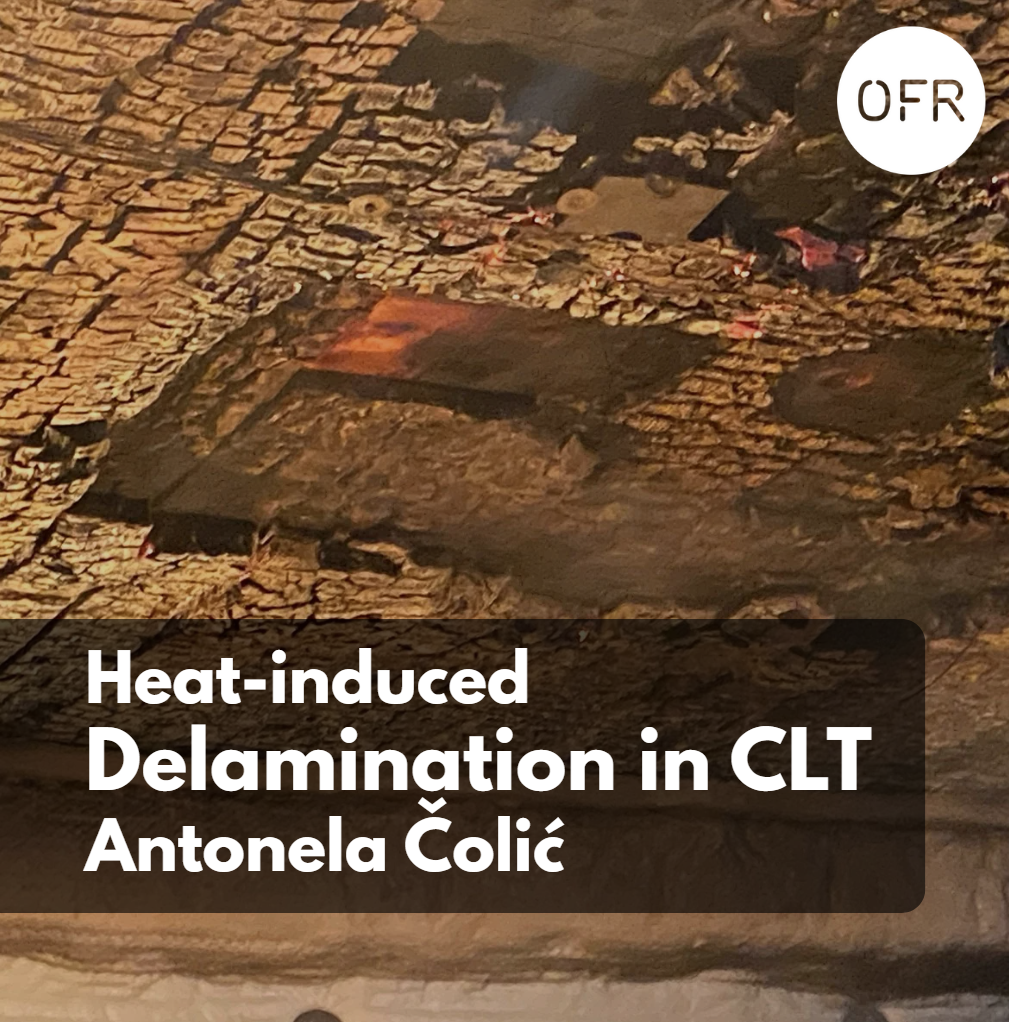
223 - Heat-induced delamination in CLT with Antonela Čolić
In this episode of the Fire Science Show we invite dr. Antonela Čolić from the OFR Consultants, to break down the performance of adhesives used in CLT in fire, what differences between the glues are observable at the microscale and how they show up in real structure fires. We compare common polyurethane adhesives: one that softens near 200–220 C and one that resists softening, crosslinks, and ultimately chars. Through thermogravimetric and calorimetric testing, we map pivotal transitions like...

Sept. 16, 2025
218 - Fire decay and cooling phases with Andrea Lucherini
What happens when the flames die down? It's a question rarely addressed in fire engineering, yet the decay and cooling phases of fires can be more dangerous than peak fire conditions. In this deep-dive conversation with Dr. Andrea Lucherini from Frisbee at ZAG in Slovenia, we uncover why these overlooked phases matter profoundly for structural safety. Most engineers focus on protecting structures during the fully developed fire phase, but as Dr. Lucherini reveals, catastrophic failures can a...

May 6, 2025
200 - Façade flammability across scales and standards with Guillermo Rein and Matt Bonner
Episode 200! And for this special episode, I've travelled to London to interview Prof. Guillermo Rein and Dr Matt Bonner on a piece of research carried out at Imperial College London, with the experiments performed in our laboratory at the ITB. In this episode, we discuss the concept of flammability of the building facades and how this flammability is assessed with different testing methods available in the world. You could argue that every country has their own method, and in some case...

April 29, 2025
199 - Commercial Timber Guidebook with Danny Hopkin and Luis Gonzalez Avila
We know a whole lot more about mass timber in fire than we did a few years ago (even when I’ve just started the podcast 199 episodes back …). But is this knowledge widely used in engineering practice? Is it used in the same way by different stakeholders? Definitely not. This is why to move timber into something we would consider “new normal”, we need more than research. We need a consensus on how to apply the outcomes of our research in practice. And this is this podcast episode. Built by Natu...

Feb. 5, 2025
187 - Smouldering of preserved timber with Wenxuan Wu
Can a tiny amount of bio-protective coating completely change the fire behaviour of mass timber logs? If you asked me that some time ago, I would say it would probably be neutral. Can a 0.5 x 0.5 m free-standing log of timber smoulder through without any external exposure to fire? If you asked me that some time ago, I would say no, and base that on observations of dozens of logs like this. Yet, in Australia they’ve burned. And the hypothesis was that it has something to do with the preservativ...

Jan. 15, 2025
184 - Cost-benefit analysis in structural fire safety with Thomas Gernay and Chenzi Ma
This episode delves into the financial aspects of fire safety in building design, highlighting the balance between cost and effectiveness. My guests - prof. Thomas Gernay and Chenzi Ma from Johns Hopkins University share insights from their NIST-sponsored research project on cost-benefit analysis and loss estimation for structural fire safety. In the discussion, we explore the differences between prescriptive and performance-based approaches, discussing insights from a comprehensive analysis of ...

Oct. 9, 2024
172 - Lessons from mass timber experiments with Danny Hopkin
One could argue full-scale experiments on fire phenomena are the most enriching for our knowledge as the fire community. The costs associated with them and logistical nightmares of organizing them make them an uncommon sight. However, in an instance where we reach the boundaries of our knowledge, they are necessary to progress further. That was the case of the research programme carried out by the OFR, in the umbrella of Structural Timber Association Special Interest Group (SIG) - CLT compartme...

Aug. 28, 2024
166 - Bio-based insulation with Patrick Sudhoff
In the everchanging world every now and then we get a new driver, that dictates most of our choices. In the current built environment and building industry, carbon dioxide feels like such a driver. We don't like it, we want to get rid of it... One way is to sequester or store large amounts of CO2 in our buildings. Ways to do that - more obvious is mass timber, but thats not the only thing. Let's talk bio-based insulation. In this episode I've invited Patrick Sudhoff, now from DBI but the resear...

Nov. 29, 2023
130 - Mass timber fire dynamics with Dr. Carmen Górska
In this episode, I am joined by Dr. Carmen Górska from OFR Consultants, the recent IAFSS Phillip Thomas Award recipient for the best paper at the previous IAFSS Symposium. In this interview, we touch on preconceived notions about fire dynamics in timber compartments, and Carmen explains how she has learned the intricate physics behind it. The research discussed covers dozens of medium-scale timber (CLT) compartments with different amounts of exposed timber. The findings relate to the conditions...

Oct. 26, 2023
124 - Advancements in Fire Safety of Facades with Eleni Asimakopoulou
In today's episode, I have invited dr Eleni Asimakopoulou from the University of Central Lancashire to discuss her extensive expertise on fire behaviour of facades. In the talk, we will go through Elenis' experiments on ventilated facades (and clear out what they are and why we use them). We do discuss the complexities of testing facade systems. We traverse through the global testing landscape, comparing diverse methods ranging from the German DIN4102 to its American NFPA counterpart. We discuss...

Oct. 18, 2023
123 - Futureproofing fire safety systems with Jaime Cadena Gomez
Balancing the cost and the potential to change a system in the future is a difficult act. Discover a new perspective on this aspect of fire safety systems with our guest, Jaime Cadena Gomez. We discuss the significance of longevity and sturdiness in these systems, bringing examples of technologies that have not withstood the test of time such as PFAS firefighting foams, and technologies that will rapidly enter our buildings such as Li-Ion storage for energy backups. Jaime offers intriguing insig...

July 26, 2023
111 - Experiments that will change fire science pt. 7 - CodeRed with Panos Kotsovinos
In this week's series covering experimental fire science, we venture into a recently finished Code Red project by ARUP, led by my today's guest Dr Panos Kotsovinos. The project was carried out in CERIB with the collaboration of the Imperial College London. History will tell if this experiment will change fire science, but I truly believe it is at least worth sharing! The research was carried out on a large open-plan office (350m2) with a combustible CLT ceiling. It was a continuation of previou...

Feb. 1, 2023
087 - Structural FSE inspired by earthquake engineering with Negar Elhami Khorasani
Performance-based engineering or the use of probabilistic methods in building design are not inventions of Fire Safety Engineering. But we sometimes tend to act like we need to 'discover' and work out everything on our own. I strongly believe this is not the best way forward. And certainly not the cheapest one... Where I see a lot of potential is the adaptation of methods and models that work in other parts of civil engineering, that could act as solutions to issues related to fire. Such a case...

Jan. 25, 2023
086 - Experiments that changed fire science pt. 4 - Runnehamar tunnel with Haukur Ingason and Anders Lönnermark
Would you rather do 20 published experiments and take your impact factors, or make one that truly changed the world of fire science? Or maybe a different way, would you pursue something that is quick, easy and gives immediate credit over something hard, stressful and requiring maybe years to really change mainstream engineering? Sure, we all like to see ourselves as heroes, but in reality, very few of us have the courage and vision to pursue these hard-to-achieve goals. But it seems worth it. T...

Dec. 14, 2022
080 - Adaptive Fire Testing: A new foundation stone for fire safety (ERC StG Grant) with Ruben van Coile
Today is a great day to celebrate with Prof Ruben van Coile of Ghent University, who is most likely the first representative of Fire Safety Engineering to receive a grant within the European Research Councill Starting Grant scheme. It is not common to celebrate a grant award this much - usually, we would wait till the work gets done and we see the effects... But not here. ERC is something else. ERC is a place for the bravest proposals brought by the brightest minds of science. And even that does...

Dec. 7, 2022
079 - Timber columns failure in the decay phase with Thomas Gernay and Jochen Zehfuss
When the flaming combustion stops and the raging inferno disappears, the environment is still far away from a stable, stationary state. The heat emitted by the fire and accumulated by the structural elements is still on the move, travelling through the members until it gets eventually dissipated. As parts of the structure get heated, some processes will occur, that may influence their load-bearing capacity and other properties. This is nothing new, we recognize this as an obvious process within ...

Nov. 30, 2022
078 - Experiments that Changed Fire Science pt. 2 - BRE Cardington with Tom Lennon
If Dalmarnock was the reality check for fire modelling, we could call the work carried by BRE at Cardington the birthplace of Structural Fire Engineering. Welcome to episode 2 of Experiments that Changed Fire Science! In this episode dr Tom Lennon from BRE takes us to a journey through the massive experimental programmes carried at BRE Cardington facility. A former aircraft hangar turned into a testing ground for ENTIRE BUILDINGS. That is what was the most unique for the programme - instead of ...

74
Nov. 2, 2022
074 - Engineering not magic, intumescent coatings with Andrea Lucherini
Intumescent coatings are not magic. They are a product of amazing engineering, a theatre of thermophysical properties that create an insulative layer that sometimes is the only thing holding fire from destroying a structure. A chemical masterpiece in which the onset of swelling is chosen so that the paint layer is soft just when the chemical compound used to foam starts releasing gasses. Sharing many features with natural carbon-made materials, they char and oxidize. And once you start modelling...