Structural Fire Engineering Episodes

Oct. 21, 2025
223 - Heat-induced delamination in CLT with Antonela Čolić
In this episode of the Fire Science Show we invite dr. Antonela Čolić from the OFR Consultants, to break down the performance of adhesives used in CLT in fire, what differences between the glues are observable at the microsca...

Sept. 16, 2025
218 - Fire decay and cooling phases with Andrea Lucherini
What happens when the flames die down? It's a question rarely addressed in fire engineering, yet the decay and cooling phases of fires can be more dangerous than peak fire conditions. In this deep-dive conversation with Dr. Andrea Lucherini from Frisbee at ZAG in Slovenia, we uncover why these over…

May 6, 2025
200 - Façade flammability across scales and standards with Guillermo Rein and Matt Bonner
Episode 200! And for this special episode, I've travelled to London to interview Prof. Guillermo Rein and Dr Matt Bonner on a piece of research carried out at Imperial College London, with the experiments performed in our laboratory at the ITB. In this episode, we discuss the concept of flammabilit…

April 29, 2025
199 - Commercial Timber Guidebook with Danny Hopkin and Luis Gonzalez Avila
We know a whole lot more about mass timber in fire than we did a few years ago (even when I’ve just started the podcast 199 episodes back …). But is this knowledge widely used in engineering practice? Is it used in the same w...

Feb. 5, 2025
187 - Smouldering of preserved timber with Wenxuan Wu
Can a tiny amount of bio-protective coating completely change the fire behaviour of mass timber logs? If you asked me that some time ago, I would say it would probably be neutral. Can a 0.5 x 0.5 m free-standing log of timber...

Jan. 15, 2025
184 - Cost-benefit analysis in structural fire safety with Thomas Gernay and Chenzi Ma
This episode delves into the financial aspects of fire safety in building design, highlighting the balance between cost and effectiveness. My guests - prof. Thomas Gernay and Chenzi Ma from Johns Hopkins University share insi...

Oct. 9, 2024
172 - Lessons from mass timber experiments with Danny Hopkin
One could argue full-scale experiments on fire phenomena are the most enriching for our knowledge as the fire community. The costs associated with them and logistical nightmares of organizing them make them an uncommon sight....

Aug. 28, 2024
166 - Bio-based insulation with Patrick Sudhoff
In the everchanging world every now and then we get a new driver, that dictates most of our choices. In the current built environment and building industry, carbon dioxide feels like such a driver. We don't like it, we want t...
Nov. 29, 2023
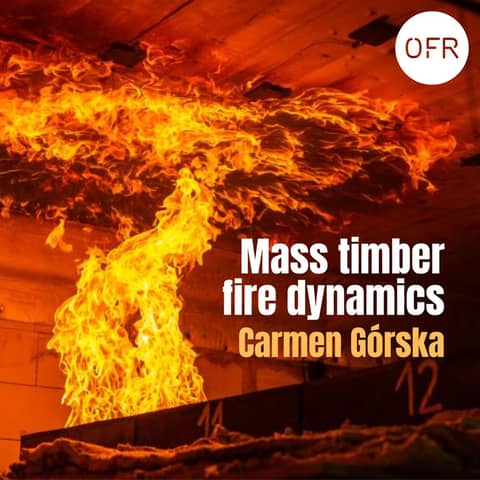
130 - Mass timber fire dynamics with Dr. Carmen Górska
In this episode, I am joined by Dr. Carmen Górska from OFR Consultants, the recent IAFSS Phillip Thomas Award recipient for the best paper at the previous IAFSS Symposium. In this interview, we touch on preconceived notions a...
Oct. 26, 2023
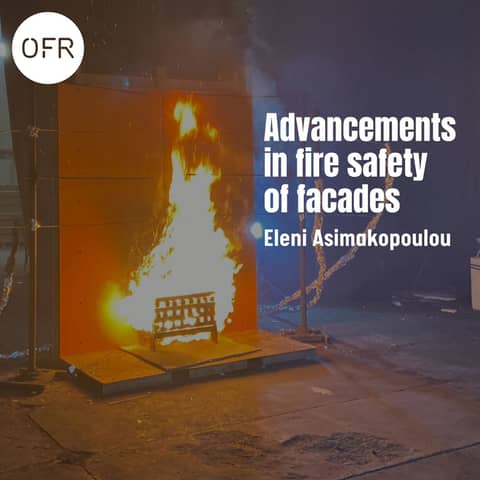
124 - Advancements in Fire Safety of Facades with Eleni Asimakopoulou
In today's episode, I have invited dr Eleni Asimakopoulou from the University of Central Lancashire to discuss her extensive expertise on fire behaviour of facades. In the talk, we will go through Elenis' experiments on venti...
Oct. 18, 2023
123 - Futureproofing fire safety systems with Jaime Cadena Gomez
Balancing the cost and the potential to change a system in the future is a difficult act. Discover a new perspective on this aspect of fire safety systems with our guest, Jaime Cadena Gomez. We discuss the significance of lon...
July 26, 2023
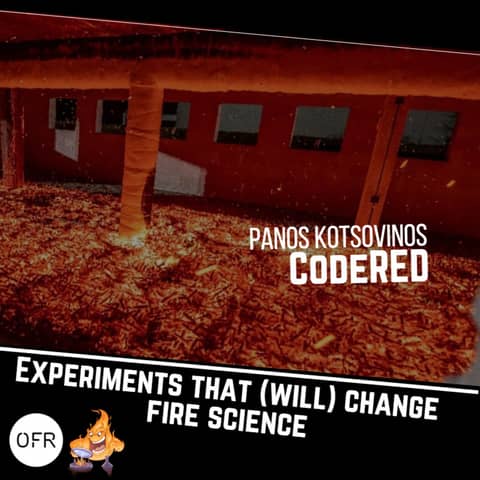
111 - Experiments that will change fire science pt. 7 - CodeRed with Panos Kotsovinos
In this week's series covering experimental fire science, we venture into a recently finished Code Red project by ARUP, led by my today's guest Dr Panos Kotsovinos. The project was carried out in CERIB with the collaboration ...
Feb. 1, 2023
087 - Structural FSE inspired by earthquake engineering with Negar Elhami Khorasani
Performance-based engineering or the use of probabilistic methods in building design are not inventions of Fire Safety Engineering. But we sometimes tend to act like we need to 'discover' and work out everything on our own. I...
Jan. 25, 2023
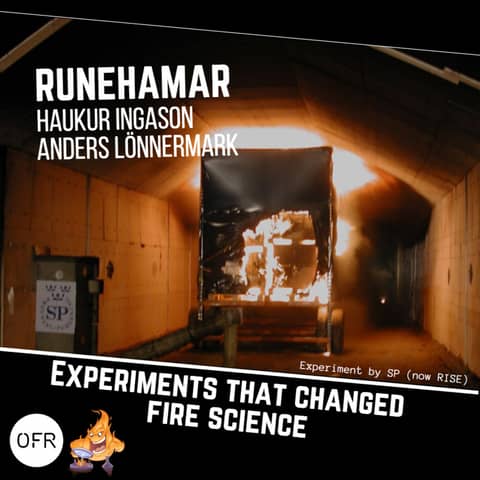
086 - Experiments that changed fire science pt. 4 - Runnehamar tunnel with Haukur Ingason and Anders Lönnermark
Would you rather do 20 published experiments and take your impact factors, or make one that truly changed the world of fire science? Or maybe a different way, would you pursue something that is quick, easy and gives immediate...
Dec. 14, 2022
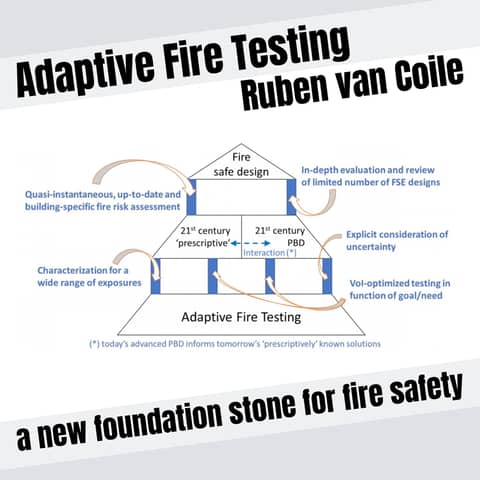
080 - Adaptive Fire Testing: A new foundation stone for fire safety (ERC StG Grant) with Ruben van Coile
Today is a great day to celebrate with Prof Ruben van Coile of Ghent University, who is most likely the first representative of Fire Safety Engineering to receive a grant within the European Research Councill Starting Grant s...
Dec. 7, 2022
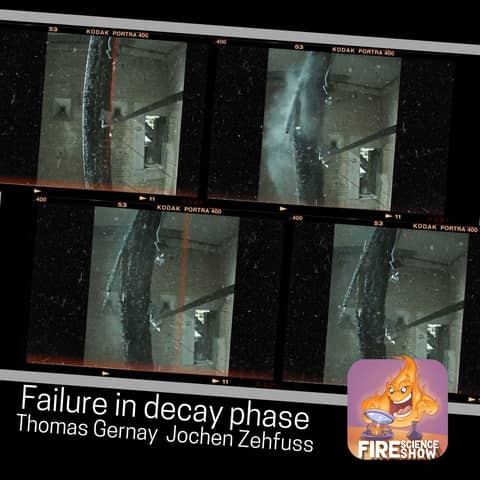
079 - Timber columns failure in the decay phase with Thomas Gernay and Jochen Zehfuss
When the flaming combustion stops and the raging inferno disappears, the environment is still far away from a stable, stationary state. The heat emitted by the fire and accumulated by the structural elements is still on the m...
Nov. 30, 2022
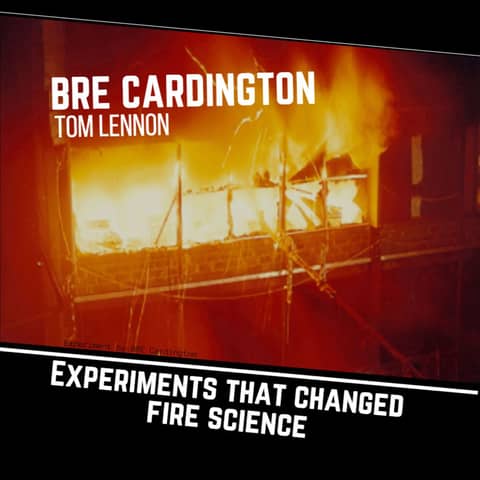
078 - Experiments that Changed Fire Science pt. 2 - BRE Cardington with Tom Lennon
If Dalmarnock was the reality check for fire modelling, we could call the work carried by BRE at Cardington the birthplace of Structural Fire Engineering. Welcome to episode 2 of Experiments that Changed Fire Science! In thi...

Nov. 2, 2022
074 - Engineering not magic, intumescent coatings with Andrea Lucherini
Intumescent coatings are not magic. They are a product of amazing engineering, a theatre of thermophysical properties that create an insulative layer that sometimes is the only thing holding fire from destroying a structure. ...

Oct. 5, 2022
070 - Fire resistance is whatever you want it to be with Piotr Turkowski
Today we talk fire resistance, but unlike you have ever heard. Join me and Dr Piotr Turkowski - two fire laboratory professionals in an honest discussion about their craft. The challenges in standardization and committee work...
Sept. 7, 2022
066 - Fire Safe Use of Wood in Buildings with Andy Buchanan
I wonder if we will be ever able to say: we know exactly how to build fire-safe buildings with mass timber. However that day may never come, each day of research brings us a little bit closer to achieving this goal. And some...
Aug. 2, 2022
061 - Glazing in fire with Yu Wang
The relation between ventilation conditions and fire severity is quite a fundamental one. You don't even have to be a fire safety engineer to realize that more air means a bigger fire. But how does air get into the compartmen...

July 6, 2022
057 - Structural fire engineering with Thomas Gernay
The subject of structural fire engineering was long overdue in the podcast schedule. But once I finally got it on my agenda, I made sure to interview one of the very best there are - prof Thomas Gernay of John Hopkins Univer...

Feb. 15, 2022
038 - Fire resistance is not always enough for timber with Daniel Brandon
It is the third time we talk about mass timber and fire in this show, and I hope every time the message gets even more refined. In this episode, it is clear - fire resistance is not always enough. But why? You will learn that...
Nov. 17, 2021
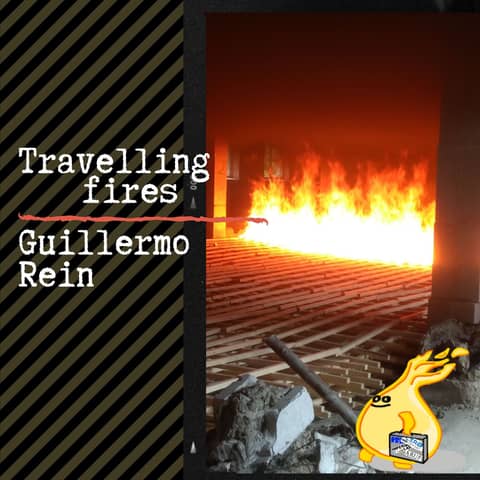
027 - Travelling fires with Guillermo Rein
If you have ever learned about the compartment fire dynamics framework, have tried zone modelling or any kind of fire modelling, you have probably noticed that as the compartments get bigger, the less uniform conditions insid...