Episodes
Sept. 23, 2026
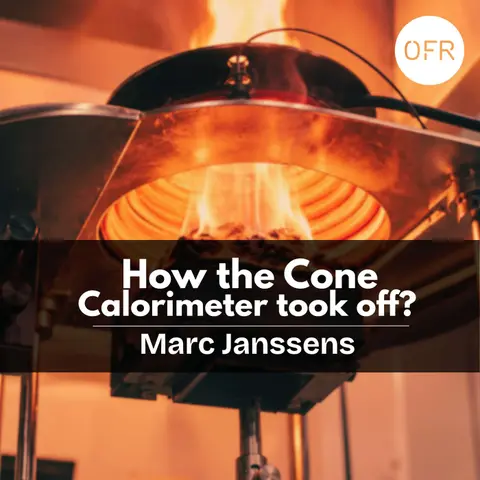
270 - How the Cone Calorimeter took over with Marc Janssens
A tool doesn’t become a global workhorse because it’s clever. It becomes a workhorse when different labs can run it, calibrate it, compare it, and trust it. It is a very long road from the invention to widespread use. And I got the chance to discuss the path of how the Cone took off with Dr. Marc Janssens, who is a key figure in this story - he was even jointly co-awarded the Phillip DiNenno Prize together with dr Vyto Babrauskas, for his efforts on developing, standardizing and promoting the Co...
Sept. 16, 2026
269 - Fire investigations and the scientific method with Vincent Brannigan
A fire scene looks like a puzzle, but it’s a puzzle where the pieces melt, burn, and get hauled away before anyone can measure them. On the 25th anniversary of 9/11, I sit down with Professor Vincent Brannigan to ask a questions - does a fire investigation truly use the scientific method, or are we doing something else and calling it science? Vincent brings a rare mix of experience as a fire protection engineer, a lawyer who has seen cases up close, and a historian of science who cares deeply a...
Sept. 9, 2026
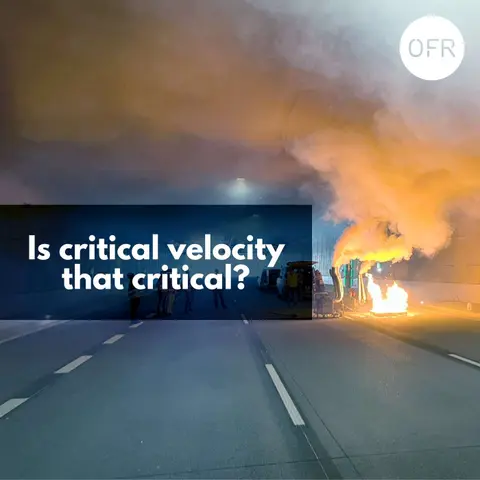
268 - Is critical velocity that critical?
Critical velocity is supposed to be the clean moment when tunnel smoke control flips from unsafe to safe. But after too many real projects and too many review battles, I am very sure that such a single number cannot be a sole proxy of what is safe or unsafe... So why it has so much power over my design? In this solo episode I walk through why critical velocity became the world's favorite proxy for tunnel fire safety: it’s simple, it’s calculable, and it gives verifiers something rigid to check....
Sept. 2, 2026
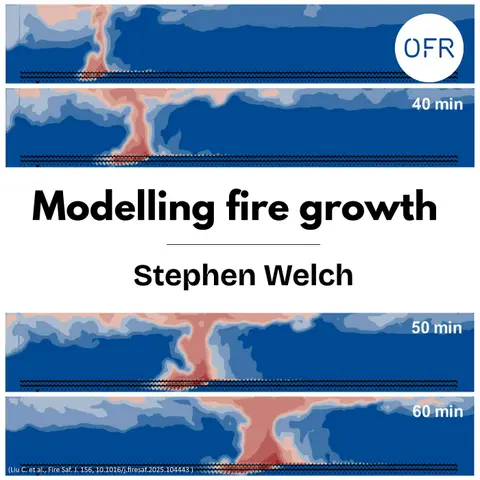
267 - Modelling Fire Growth with Stephen Welch
Pretty CFD flames are something we got used to, but they usually are a product of our design assumptions - the design fire. While they give us a lovely illusion of being "real" fires, predicting real compartment fire growth is a completely different game. We’re joined by Dr. Stephen Welch (University of Edinburgh) to get honest about what “modeling fire spread” actually means, how quickly results can become believable but wrong, and why validation has to be the foundation of any serious CFD fire...
Aug. 26, 2026
266 - Compartment fire framework with Vinny Gupta
A compartment fire is more than just “a fire in a room.” The moment flames, smoke, and heat are trapped by walls and fed through openings, the physics changes and so do the hazards we design for. We sit down with Dr. Vinny Gupta (University of Waterloo) to rebuild compartment fire thinking from the ground up, from what the enclosure does to airflow and smoke layers to why those effects still anchor modern structural fire safety. We trace the roots of today’s design tools through post World War ...
Aug. 18, 2026
265 - How fires can lead to a nuclear winter? with Stephen Welch
As a kid of 80s and 90s, a lot of the pop culture was around the post-apocalyptic scenarios following a nuclear exchange. I always thought a nuclear winter is a consequence of atomic bombs falling down, but now as a fire researcher I've learnt it is mostly about fires, after all. Today I sit down with Dr Stephen Welch (University of Edinburgh) to trace the fire-engineering-heavy pathway from mass urban ignitions to firestorms, through soot production and its injection into the stratosphere, up t...
Aug. 11, 2026
264 - Engineering Firebrand Showers with Samuel L. Manzello
A wind-driven ember shower is a key wildfire exposures a building can face, but we have not yet fully understood or accounted for them in making our communities wildfire resilient. Today we sit down with Samuel L. Manzello of Tohoku University and Reax Engineering to unpack how in the last 20 years the firebrand science went from not being able to characterize the features of them well to being able to procur controlled experiments and standardized generators that can actually shape building cod...
Aug. 4, 2026
263 - Developments in modelling WUI fires with Arnaud Trouvé
Wildland-Urban Interface fires are a class of fires that deserves own models, own studies and a lot of research focus. This is what I discuss today with prof. Arnaud Trouvé from the University of Maryland, shortly before he has given his plenary talk at the recent Combustion Symposium in Kyoto. In this interview, Arnaud explains what makes wildland urban interface (WUI) fires and urban conflagrations so hard to predict, also with a focus on the combustion phenomena. Arnaud is interested in how ...
July 28, 2026
262 - Fire Fundamentals pt. 22 - Optical diagnostics in fire with Elizabeth Weckman
In todays episode of fire fundamentals we talk with Professor Elizabeth Weckman from University of Waterloo about advanced optical diagnostics that let fire researchers read temperature, chemistry, soot, and velocity from light without relying only on probes. We break down what cameras, infrared imaging, spectroscopy, lasers, and PIV can reveal, plus the calibration and interpretation pitfalls that can quietly ruin your data. Things covered in this episode: • why optical diagnostics are “non-in...

July 21, 2026
261 - The story of the Cone Calorimeter with Vyto Babrauskas
The cone calorimeter sits in thousands of labs, shaping what we know about flammability, smoke production, and heat release rate. This essential piece of equipment comes with quite a story of how it was engineered or why its “obvious” design choices were anything but obvious. We wanted that history from the source, so we invited Professor Vyto Babrauskas to walk us through the decisions, constraints, and small breakthroughs that turned an idea into the most practical bench-scale fire test in com...

July 15, 2026
260 - Fire safety in a carbon budget with Cecilia Wetterqvist and Axel Mossberg
A carbon budget can feel like a hard wall in modern building design, and once you treat CO2 as currency, everything starts competing for a slice of it. The problem is that fire safety systems often show up in those spreadsheets only as a penalty: extra embodied carbon for sprinklers, alarms, and protection. What gets ignored is the payoff. A serious fire can erase years of “sustainable” choices through demolition, replacement materials, repair labor, and lost building value, all with a very real...

July 7, 2026
259 - Communicating fire science with politicians with Birgitte Messerschmidt
Fire safety is a tough “product” to sell because the best outcome looks like nothing happened. That’s exactly why we sat down with Birgitte Messerschmidt (NFPA) to talk about communicating fire science to politicians, regulators, grant bodies, and other people in positions of power who can approve policies, permits, and funding, often with only a few minutes to spare. We share what changes when your audience is nontechnical, busy, and sometimes driven by incentives that do not neatly match engin...

July 1, 2026
258 - e-mobility fires in trains with Adam Barowy
A battery fire on a train is not “just another small fire.” When a lithium-ion battery in an e-scooter or e-bike fails, the rail car can behave like a long pipe that moves smoke fast, limits escape options, and compresses decision-making into minutes. We sit down with Adam Barowy from UL Research Institutes FSRI to unpack new full-scale passenger rail car burn tests using real micro-mobility devices and realistic storage locations. We talk through what thermal runaway looks like before flames, ...

June 23, 2026
257 - Fire Fundamentals pt. 21 - Radiation with Simo Hostikka
In this episode of fire fundamentals we sit down with Professor Simo Hostikka from Aalto University to cover radiation in fires, both from the angle of physical phenomena and ways to model it. In this episode we cover following topics: feel less mysterious, from blackbody basics and role of radiation actually does inside the CFD N-S equation. Spectrum and emissivity to real engineering outcomes like heat flux, tenability Radiation’s two roles in fire CFD: target heat flux and the gas energy s...

June 17, 2026
256 - Modelling turbulent combustion in fire CFD with Bart Merci
While we can get pretty far with a very simple approximation of what a fire is in our fire cfd, at some point our simplications are not enough. And there is a plenty of features and phenomena, for which we simply need a better tool to handle - carbon monoxide, soot, extinction, flashover behavior, and what happens when ventilation disappears. At the IAFSS symposium, we sit down with Professor Bart Merci (Ghent University), fresh off delivering the Howard Emmons Invited Plenary Lecture, to talk a...

June 10, 2026
255 - Timber load bearing capacity in fire from nano- to megascale with Felix Wiesner
A timber column can survive the heating phase of a fire resistance test and still collapse later, after the flames are gone. We know there is so much more to structures in fires than the test demonstrates, but how much exactly do we know about timber nowadays? In this episode we try to dive deeper and discuss mass timber fire safety, structural fire engineering, and what a fire resistance rating does and does not tell us. I’m joined by Dr. Felix Wiesner from the University of British Columbia, ...
June 3, 2026
254 - Communicating fire science with firefighters, with Steve Kerber
Fire science should have its place at the fireground, yet I've learned how hard it is to communicate it with the key stakeholder - the firefighters. It's not my isolated experience, and that tension drives our conversation with Steve Kerber, Vice President at UL Research Institutes Fire Safety Research Institute (FSRI). Today we dig into the real craft of communicating fire dynamics to firefighters without losing the truth of the science. We talk about why experience alone can mislead when e...
May 27, 2026
253 - NERIS - the paradigm shift for the US fire data collection with Craig Weinschenk
A national fire statistics system that updates in weeks is not a statistics system, it is a history lesson. We talk with Dr. Craig Weinschenk from UL Research Institutes - Fire Safety Research Institute about NERIS (the National Emergency Response Information System) and why it represents a real shift in fire incident reporting, emergency response data, and fire service analytics across the United States. We trace the arc from NFIRS, built for paper forms and rigid codes, to a modern cloud base...
May 20, 2026
252 - Substantiating Fire Models with Craig Hofmeister and Bryan Klein
Jumping straight to CFD has become the default move in fire safety engineering, but that habit can quietly weaken our work: more inputs, more assumptions, more ways to be wrong, and often no clearer link to the actual design question. We sit down with Craig Hofmeister and Brian Klein to unpack a practical, defensible way to choose the right fire model for the job using the SFPE guideline “Substantiating a Fire Model for a Given Application.” The broad framework of this work is to define the phe...
May 13, 2026
251 - Occupant loads in Car Parks with Mike Spearpoint
“Two people per parking space” is one of those default fire engineering inputs that we are very used to place into a model without really thinking much of it. But it is one of those defaults that show a huge richness once you dig deeper. Are all parking spaces taken? Are people in their cars? What are they doing? How long have they been there concurrently... We take that simple rule and pull on the thread until it turns into a full conversation about evidence, uncertainty, and what “credible max...
May 5, 2026
250 - Communicating fire science with construction professionals
A fire strategy can be technically correct, but if the team building the building never truly understands it - goals and objectives may be missed. For the 250th Fire Science Show, we slow down and talk about the craft of communicating fire science to construction professionals so that the intent survives real projects, real deadlines, and real handovers. This episode is an extended version of my talk I gave recently at the IAFSS Research Sub-Committee Workshop, which we have organised with Feli...
April 28, 2026
249 - PBD of a large car park with EVs (Case study) with Jonathan Hodges, Mark McKinnon and Christian Rippe
From the SFPE Performance Based Design Conference in Singapore, we sit down with Jonathan Hodges and Mark McKinnon (UL Research Institutes) and Christian Rippe (Jensen Hughes) moments after their case study presentation to break down a modern parking garage fire engineering workflow with a huge does of performance based and probabilistic approaches. We talk about what changes when today’s vehicle fleet makes multi-vehicle fire spread more plausible, and why picking a single car fire curve can q...
April 21, 2026
248 - JRC update on Fire Safety Engineering in Europe with Francesca Sciarretta
Fire safety in Europe is shaped in a challenging ecosystem - each member country owns its fire safety rules, yet the construction market, standards, and technical language are increasingly shared. I’m joined by Francesca Sciarretta, Scientific Project Officer at the European Commission’s Joint Research Centre (JRC), to explain how the JRC supports EU decision-making with independent research and why that “science behind the policy” matters for every practicing fire safety engineer. We unpack wh...
April 14, 2026
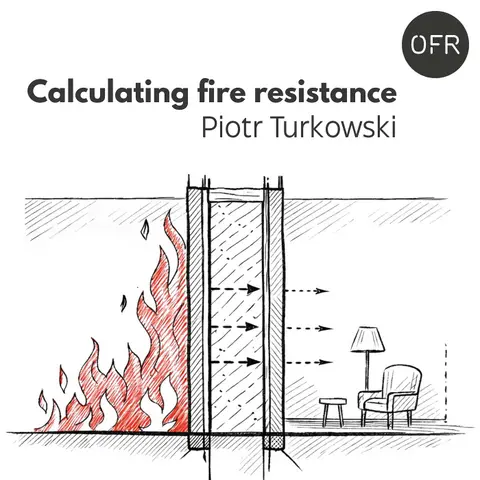
247 - Calculation methods for fire resistance with Piotr Turkowski
You don’t always need a furnace to end up with a fire resistance rating, but you do need to understand what kind of “proof” you’re actually creating. I’m joined again by Dr. Piotr Turkowski from ITB to unpack calculation methods for fire resistance and the real-world chain from engineering assumptions to a Declaration of Performance. We talk about when standards and European Assessment Documents (EADs) explicitly allow Eurocode-based assessment, and how different methods will lead you to your re...