Smoke And Visibility Episodes

Jan. 28, 2026
236 - Fitting an efficient smoke control system in a confined space
A tight, historic cellar. Arched ceilings. Long corridors. Tiny shafts. We faced a design wall: to keep routes tenable, we needed twice the extraction that the building could carry. At that point, I've failed as an engineer - I've reached my limit and could not find a solution. Some time later, a solution appeared in my head from nowhere —what if the fan changed with the fire? Not in a crude on-off way, but by tracking temperature, exploiting density changes, and chasing constant mass flow inst...

Sept. 10, 2025
217 - Things that go wrong with the smoke control and how we fix them
In my personal view, an alarming truth about building fire safety lies in the gap between what's designed and what actually works in a building. After conducting 1000+ hot smoke tests in 200+ buildings, my experience is that most (maybe even 90%) of buildings had deficiencies in their smoke control systems, with 30% experiencing issues significant enough to potentially endanger occupants during a real fire. But it's not just about the problems. Good news - we have solutions. Hot smoke testin...
July 23, 2025
211 - Fire Fundamentals pt. 17 - Detecting fires
In episode 17 of the Fire Fundamentals, we delve into the fire detection technology. Fire detection forms the critical foundation of all active fire protection measures, serving as the prerequisite for any fire safety engineering solution to work effectively. Following key points are discussed: Detection systems must balance sensitivity with reliability to avoid false alarms that disrupt building operations False alarms lead to serious business continuity issues and may eventually cause system...

May 28, 2025
203 - The lessons from repeating Jin's experiment on visibility in smoke
I've finally done it. We've repeated Jin's experiment! I thought I knew-it-all about that experiment, but boy... knowing and doing it are two different things. I can say, I've finally cleared my mind on some thoughts after this, which I am finally happy to share with all of you! First things first, massive thanks to my partner in crime Wai-Kit Wilson Cheung, from the group of prof. Xinyan Huang, who was the man on the ground doing the experiments with me. Together we went further into this mode...

May 21, 2025
202 - Designing fire safety with firefighters in mind
The gap between fire safety engineering and firefighting operations creates a profound challenge that affects building safety worldwide. Even experienced fire safety engineers - myself included - face uncertainty when designing for firefighters without being firefighters themselves. Yet many building codes explicitly require engineers to account for firefighting operations in their designs. This examination dives into the timeline analysis essential for effective firefighter support, from notif...

March 12, 2025
192 - Fire Fundamentals pt. 14 - Jet fan systems for car parks
Jet-fan systems effectively control smoke in car parks by creating directed airflows that transport smoke from one point to another, similar to how longitudinal ventilation works in tunnels. These systems offer cost-effectiveness and simplicity by eliminating ductwork while providing powerful smoke management capabilities when properly designed and understood. • Jet Fans create momentum transfer through air entrainment rather than directly moving smoke • Two distinct operational modes exist: sm...

Sept. 4, 2024
167 - CFD for consequences and fire growth with Jonathan Hodges
In this episode we talk with Jonathan Hodges of the Jensen Hughes on his experience with using advanced modelling in the realm of fire safety engineering. Jonathan sheds light on how the modelling is used at various Jensen Hughes offices around the world, highlighting interesting differences they see across their practice. The core of the talk revolves around using CFD for modeling the consequences of fires, versus using it to assess the fire growth. While the first one is a commonly practiced ...

Aug. 7, 2024
163 - Fire Fundamentals pt 11 - Soot in Fire Safety Engineering
Soot is perhaps the most complex product of combustion, and at the same time one of the most profound for our everyday fire safety engineering. The topic of soot is not getting much love in the world of fire science, so I’ve chosen to give you a broad introduction to this subject. In this episode of fire fundamentals we will go through: · Soot creation from chemical perspective; · Soot creation from practical perspective; · Soot effects on radiation, toxicity and obscuration; · Extinction co...

July 31, 2024
162 - Experiments that changed fire science pt. 9 - Jin's experiment on visibility in smoke
In this episode of Experiments that Changed Fire Science we cover T. Jin’s experiments on the visibility in smoke – two experiments carried out in 1970 and 1971 in Japan that truly changed the way how we model fires and how we design fire safety in our buildings. This episodes presents my recollection of Jin’s experiments, based on the published work – the seminal paper at the IAFSS in 1997 (https://publications.iafss.org/publications/fss/5/3/view/fss_5-3.pdf) and the original material publishe...

June 26, 2024
157 - Revising Critical Velocity with Conrad Stacey and Michael Beyer
A critical velocity episode... who would have thought? Even though I'm not an enthusiast of this approach, I have to admire the new science and researchers striving to improve it. This week I welcome Conrad Stacey and Michael Beyer from Stacey Agnew to talk about their recent developments. We'll take you through the historical development of this concept since its inception in 1958, examining key variables like tunnel height and heat release rate along the way. We go into the Memorial Tunnel ex...

Feb. 13, 2024
139 - Wind and Fire Interactions for Safer Open Car Park Design
I've finished my first large research grant! I guess that makes me a 'real' scientist now. Came here today to share some most interesting aspects of this project with you. Not going to bore you all about the wind and fire interaction physics (hey, there is an entire episode 50 devoted to that!), but rather talk about challenges and stuff that perhaps will matter if you would like to engineer a case similar to one we have studied. So in this podcast episode, we will go into: How our framework f...

Aug. 30, 2023
116 - Fire Fundamentals pt. 4 - Natural and Powered Smoke Vents with Wojciech
It is time for some engineering fundamentals in the show. This time in the fire fundamentals series we delve into the details of natural and powered smoke ventilators - what they are, how they work, how they are tested and what interesting mechanics impact their performance in fire. I hope this episode is valuable for all engineers who would love to know how the devices they place in their design are tested and qualified for use in fire safety. It should also be a great way for fire scientists ...

Aug. 16, 2023
114 - Ventilation and fire flow paths with Craig Weinschenk
Most fire engineers would be aware of how openings like doors and windows, the stack effect, and even wind can significantly alter fire outcomes. But there is a considerable difference between knowing that it does, and knowing how much that changes fire growth, size and the internal building environment. I've invited FSRIs dr Craig Weinschenk to discuss his years of full-scale research on fire flows. In this episode, we discuss different conditions that occur once the flow is established at win...

July 19, 2023
110 - NIST Fire Calorimetry Database with Matt Bundy
Ever wonder how scientists measure the intensity of a fire? Join us on this episode as we invite Dr. Matt Bundy from NIST. We discuss the intricacies of heat release rate, calorimetry, and how NIST is championing open data with their astonishing database. You can learn more about the database here: https://www.nist.gov/blogs/taking-measure/new-nist-fire-calorimetry-database-available-answer-your-burning-questions And find the database here: https://www.nist.gov/el/fcd I've tried to make this ...
June 28, 2023
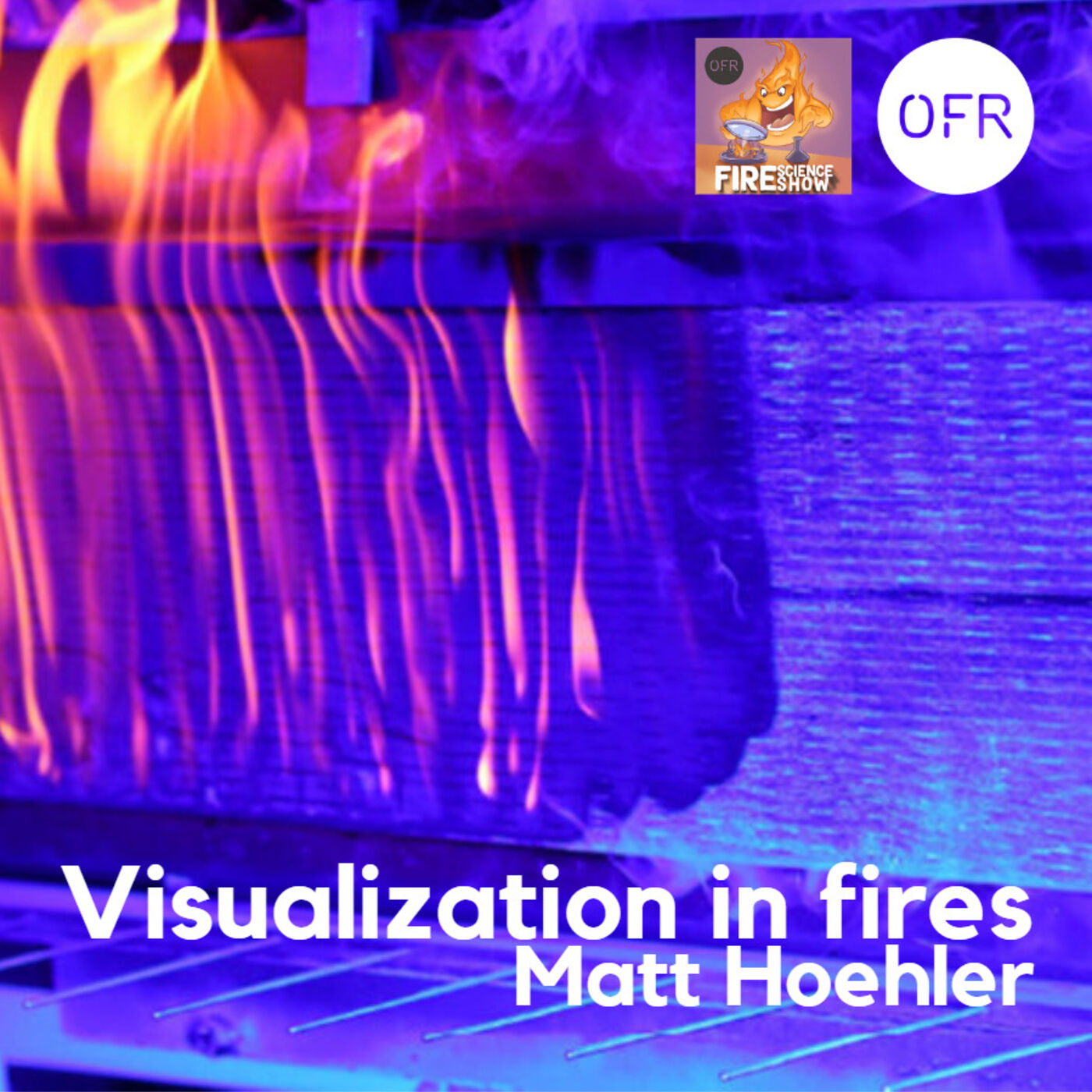
107 - Visualization in fires with Matt Hoehler
If you ever wondered how to capture fires in photographs and videos so it is a real science, not just pretty pictures, this episode is for you. With dr Matt Hoehler we explore the world of visualization in fires - from just shooting the pictures, through composition and what is your target, to fancy techniques - water-cooling, blue light illumination and 360-degree shoots. We also discuss the role of audio in the further use of these pictures. To watch for yourself how the magic works, check th...

June 21, 2023
106 - Chemistry of smoke - Nitrogen, retardants and cancirogens with David Purser
And so we have reached the fourth and final episode featuring Professor David Purser, a leading expert in fire toxicity. In this episode, we explore the complexities of nitrogen in fires, the impact of fire retardants on fire atmospheres, and the long-lasting hazards related to the consurgents and carcinogenic properties of smoke. We'll be discussing the different hazard zones associated with fire smoke and the potential risks they pose to people, buildings, and the environment. Discover how fi...

June 14, 2023
105 - How much smoke is made in fires and how we measure that? with David Purser
In this show, we have already ventured into the fascinating world of toxicity in fires, and I have promised you more. So today, I fulfil my word and invite you to another conversation with renowned fire toxicity expert Professor David Purser, who shares invaluable insights on measuring smoke and toxic products created in fires. From understanding mass loss concentration in a CFD analysis to exploring various test apparatus, discover how we can determine the yields and concentrations of toxic pro...

May 31, 2023
103 - The Science and Art of Scale Modeling with James Quintiere
Ever wondered how scale modelling can provide invaluable insights into fire science? Join us for an enlightening conversation with Professor James Quintiere, as we delve into the fascinating world of scale modelling and its applications in both fire science and fluid mechanics research. You will discover how this powerful experimental technique has been used to develop correlations, understand complex phenomena, and even predict outcomes of full-scale experiments. Together with prof. Quintiere ...

100
May 10, 2023
100 - Fire Fundamentals pt. 3 - Smoke plumes (and other flow phenomena) with Wojciech
This week we cover the fundamentals of smoke flow (proliferation!), entrainment and smoke plumes. All the basics that impact the spread of the smoke in our buildings. You will learn: the ideal gas assumption for a smoke mixture turbulent nature of fire-induced flows axisymmetric plume models and their origins spill plumes window and door plumes basics of smoke control If you would like to read up more, please resort to: Review of plume models Enclosure Fire Dynamics - Karlsson, Quntiere,...

April 12, 2023
097 - Smoke toxicity (Part 2) Asphyxiants and irritants with David Purser
This episode is the 2nd part of interview with Professor David Purser, this year recipient of IAFSS'14 Emmons Plenary Lecture. If you have not seen it, I would highly encourage you to first listen to the Part 1, which sets the context of the discussion here. In Part 1 we have talked a lot about the toxic hazards and how the production of toxicants has evolved together with fire loads. We have also gone quite deep into the toxicity of CO. In part 2, we cover the combined effects of asphyxiant ga...

April 5, 2023
096 - Smoke toxicity (Part 1) Why fires used to be less toxic in 1950's? with David Purser
I have to start with a word of warning, I am extremally hyped about this and upcoming episodes. I think for the first time I have recorded a podcast episode with a ratio of my commentary to the guest 1:5. This is because when you get Prof. David Purser to tell you about toxicology, there is not much to add. It is a story of the history of fire science, difficult discoveries and how a fire scientist had to combine knowledge from multiple fields into useful models. All of this is so that engineers...

Oct. 26, 2022
073 - Smoke control in shopping malls - uncommon aspects that make or break the system
Long before I started the podcast, my bread and butter was to find clever ways to remove smoke from shopping malls. Actually, I like to believe I was pretty good at the job, given the fact some of the biggest projects in Eastern Europe successfully made their way through our office. At some point (after reading Roger Harrisons PhD thesis) I figured out there is some science in the stuff we are doing in our engineering, and that day I turned into a scientist. This idea turned into passion, and pa...

Sept. 14, 2022
067 - Next-gen smoke control experimental facility and a digital twin with Grzegorz Krajewski
We've felt a bit awkward about how FSE handles smoke control in corridors. If you look closely into common practices, they rarely do include impressive engineering - more often you see some 'tips and tricks' that make the CFD simulations work out and systems are accepted. Doors opening/closing in specific timeline points, heat source sizes or soot generation parameters... I agree it does not necessarily mean that all the systems are designed wrongfully, or they do not provide safety... but in fa...

April 20, 2022
047 - Effective pressurization of compartments with Grzegorz Sypek
Pressurization is a common strategy for protecting spaces against the infiltration of smoke. However, the solution has a kind-of bad press as "not-working" or "incapable to meet its design goals". We know, that the systems are as good as their design, and in this episode with my guest, Grzegorz Sypek, we try to bust some myths around PDS systems. We touch on the important design points and the properties of modern solutions available in the market. We also discuss the standardization of PDS syst...