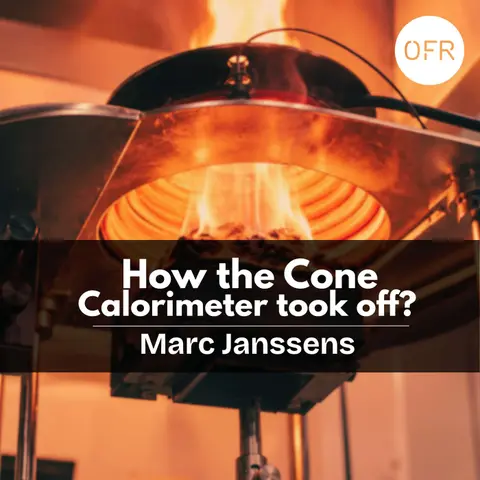
270 - How the Cone Calorimeter took over with Marc Janssens

 Apple Podcasts
 Spotify
 A tool doesn’t become a global workhorse because it’s clever. It becomes a workhorse when different labs can run it, calibrate it, compare it, and trust it. It is a very long road from the invention to widespread use. And I got the chance to discuss the path of how the Cone took off with Dr. Marc Janssens, who is a key figure in this story - he was even jointly co-awarded the Phillip DiNenno Prize together with dr Vyto Babrauskas, for his efforts on developing, standardizing and promoting the Cone.
Marc takes us back to the early days of reaction-to-fire testing, when heat release rate measurement was messy, methods differed by country, and oxygen consumption calorimetry still had to prove itself. He was sent on a mission to find a heat measuring device, and shares on what was available back then.
Later in the episode we dig into the questions raised: is a 10 by 10 cm specimen too small, what does “scaling” really mean, and how do you avoid fooling yourself when you try to turn cone calorimeter curves into real-fire predictions. We also get into why the cone’s controlled heat flux and feedback control mattered so much, and how interlaboratory round robin studies turned uncertainty into precision statements that standards could stand on.
From there, the conversation opens up into what cone calorimetry enabled: faster R&D for products, smarter screening ahead of costly room corner testing, and a path to modeling. Marc shares how cone calorimeter data supports fire modeling efforts, including flame spread approaches in FDS, and why validation at larger scales still matters. The episode lands with a powerful case study: performance-based, risk-informed nuclear power plant fire safety, where cable tray fire spread scenarios depend on models fueled by cone calorimeter measurements of cable insulation.
If you are a daily user of a Cone, an engineer who depends on high quality models and data, or simply want to hear about the history of our discipline... this one is for you.
----
The Fire Science Show is produced by the Fire Science Media in collaboration with OFR Consultants. Thank you to the podcast sponsor for their continuous support towards our mission.
00:00 - Cone Calorimeter Part Two Setup
02:46 - Sponsor: OFR Consultants
03:46 - Marc’s Start And ISO Mission
08:35 - Competing Calorimeters And Oxygen Method
13:10 - Small Specimen Doubts And Scaling
20:10 - Standards Built Through Round Robin Tests
27:35 - Calibration Lessons On Heat Flux
32:55 - New Uses From Furniture To Cables
40:00 - Nuclear Cable Tray Fire Modeling
44:25 - Future Improvements And Final Takeaways
Cone Calorimeter Part Two Setup
Wojciech WegrzynskiHello, everybody. Welcome to the Fire Science Show. Some weeks ago, I've interviewed Vyto Babrauskas on the history of cone calorimeter when we have discussed how the device was developed, made, uh, what, uh, the inventor had in mind when he was building this, this device, what inspired him. But, you know, that's just a part of the story of, of how it became a tool. And today, I have a second part of the story with Dr. Marc Janssens from, uh, Southwest Research Institute. And Marc tells me the story about how this brilliant device built by Vyto turned into something that you can find in every single fire laboratory on the planet. How the standardization, uh, calibration round-robin efforts followed the development of technique, how it became widespread, in Europe and then worldwide, and what efforts, uh, touched it and, and what kind of practical applications, uh, ha-have it been used across the years, like applications that driven the development and improvements in the technology. We talk about what did the cone calorimeter allow, uh, models built on the basis of their cone calorimetry data. We even talk about, um, the change to, to approach in, in nuclear industry, where performance-based design was largely enabled thanks to, uh, thanks to models developed through cone calorimetry. So it's a pretty impactful device. If it was not, we would be not talking about it probably in here. Everyone knows that cone calorimeter is a fundamental tool for, for fire science and engineering. But, uh, forty years ago, uh, it was just a new device on the Marcet. So it's interesting to understand the pathway it went from its development, uh, to the modern times. And Marc is, uh, extremely kind, and he's given me all the details from, from the past. So it's a very rich episode for those who want to understand some of the history of our discipline and who are interested in how good solutions turn into widely adopted solutions, because that's not necessarily instantaneously same thing. Um, a lot of lessons in this podcast episode. I hope you will enjoy it. Let's spin the intro and jump into the episode.
Sponsor: OFR Consultants
Wojciech WegrzynskiThe Fire Science Show podcast is brought to you in collaboration with OFR Consultants, a multi-award-winning independent consultancy dedicated to addressing fire safety challenges. OFR is the UK's leading fire risk consultancy that this year celebrates its 10th anniversary. As experts in fire engineering, they are fully committed to delivering preeminent expertise to protect people, property, and the environment. With over 30 chartered engineers and a team of fire researchers at their core, they continually explore the challenges that fire creates for their clients and society so that the best research, experience, and diligence can be applied for effective tailored solutions. In 2026, OFR will grow its team once again and is keen to hear from industry professionals who want to collaborate on fire safety features this year. Get in touch at ofrconsultants.com. And now back to the episode
Marc’s Start And ISO Mission
Wojciech Wegrzynskihello, everybody. I'm joined today by Marc Janssens from Southwest Research Institute. Hey, Marc.
Marc JanssensHi.
Wojciech Wegrzynskiwelcome back to Poland. Great to have you here, especially in, person, and, um, really happy, uh, to discuss, some of the important developments of our industry, uh, with you. as a context, few weeks ago, I, I hosted, uh, Vyto Babrauskas, who told me the story of developing, uh, the cone calorimeter as an important thing, and you're, uh, the second part of that story of introducing cone calorimeter to the wider world of research. Uh, if I'm not wrong, you both, uh, received the Nano Prize, uh, two years ago for that.
Marc JanssensYes, that's correct. Yeah.
Wojciech WegrzynskiYeah, congratulations. That's a huge, uh, huge recognition and, uh, the cone calorimeter is defin- definitely something worth that. So I would love to understand how, how that tool turned from, uh, scientific, uh, device into something that's workhorse of the modern industry. But maybe let's, let's start w- w- with, with you first. Like how did you end up doing fire and, uh, developing calorimeters and standards, et cetera?
Marc Janssensit, it takes us back to 1980 when I graduated with, uh, an engineering degree, electromechanical engineering degree- Perfect at the University of Ghent in Belgium.
Wojciech WegrzynskiVery nice place.
Marc JanssensAnd, um, maybe, you know, if, there was a, the National Fire, uh, Testing and Research Laboratory in Belgium was at Ghent University.
Wojciech WegrzynskiUh, back then already? Okay.
Marc JanssensSo, When I was looking for a job, I guess after I graduated, and, uh, I spotted this opening at the Fire Research Laboratory And I thought maybe I'll give it a try, and, uh- And here we
Wojciech Wegrzynskiare
Marc Janssenstoday so we're here,
Wojciech Wegrzynskiso y- you didn't plan a, a research as a fire?
Marc JanssensNot really, not really. It was something kind of let's check it out and see- if it's, uh, something interesting. I had taken one course, you know, on, uh, fire safety, I guess in the last year of the engineering school there. And I thought it was interesting. It's something that I didn't know much about, and, uh- Okay having that laboratory there was a, a unique opportunity to learn more about it.
Wojciech WegrzynskiI, I hope y- y- you've paid back by introducing a lot of people to the world of fire safety and bringing them to the world of engineering through the lab work. That's what I try to do.
Marc JanssensRight. So, so I applied and I got the job, and, uh, initially I was involved in fire resistance testing, and that wasn't too, too great. And, uh, after a year or so, um, maybe a little longer, um, you know, Paul Van de Velde, who was the, the guy in charge of the lab at the time- Right uh, which some of you older folks may know, he basically asked me, you know, "Wouldn't you be interested in getting into reaction to fire? I mean, we're, we're looking for somebody to take this over," and he, he, uh, had too many things to, to worry about. So, so I said, "Yeah, that seems like, uh, more along the lines of what I, what I studied and I would be interested in." and that was in, uh, 1981, 1982. Paul, at the time, was the, uh, convener of, ISO/TC 92- Okay subcommittee one, working group five, um- their task basically was to develop a small scale, a heat release rate device.
Wojciech WegrzynskiMm-hmm.
Marc JanssensYou know, at the time, um, subcommittee one, which deals with the reaction to fire, was kind of implementing Philip Thomas' idea of a suite of test methods. Mm-hmm. We would need one test method to, evaluate ignitability.
Wojciech WegrzynskiMm-hmm.
Marc JanssensThen we would need one to evaluate flame spread, one to evaluate, uh, smoke, production, and then one to measure heat release rate.
Wojciech WegrzynskiMm-hmm.
Marc JanssensSo I, I took that on, and in the early 1980s, um, actually, went on a tour, uh, both in Europe and also in North America- to see what kind of devices people were, uh, you know, using and, and so I stumbled, uh, into the Cone Calormetre at that time because that was what they had at NBS that, uh, Vyto basically had developed. I also went to, uh, Factory Mutual at the time, so we had Arsene
Wojciech WegrzynskiWarsin's-
Marc JanssensMm-hmm uh, fire propagation apparatus. Uh, there were some prototype test methods that were developed in the UK by the Timber Research and Development Association. Um, DANTEST in DenMarc also had one, and in Sweden,
Wojciech Wegrzynskias well As I understood from the interview with Vyto, maybe I got it wrong, but, uh, it was not yet obvious at that time that, uh, heat release rate measured through oxygen calorimetry is the, the best way. It was still open, uh, to debate. Vyto told me about some replacement, uh, other techniques that were used at that time. Yeah,
Marc Janssensyeah, that's correct. I mean, some of these test methods basically you s- did it the old-fashioned way. Yeah. You, you had a box, and you burned something inside, and
Competing Calorimeters And Oxygen Method
Marc Janssensyou measured the temperature difference, and you know what the flow rate that goes- Mm-hmm through the box. And, and from that you come up with a fairly rudimentary, uh, measure of the heat release rate. I
Wojciech Wegrzynskiit's important to set the context. I mean, now it's easy. Like I take your '91 paper on, on measuring oxygen and, and, and turning it into a calorimeter, and I can develop a quite a robust device. But, uh, when this was not yet, uh, you know, that clear, it must have been a, a, a challenge, and I guess a lot of different approaches were competitive.
Marc JanssensYeah. so from, from these methods that we, we, uh, surveyed at the time, I also had a colleague in Germany who joined me on this, um, you know, on these trips to visit everybody. Um, there was one lab in Sweden. Mm-hmm. It was a, you know, the wood research trade tech, uh, and they used oxygen consumption calorimetry also.
Wojciech WegrzynskiOkay.
Marc JanssensAnd it was based on, kind of a predecessor of the cone calorimeter-
Wojciech WegrzynskiMm-hmm
Marc Janssensdeveloped by Daryl Sensenig at NBS. Uh, he was a research associate there and, you know, it was kind of a totally different setup, but at least they used oxygen consumption calorimetry. Okay. And figured that that was a much more, convenient way to measure heat release rate, as opposed to the old methods where we, In some cases we had calorm- calorimeters that filled an, an entire room essentially because you needed all this instrumentation to-
Wojciech WegrzynskiAnd w- when you first saw the, the cone calorimeter, were you immediately convinced that this is the thing that you, you, you are looking for or?
Marc JanssensNo, that, that was, uh, That was not an easy journey, uh, to get to that. Okay. Uh, so I was the convener of the ISO, uh, working group, and we looked at all these methods that, uh, were around. And some of these, the advantage was that you had a specimen that was, like, 30 by 30 centimeters or so.
Wojciech WegrzynskiMm-hmm.
Marc JanssensUh, and, uh, cone calorimeter had only a s- a specimen size of 10 by 10 And it took, uh, quite some convincing that, you know, this was the test method to go with because the specimen size was really smaller than what people had in mind at that time. But, uh, the problem is that if you scale it up to a 30 by 30 centimeter, then it becomes again, you know, something that, uh, has a much larger footprint, is much more complicated. And so the elegance of, doing something at the scale of a cone calorimeter, uh, was, kind of won in the end over, uh, the concerns that people had on the working group.
Wojciech Wegrzynskiw- what other tools were available for reaction to fire? was the room corner already existing? Because SBI was a decade later, right? SBI came much later.
Marc JanssensYeah. SBI didn't, did not come until-
Wojciech WegrzynskiYeah. But a room corner- until much later did that, did that test method exist already back then?
Marc Janssensat NBS, they had, uh, they had some, um, development, early development of a, a room corner test. It wasn't standardized yet at that, at that time. Uh, that did not happen until later in the '80s. There was another working group in ISO, uh, you know, subcommittee one
Wojciech Wegrzynskiof- T- t- tell me more about the worries about scalability because y- you bring it up and that's important. How, well can we predict, a large scale behavior based on 10 by 10 centimeter sample? And I think this is still a relevant discussion because many colleagues would like to, you know, run a contest, get the heat release rate per unit area, scale that to a square meter and put that in FDS and, and think that this is, uh, you know, representative of fire behavior. So, so it's, it's, uh, I would say it's still a challenge.
Marc JanssensUh, right. Yeah. And, there were a lot of doubts about that. Um, but, ultimately, you know, right now we do have a, uh, a model that's still under development, uh, uh, I guess an approach to use cone calorimeter data to predict flame spread. You know, it's called, uh- Mm F-SPIRO. Uh, and so after, I don't know, 40 years or so, I guess we're finally getting there where we can, uh, make some predictions that seem to work, uh, reasonably well. In those days, we were essentially working with calori- correlations, you know.
Wojciech WegrzynskiCorrelation,
Marc Janssensyes. Measure, measure, uh, certain parameters in the cone calorimeter that tell you something about the ignitability of the material- Mm-hmm and how much heat it releases under certain conditions, and then correlate that with, uh, you know, the time to flash over in a room corner test and-
Wojciech WegrzynskiYeah. I, I mean, the, uh, since then a lot of people have done a really good job at correlating the predictions of cone to, different devices, uh, like room corners. Uh, so that's definitely possible. Uh, still people are approaching that, that, that today. I find it quite interesting. H-How
Small Specimen Doubts And Scaling
Wojciech Wegrzynskiabout the, range of conditions under which you test in the cone? Because it... You, you set the, the, the heat flux o-on it. Of course, the sample is, is, is fixed in terms of the size, but you can have it vertical, horizontal. Were you looking also at, at, like, these things were look- when looking for a, a new small scale, uh, calorimeter device?
Marc JanssensWell, initially that, that wasn't really, uh, initially our objective was to have at least a standardized test method to measure heat release rate and- Yeah ignitability, and also smoke production rate. Um, but then later, you know, what you just mentioned, uh, there was a concern about, or a question about, you know, can we use this device to get more information about, let's say, um, uh, smoke toxicity.
Wojciech WegrzynskiMm-hmm.
Marc JanssensRight? Uh, so there are now variations of the original cone calorimeter standard available that with that in mind, you know, where you can t- run tests in a controlled atmosphere. Mm-hmm. You can do it in vitiated oxygen, and then couple a Fourier transform-infrared spectrometer to it and, and make these types of measurements. So that, that kind of evolved, uh, and now we have, uh, um, a fairly, complete suite of, uh- Mm cone calorimeter standards.
Wojciech WegrzynskiW-Was the heat feedback immediately important, uh, to, to, to, to you or was this just a, a gadget or, or, or a feature of the calorimeter?
Marc JanssensUh, I think that was sort of, What was unique about the Cone Calorimeter that you actually-- I think it was probably the first device where you could sort of in a scientific way, you know, systematically examine the burning behavior of a material.
Wojciech WegrzynskiMm-hmm.
Marc JanssensUh, until that time, we had these national, methods, you know, reaction to fire methods, and they were different in France from the UK- Of course, yeah and from Germany and, and they all, you know, they tried to measure the same thing- Mm-hmm but they did it differently. And, uh, there was really no rhyme or reason to, know, make a, a comparison between all of these because, you know, correlation basically did not, did not exist. And the Cone Calorimeter was the first Device that was advanced enough where we could make quantitative measurements that meant something, and that we could ultimately, uh, had the hope of using in predictions of, uh, how fire is growing- Mm-hmm in environments.
Wojciech WegrzynskiAnd, and, uh, how was the utility o- of, of that back then? Like w- what was the first like commercial or out of science u- use for that? We, uh, Vyto mentioned the plastic industry is very interested in that, or, or, or like there was a lot of people from the plastic industry at the NBS back then because of, uh, some arrangements, uh, political arrangements, so, so they were working close with that industry. And he also mentioned it was the industry that gained the most from the cone calorimeter later on. So, so w- was it immediately towards the new plastic materials at the time, or, or w- where did it find its first use?
Marc Janssensso to continue my story again, so in this working group, there was a need to run an interlaboratory study- Okay to get some, you know, precision and- And, uh, there was only one, one manufacturer in the United States. Uh, it was pretty expensive at the time to buy it from them. So I got some funding back in the mid-'80s, uh, from the, you know, the Flemish, Foundation of Scientific Research managed to build a cone calorimeter, and then also made that available to other, countries that were participating in the working group.
Wojciech WegrzynskiMm-hmm.
Marc JanssensAnd, we basically managed to, uh, develop, a round robin, uh, which is sort of a necessary condition to develop this into a standard. and sort of indirectly this put me in contact with Vyto.
Wojciech WegrzynskiOkay.
Marc JanssensAnd, uh, the wood industry, uh, in North America was very interested in this concept because... I mean, there's... it's a long story why, uh, they, they were so interested in it, but it had to do with, uh, you know, the building codes and- Mm-hmm the way wood is treated versus, uh, other types of construction materials.
Wojciech WegrzynskiAnd it's the main material for, for single house, uh-
Marc JanssensCorrect.
Wojciech WegrzynskiYeah also in the US,
Marc Janssensright? Right, right. Yeah. Right. So, at the time, uh, the North American wood industry, had a research associate at NBS- that person was going to retire, and they were looking for somebody else to go there.
Wojciech WegrzynskiOkay.
Marc JanssensAnd Vyto said, "Why don't you just talk to Marc? I mean, You know, he would be a very good guy to do this." Um, so they approached me, and I guess the rest is history. I moved to the States in 1987, and, and basically started working with Vyto and doing... continuing my work on the cone. So the wood industry is essentially the, the... That was the driving force there um-
Wojciech WegrzynskiBefore that move, how did the exchange of knowledge look like? I mean, you could write to Vyto and he would s- like you said, you built a, a cone calorimeter in Ghent, and you'd just seen one in NBS. So, uh, w- was it openly shared? How... What was the atmosphere? Because today I feel like-
Marc JanssensYeah, it was very, it was very open. Vyto was very, uh- Okay you know, generous in sharing information, and, I think I went to, uh, uh, the bureau about maybe three or four times or so.
Wojciech WegrzynskiMm.
Marc JanssensAnd he visited Ghent. so there was a lot of, interaction. Of course, the communication in those days was a little more difficult. Uh, you know- Mm-hmm uh, we were still using fax machines. And, uh, internet kind of was in- nonexistent. And we would meet at these ISO meetings and, and other conferences- Oh, right. Okay. Okay and sort
Wojciech Wegrzynskiof, so it was- Yeah
Marc JanssensUm, yeah, it went very well. It was very- I
Wojciech Wegrzynskimean, it, it's interesting because, you know, the, today's, uh, research is, largely dominated by, you know, grant funders, and you have to have your impact factors and your papers, and there's this sense of competition that's very strong. And I mean, we're still a nice community of people, and there's a large number of people who will happily collaborate together. But, it has some boundaries you know? So if someone came up with a novel device that can do some stuff that nothing else in the world at that time can, I'm not so sure if, if it would be so immediately, uh, you know, dissipated widespread. So I, I find it interesting, this concept- Yeah of sharing.
Marc JanssensYeah, this is something that, that we really didn't think about. You know? Mm-hmm. That was kind of nonexistent. I don't think impact factors existed in those days. Yeah. So, that, that wasn't really of any concern. and also, I mean, he worked at a research institute, and I essentially worked at a... I mean, it was a university, but it, it was sort of more like an industrial service to the industry- Mm-hmm because it was the national testing laboratory. So they really didn't have that much interest in, uh, you know, academics and being sort of viewed as a, a leader in.
Wojciech WegrzynskiOkay. So now the transition from, from that stage where it's first exported outside of the US, you build one in Ghent, you, you help, uh, colleagues in Europe, uh, build their owns or, or, or you build
Standards Built Through Round Robin Tests
Wojciech Wegrzynskithem together. Uh, h- how does that transition into it becoming an established method of, of engineering? Because if I understand correctly, it didn't make all the way to Euroclasses, right?
Marc JanssensUh, well, the ISO standard was first published in 1993.
Wojciech WegrzynskiMm-hmm.
Marc JanssensAnd, uh, in the United States it was in 1990. and that's ob- obviously the first step. I mean, once you have a standardized method, then- Mm-hmm people can start doing, you know, some research, and you can do it in a consistent way and compare results and see how you can use those results to make some... the real key was that our, maybe our hope initially was, and it, it materialized over time, our hope was that we could use these quantitative results at some point to make actual predictions- Mm-hmm of how materials behave in real fires.
Wojciech WegrzynskiMm-hmm.
Marc JanssensRight? And, the emphasis, there was, primarily on interior finish materials, fire growth, and, uh, that was also the time, early '90s, when the, uh, you know, ISO 9705 and corner test was, Uh, developed, and it was also a time where there was a need for harmonization in Europe-
Wojciech WegrzynskiMm-hmm
Marc Janssensof fire test methods. And, uh, you know, one approach was to use the, it's the three sisters approach, where you have a test method from the UK, one from Germany, and one from France that, uh, I guess that was a group that Paul Vanreule was, was leading at the time. You know, they were going to develop a system that was, uh, based on these three, uh, methods. But then the other... That really didn't go anywhere, and it ultimately resulted in the SBI. But the alternative proposal at the time was to use the room corner test that was primarily developed in the Nordic countries- Mm-hmm you know, in, in Finland, uh, Sweden, uh, Norway, and DenMarc. And they had, uh, done some, some, uh, Nordic research and used the cone calorimeter basically as a screening tool.
Wojciech WegrzynskiUh-huh.
Marc JanssensAnd managed to, show that, "Hey, we can run some tests in the cone calorimeter, and we get this information, and that will allow us to, uh, determine how these materials are going to perform in ISO 19705-" Yeah in room corner tests.
Wojciech WegrzynskiI mean, in, in the end, the room corner gives you the time to flashover, uh, and, uh, but it requires a lot of material. And, and it, it's a large test. And you, i- if you run o- once a day, then it's your normal operation. If you run twice a day, you're pretty courageous, to be honest. Uh, cone is, is, is 10 by 10 centimeter device. You can do 20 a day. Yeah. Th- Th- Th- That, that's a whole different, you know...
Marc JanssensYeah, and that, that's correct, and also the amount of material that you need, right? If you have a screening tool that gives you a fairly, uh, give you good confidence that you're going to, uh, be successful in the ultimate classification test, then that's, that's very valuable for the industry, right? To develop a new product, you don't wanna go through and run 20 room corner tests before you find out that your, uh, formulation is actually, uh, uh, the right one.
Wojciech Wegrzynskiit's also less prone to any epistemic variabilities because, like, it's a small sample heated in the same way every single time. Like, you don't have this variability based on how the fire did propagate across your sample, you know, those little randomness that, that you will have in real fires or full-scale fires, right?
Marc JanssensRight. Yeah, so the cone calorimeter, there's a... This is a test method where you, you, you'll find the most, uh, the highest number of interlaboratory studies that have ever been conducted. I think the, the count is at somewhere close to 10 or so. Uh, the initial, round robins that were conducted, there was one in the States and then in, uh, one the rest of the world, and then we kind of put all these results together, and that was the first time really that we had, you know, reasonable repeatability and reproducibility numbers- Mm-hmm because these other test methods that had been in use since, you know, the '60s or so, uh, sometimes were kind of all over the map.
Wojciech WegrzynskiMm-hmm.
Marc JanssensUh, so we're making quantitative results. We can do it in a reasonably repeatable and a reasonably reproducible manner. So this is all kind of moving in the right direction where you have, uh, a predictive tool that is pretty reliable.
Wojciech WegrzynskiDid, at the time, you already work on robust calibration methods for, for the device to, to have a set of, of, uh, standardized materials that everyone, uh, having a cone should run and, and validate their own, uh, device? Uh, how, how did that side of implementation look like?
Marc JanssensYeah. The, the- Two things that kind of, came out of this. Uh, obviously, you know, accurately measuring the heat flux is important. Yes. All right? You know, if you want to have good reproducibility, uh, between labs.
Wojciech WegrzynskiAs the cone part of the cone.
Marc JanssensYes. Correct. Yeah. Mm-hmm. Yeah, yeah. I mean, if you're testing at 50 kilowatts per meter square- You want to test at 50 but then actually, you think you're testing at 50- Yeah you're actually testing at 40. That's, that's the difference. Yeah. Then, uh, then your results are going to be... So out of these round robins, and not only the cone calendar, but also there was the ISO, uh, ignitability test- Mm-hmm which was sort of a predecessor of the cone. we found out from these round robins that there were some, uh, there was quite a bit of scatter in, uh, what we we thought was rather like, like an easy measurement to make, and that's heat flux. It turned out to be a lot more complicated.
Wojciech WegrzynskiOkay.
Marc Janssensso we finally got a handle on that and got it to a point where all the labs could measure, uh, heat flux you know, with reasonable consistency. Uh, and then, we had to go through, uh, some interlaboratory testing- Mm-hmm to actually figure this out because n- we did not know that, but-
Wojciech WegrzynskiBut the devices were very similar to each other. It's just the nuances that d- dictated that.
Marc JanssensYeah. It's, it's, uh, it has to do with calibration of these devices.
Wojciech WegrzynskiMm-hmm.
Marc JanssensYou know, the way they're calibrated and also over time, I guess they, uh, you have to put some time limits to and then you have to recalibrate. Well,
Wojciech Wegrzynskiit, it also is like, has this, uh, feedback loop of, of, uh, measuring the heat flux and steering the, the, the radiator part to that. Uh, uh, Vyto mentioned that it was the first device that, that had this PID type of, uh, loop-
Marc JanssensYeah, that's right
Wojciech Wegrzynskiin there. So, so- Yeah,
Marc Janssensyeah, yeah. All these other devices that we had looked at, it was power control. Mm. Okay you just set it to, you know, during calibration you find out what, the amount of power is that you need.
Wojciech WegrzynskiOne kilowatt and I'm done.
Marc JanssensYeah. Yeah. Yeah. Set the heater at, uh, one kilowatt, and that will give us, uh, 20 kilowatts per meter square to the sample.
Wojciech WegrzynskiMm-hmm.
Marc JanssensThat's fine at the beginning, but then the material starts burning, right? Mm-hmm. That heats up the heater, and, the heat flux basically varies because of the, the fact that the material itself-
Wojciech WegrzynskiMm-hmm
Marc Janssenscontributes. Uh, so Vyto was... That, that was the, the first instrument where there was some control of the heater temperature.
Wojciech WegrzynskiMm-hmm.
Marc JanssensUm, that was a, a major breakthrough.
Wojciech WegrzynskiAnd, for, uh, measurements of oxygen, uh, smoke, uh, other things that, that, that is, that are captured, uh, how, how did you come up with robust calibration of those? Because it's also not easy.
Marc JanssensSo, um, initially we weren't too worried about
Calibration Lessons On Heat Flux
Marc Janssenssmoke. That was sort of a different working group. Uh, so we were kind of focusing on heat release rate and, and, uh, Vyto had, uh, had used black PMMA as a calibration material- Mm-hmm because it produces quite a bit of heat. and that was, at the time, was kind of widely available, worldwide, and, uh, so that became sort of the de facto calibration- Mm material. That together with a methane burner.
Wojciech WegrzynskiOkay.
Marc JanssensSo you have a methane burner, and you know what the flow rate is of methane that you're burning, so you can check the measurements. It w-
Wojciech Wegrzynskiwas it kind of traced to the first NVS Cone, uh, of Vyto? So what was the- Yeah, it was- Was the source of the initial-
Marc JanssensYeah, that's right. Yeah.
Wojciech WegrzynskiAll
Marc Janssensright. Yeah, it was all kind of based on Vyto's work, initial work.
Wojciech WegrzynskiAll right. N- now let's, let's move, uh, uh, through the '90s and, and the widespread o- o- of cone. how quickly it became, uh, the, the workhorse o- of the industry? Like, was it very easily adopted, or there were challenges in, in, in introducing that to different industries?
Marc JanssensYeah, as, as these round robins were completed and, and standards were published, then, um, all of a sudden we had a, you know, a lot more interest in other uses of this device rather than, you know, qualifying materials for use in buildings. And, uh, the device is quite versatile. You can do lots of additional measurements on it. Uh, so the, I think the primary use of the device these days is for research and development.
Wojciech WegrzynskiMm-hmm.
Marc Janssensand then there are other, I guess, applications that followed. Um, you could predict basically how upholstered furniture burns and what the heat release rate is from that. Vyto developed a few models. and then there were other models that used cone calorimeter data to predict, you know, how a chair burns and what the heat release rate is of a chair.
Wojciech WegrzynskiYeah.
Marc JanssensUh, the, in a, in a CBEFF program. Then we, uh, we had, uh, also electrical cables. Uh, there was another program that was new European program that looked at, uh, you know, cable testing was pretty kind of- rudimentary put it, uh, mildly. Uh, and, uh, that really created, a sort of a, a revolution in the sense that it was going to be approached in sort of more systematic, scientific way.
Wojciech WegrzynskiAll right. But, but here y- y- you're changing the complexity of the sample. Like, you, you have a sample of a material, maybe uniform, uh, block 10 by 10, that's easy. Now you go into more complicated materials, upholstery. Uh, you start having layers, you start having, you know, physical response to the flux. It's gonna bend, break, crack. Then you move to cables. You, you suddenly don't have a flat surface. You're, you're likely testing, you know, objects that are not... They're, they're round, right? Usually. Uh, and in wildfires you would test porous fuels. That's, that's quite far away from, from a solid material, yet the device has not really changed that dramatically in... Like, it was not, a wildland cone calorimeter developed. They just, uh, changed the holder and, and, and, and, and it's done. It's... I, I find it quite reMarcable how universal it became.
Marc JanssensYeah. For, for each of these applications there were major research programs- Mm-hmm that involved full-scale testing. Like, you know, the CBF program on upholstered furniture tested, uh, different types of upholstered furniture, different shapes, uh, inside the room and under the hood. and then, uh, tested in a cone calorimeter and, and you know, there were a few trials in there- up front to get it right. You know, how do you prepare the specimen? Maybe we should do it this way, maybe we should do it that way. And then ultimately, I guess there is a, uh, standard procedure that emerged from that, that gave us, uh, consistency between laboratories and that allowed us to kind of come up with predictions that were, relatively reliable.
Wojciech WegrzynskiTell me more about, the role of, of cone in developing, uh, models for flammability or, or just burning because I... It also became an important role of, of the, of the device being the source of data which you use to model. If I was tasked today to create a new surrogate model of a fuel, I would first go to the cone for sure.
Marc JanssensRight. Yeah. Yeah. So it, it has been a, a fairly long journey. Uh, one of the main issues that you're dealing with You know the heat flux that a specimen is exposed to- Mm-hmm before it ignites. But once it ignites, then you have a flame, and the flame also produces, you know, additional heat flux to the specimen surface.
Wojciech WegrzynskiMm-hmm.
Marc JanssensAnd, uh, it has been very difficult to actually account for that, and it's a dynamic thing. It's gonna vary over the entire test and so. So we're now kind of, as I said, maybe, 40 years later And now we have this model in, in FDS, you know, Aspiro, where, uh, where we're getting there. it's not ideal, but, you essentially put in a series of heat flux, uh, heat release rate curves that you measure in the cone calorimeter at different heat fluxes. And then, then
New Uses From Furniture To Cables
Marc Janssensthere's algorithms in there that will basically kind of account for this flame flux, and it's not perfect. Uh, I'm sure it's going to be improved over time, but, uh, so far I have been working with it, and it seems to be really working quite well. So-
Wojciech WegrzynskiYeah. I, I mean, from the world of science, I, I know a lot of people had huge challenges with inverse fitting, you know, cone data into, into predictive models. But, uh, definitely it's, it's a pathway that, that is very attractive because it's, uh, an easy way to get a lot of data for, for, for your models.
Marc JanssensYeah, that's right.
Wojciech WegrzynskiYeah. But, do you think we still, uh, need like larger... Like, it, it's not the only source of data. It still would need larger scale, uh, tests, larger scale, like compartment-sized, uh, fire experiments to, to support the devel- developments, at least for validation, right?
Marc JanssensYes. Absolutely Yeah, but the, but the point here is that, if you look at it from a fire safety engineering perspective, right? And you want to model a, you have a particular scenario that you're considering, and it involves flame spread over a surface, then until very recently really, you were kind of out of luck because we didn't have... We had a number of... We knew that there were s- a few gaps there that we have not been able to fill. So all our predictions were going to be relatively... We, we knew that we could do well for a room corner test, but that's sort of a standard-
Wojciech WegrzynskiMm-hmm
Marc Janssensuh, you know, a standard case. And, um, there may be some independent variables there that were not, properly accounting for if you were to just generalize that and-
Wojciech WegrzynskiI was always, um, interested and fascinated by, by fires in vehicles. Uh, and I know you've also done a lot, uh, your own share of, of work on, on that. You, you had, uh, the best database on, on the vehicle fires, and I'm, I'm thankful for that development for sure. w- was cone adopted by the, the vehicle industry, train, cars,
Marc Janssenswe, we had a research program for the, uh, National Highway Traffic Safety Administration in the United States, uh, back in, I think around 2000- And, uh, at that time, that resulted in a, a model. It was a relatively rudimentary model, but it basically connected, data from the cone calorimeter with, fire growth inside a vehicle.
Wojciech WegrzynskiMm-hmm.
Marc JanssensBut it never went anywhere. It, it just ended up on a shelf somewhere and, uh, nobody have, ever used it. Maybe,
Wojciech Wegrzynskimaybe someone's gonna pick it up and, and then, and revisit. That's a- Yeah that's, that's a modern
Marc Janssenstrend.
Wojciech WegrzynskiAnd
Marc Janssensso, yeah, predicting, uh, fire growth in a vehicle is, complicated because it's not necessarily much about fire growth inside the passenger compartment because that really is a maybe a something that, uh, from a safety... a life safeties, uh, aspect is, is not very valuable.
Wojciech WegrzynskiMm-hmm.
Marc Janssenswe had, I think, better success with, uh, with rail cars. Yeah. That's a different story.
Wojciech WegrzynskiThat's a different story, yeah.
Marc JanssensYeah. There, there we, we, we can make relatively good predictions on, you know, how fires grow inside of a rail car and what that lead to in terms of heat release rates.
Wojciech WegrzynskiNow, uh, please tell me a little bit more about the, the, the later developments, the, your involvement with, with the nuclear industry transition, uh, to risk-based engineering in, in nuclear plants and, and the role of this testing method at that, uh, development. Uh, that's like 2010s, right?
Marc JanssensYes. In, in 2010, the Nuclear Regulatory Commission in, in the United States published, uh, an alternative, uh, approach, of compliance with the fire safety regulations in, uh, nuclear power plants, and it basically made, performance-based risk-informed option, uh, available. Prior to that, it was only prescriptive. Mm-hmm. You know, it says you run this test and you get this result, and then you're fine. Uh, here it was completely kind of, risk-based and, and performance-based. Uh, so it involves a lot of modeling.
Wojciech WegrzynskiWas it for new power plants or i- is-
Marc JanssensNo, no. No. The, uh, power plants were licensed. Uh, most of them were, were built in the '70s or so.
Wojciech WegrzynskiOkay.
Marc JanssensAnd they have, uh, their license is valid for 40 years.
Wojciech WegrzynskiAll right. So it's like continuous- Yeah management of the- Right
Marc Janssensfacilities. Right. So, so, you know, after 40 years then they basically have to... I mean, I think it was initially 20 years or something, and then it was another 20 years. Uh, so this was a, maybe an attempt to allow the industry to get a license renewal without actually having to do a lot of, uh, renovating and replacing- Mm.
Wojciech WegrzynskiOkay
Marc Janssensand, you know, reduce cost basically for the... If you could demonstrate on a performance basis that, uh, you're still okay as far as, uh, you know, fire safety, uh, is concerned, then, uh-
Wojciech WegrzynskiWell, also reducing downtime- But, but- for, for Bridgman, right?
Marc JanssensRight. And that's true. Yeah.
Wojciech WegrzynskiAnd, and what, what was the role o- o- of the, of Cone in, in, in that?
Marc JanssensWell, um- the fire load in, uh, nuclear power plants and other power plants probably, it's primarily, uh, I guess electrical cables, electrical cable insulation. So it's all over the place. and the concern is primarily about, fire spread inside cable trays. You know, you have a cabinet that sits under a, a stack of, uh, cable trays. There's a fire in the cabinet. Uh, cabinet fire basically ignites the cable and spreads over the cable, surface, and then gets to the next level, and so on and so forth. You're gonna hear a mouse fire real quick. so that scenario, uh, was sort of the main, main concern. Uh, the model was developed, and cone calorimeter data basically provides input to that model. Mm-hmm.
Wojciech WegrzynskiOkay.
Marc JanssensAnd it was validated, and it seems to work re- reasonably well. Uh, so that also required the development of, uh, a cone calorimeter standard for, you know, how do you test cables because it's not a planar
Wojciech Wegrzynskithing, right? Exactly.
Marc JanssensWell, that's, that's, that was my... All right. So it specifies basically how you, you could, um, how you cut up the cables and arrange them in a 10 by 10 centimeter, uh, uh, specimen holder. And, um, that's basically what generates the data for this, the input data for this model.
Wojciech WegrzynskiMm-hmm. Brilliant. what, what do you think about the f- future use? Like, now everything's, uh, in research about batteries, and that, that's an exciting thing. I'm, I'm wondering i- if there's space for cone. I guess that's challenging. There's accelerating rate calorimetry for, for, for batteries, for example.
Marc JanssensYeah, I'm aware that people are trying to do that, but that seems to me like, um, that's another challenge.
Wojciech WegrzynskiMm-hmm.
Marc JanssensI'm not really sure how successful people can be in, testing sort of like 3D type specimens. I don't know. I- i-
Wojciech Wegrzynskiif, if you had a chance to, to, to go back and change some things in the design of the device to, to improve it before it was w-
Nuclear Cable Tray Fire Modeling
Wojciech Wegrzynskiwide adopted, any objections ab- about the design that, that you would like to address?
Marc JanssensYeah, I, I think it would have been nice if we had, uh, from the get-go, uh, maybe have used a larger specimen.
Wojciech WegrzynskiOkay.
Marc Janssensso there's now a version of the cone calorimeter. There's both an ISO standard and, an ASTM standard, that uses, uh, rather than 100 by 100 millimeter specimen, it's 150 by 150.
Wojciech WegrzynskiHow much does that change in terms of knowledge?
Marc JanssensUh, well, the, the purpose, of developing that standard was to look at materials with low combustibility.
Wojciech WegrzynskiAll right.
Marc JanssensI mean, m- with low, uh, heat release rate. Uh, and the, the, the idea was to replace, you know, non-combustibility tests that we have with, uh- Okay you know, a scaled up cone, so that you could measure... come up with criteria that are based on heat release rate.
Wojciech WegrzynskiMm-hmm.
Marc Janssensother than in Japan where they use the traditional cone, I guess this really has not caught on, so we haven't been seeing any use of it.
Wojciech WegrzynskiSo it just makes it easier to capture low releases-
Marc JanssensYes. Yes because the
Wojciech Wegrzynskisample is two
Marc JanssensYes, but the other advantage is that if you have, uh, um, materials that are layered-
Wojciech WegrzynskiOkay
Marc Janssensuh, there, there are some limitations, I guess, with the, with the current size. I, I think that's probably the, the main, the main thing that you would be able to have a more-
Wojciech WegrzynskiWhat, what about the igniters pilot flames arcs?
Marc JanssensI think that that has worked, uh, quite well.
Wojciech WegrzynskiOkay.
Marc JanssensUh, surprisingly. I was, uh, kind of skeptical- Mm initially. but, um, in the meantime, I guess research has been done with different types of ignition sources and, um, that, that works, that works okay, I think.
Wojciech WegrzynskiA- and controlled atmosphere attachment?
Marc JanssensUh, yeah. Again, that's another thing that, uh, that's very useful. uh, if you wanna use it for toxicity assessment you can.
Wojciech WegrzynskiBut it's never, it has never became like the, the, the golden standard of it. It was
Marc Janssensjust- No, no. That's right a
Wojciech Wegrzynskigadget kind
Marc Janssensof. Yeah, that's right. Yeah. It's again a, a, a way that you can make some quantitative measurements that, that maybe meet them. There's a lot of research that has been done with, but it's not really one of the test methods that we use in regulations, if there are any. Uh, there are not many... that many regulations.
Wojciech Wegrzynskiperhaps because like, uh, i- the, the main idea is, you know, be a counterpart to room corner, which is, you know, prediction to flashover, we're all talking about fire growth, maybe this reduced, you know, oxygen concentrations, et cetera, are not that, uh, interesting from that perspective because you're not in flashover yet. But I think, you know, from understanding the, the, the fire behavior at large scales, large fires, that's a very useful tool I think.
Marc Janssenswell, at least it wasn't developed initially, you know, with fire growth in mind. Yeah. It was more, uh, you know, to characterize the toxic potency of the smoke that's being- Yeah,
Wojciech Wegrzynskiyeah, of
Marc Janssenscourse produced under, under kind of realistic conditions of where these, uh, I think as toxic species, the concentrations are the highest.
Wojciech WegrzynskiAnd, and finally, for, for the space industry, you think, uh, it has a good u- good use for, uh, developments for materials in space and, and, uh, low gravity? Uh,
Marc JanssensNo, some people have used it but again, it's kind of in the area of research and, uh, not really sure how much practical implementation or use there is there.
Wojciech WegrzynskiYou can do so much with it. I, I, I, I told it to Vyto that, uh, if I was starting a fire laboratory tomorrow, I would, that would be the first, uh, tool I would buy for the new fire laboratory. And, uh, and I, I think this is, uh, commonly shared among the world, seeing, uh, h- how many people, have access to that. It, it's like, as I said, work- workhorse of, of the industry. pretty fascinating development, uh, that, uh, the, the, such a tool, could change so much in, in industry like ours, and I think it really fueled a lot of discoveries. And the favorite research of, uh, that you can recollect, uh, from, from the cone? I always liked, uh, the, you know, work of Mike Spearpoint under Jim Contieri on, on ignition of timber under-
Marc JanssensMm-hmm
Wojciech Wegrzynskihe did that in cone. That was interesting for me.
Marc JanssensYeah, I've done quite a bit of work with, uh, with wood since the- Yeah you know, um, wood industry in North America was my Your own employee, my first employee. Yeah. Yeah. Uh, yeah, but I, I think, what's maybe at the top of my list here is the, uh, the involvement in what
Future Improvements And Final Takeaways
Marc Janssenshas happened in the nuclear industry.
Wojciech WegrzynskiOkay.
Marc JanssensUh, because that, that really has demonstrated the usefulness of this device, in support of, uh, fire safety engineering, and that kind of bridged that gap that I think existed.
Wojciech WegrzynskiYes, I, uh, when you position it like that, I agree that, uh, there is not that much direct link between the testing regimes and kind of performance-based fire safety engineering. I mean, we can refer to classes and we can say that class of this is, you know, good for this use or, or something. That, that's, that's the usual link. But, uh, a link in a way where you are able to develop models because of the measurements done in a device, that that's a whole different But again, uh, the result of cone is not a class. It's not a single number that quantifies flammability, combustibility, whatever you, you name it. It's, it's a set of results that you have to interpret, right?
Marc JanssensYeah, that's right. Yeah.
Wojciech WegrzynskiIt's, it's quite unique for, uh, for, for the, a device in, in, in, in this, uh, in this, in this space. Uh, all right, Mike- Marc, uh, thank you so much for, for bringing, uh, us the, the other side of the story of the QON calorimeter. Uh, I know a lot of people are listening to the podcast when doing QON calorimetry, so that's an excellent thing to, to spend your time. Uh, thank you, thank you so much for sharing the stories with us and, uh, I, I hope to have a chance to talk with you again in the podcast.
Marc JanssensAll right. Well, thank you.
Wojciech WegrzynskiAnd that's it. Thank you for listening. Marc was visiting our Building Research Institute, uh, as a part of scientific visit to Poland, and, uh, was kind enough to spend, some time with me. He was in my laboratory, and, uh, I was able to interview him. I'm very thankful for that. He was a very nice and kind, person, and it was a, a great person to talk with, especially that, you know, the context of how some things became the things we know them today is not directly obvious, at least like for my generation, it's, it's not that easy to, to be remembering what was happening in the '90s, '80s. And, uh, for, for the generation after me, you guys have no way to, to actually learn how those things emerged. Therefore, I find it very important to give voice to, to people, uh, who are shaping our industry, uh, to let them talk about, uh, why they've picked this thing and not another thing, why they, uh, choose this sample size and not another sample size. Very, very interesting discussions come out of that, and I'm very, very thankful that people still want to talk with me. And, and Marc was very, very kind in, in sharing the, the details and, uh, telling me the stories, uh, from the early days of cone calorimeter. Marc, uh, was co-awarded the Philip DiNano Prize in two thousand twenty-four with Vyto Babrauskas. This is perhaps the largest, uh, award you can get at, um, an FPA. It's not been given every year. It's, it's given to really, um- celebrate the milestones of our industry. And, cone colorimeter was definitely a milestone. A, a tool that, that turned from idea to just have something that measures heat release rates into a true workhorse of the industry, something you can correlate to many models, something that you can use to develop new models, something that ties to CFD. I think Marc captured that very, very well in the end of the, in the podcast, and, and I feel kind of ashamed because I was not thinking about it from this perspective. But really, this is a tool that connects the fire testing laboratory to the world of fire safety engineering. It's, it's not just a, you know, a tool to decide the class. It's a tool to do fire safety engineering, and that is absolutely brilliant. So I hope you've enjoyed this episode. You get bonus points if you listen to this episode while doing cone calorimetry. I know that's a popular thing to do, listen to podcast when doing cone. Um, unfortunately, we are unable to technologically speed up the experiment. They're still gonna take, uh, a little bit of time, so I hope you've enjoyed that. And, uh, if you have more cone calorimetry to be done, I will have more episodes for you, uh, with the one next week. Uh, let's start with that. See you there. Cheers. Bye.


