272 - How to add wind to fire CFD analysis?

 Apple Podcasts
 Spotify
 In this episode I take you into practicality of introducing wind into fire safety engineering considerations, and focus on it's implementation as a part of fire oriented CFD analyses. In here, we dig into why wind is tied to so many catastrophic fires, why firefighter safety is often shaped by sudden wind shifts, and why designing for calm air can quietly turn fire safety into a coin toss.
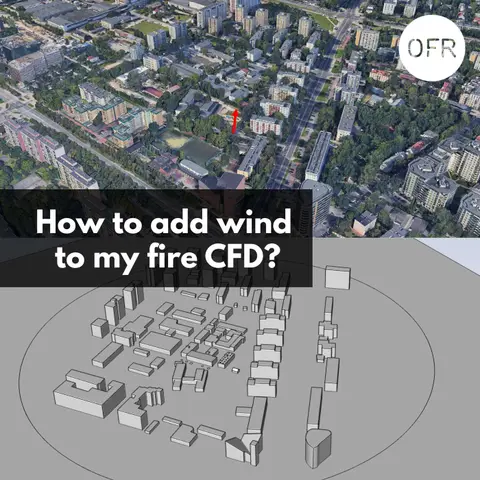
I walk through what wind actually is from a fire engineering perspective: an atmospheric, turbulent phenomenon full of vortices and gusts, not a tidy uniform flow. We talk about the trap of modeling only the average wind speed, why gusts matter so much for smoke movement and vent performance, and how the wind profile changes with height and terrain roughness. From there, I connect the dots to computational wind engineering and the messy reality of cities, where nearby buildings, parks, towers, and “urban canyons” can completely reshape the local wind field right at your façade openings.
Then we get practical about CFD. I share the domain and mesh decisions that keep results honest (including blockage and downstream wake space), how to handle wind direction, and what turbulence modeling choices mean when you’re trying to couple wind and fire. Finally, I lay out when the hassle is worth it: constrained historic roofs, atria with limited openings, exposed natural smoke ventilators, high-rise mechanical floors, complex tunnel portals, architected natural vents with uncertain discharge coefficients, and roof features where vortex shedding can damage photovoltaics.
The key resource to implement what has been said in the episode:
- Wind and Fire Coupled Modelling—Part I: Literature Review
- Wind and Fire Coupled Modelling—Part II: Good Practice Guidelines
- Fire and Smoke Modelling Chapter
----
The Fire Science Show is produced by the Fire Science Media in collaboration with OFR Consultants. Thank you to the podcast sponsor for their continuous support towards our mission.
00:00 - Why Wind Changes Fire Outcomes
04:02 - Meet Our Sponsor OFR Consultants
05:02 - Designing Against A Coin Toss
06:35 - Wind, Gusts, And Turbulent Vortices
10:55 - Good Simplifications And Common Confusions
14:27 - Historic Roof Windows Under Wind
17:22 - Domain Size, Surroundings, And Blockage
28:34 - Boundary Conditions, Profiles, And Turbulence
36:33 - How We Choose Wind Directions
38:08 - Projects Where Coupled Modeling Pays
43:58 - Wrap Up, Papers, And Next Steps
Why Wind Changes Fire Outcomes
Hello, everybody. Welcome to the Fire Science Show. Today, I think I'm going back to my roots as I will be discussing wind. Uh, we have not talked about wind and fire in the podcast for a long while, and I felt a sudden urge that perhaps it's a topic worth revisiting. For me personally, it's an very important, aspect of my engineering because wind engineering is something that I have picked up along my years, as a fire engineer. We've started implementing wind analysis along fire analysis more than a decade ago. It was kind of funny because, uh, We did not know that, uh, you're not normally doing that. For us, it was like, "Okay, there's this phenomena we have to account for." So we did, uh, and it was quite shocking because this solution was very unique in the world and, uh, yeah, eventually this built up into, uh, best practices that we've released into multiple research papers, into a large, uh, grant I've received on wind and fire. So yeah, that's quite a big chunk of my, professional, career, and I enjoyed it thoroughly. Therefore, I really like to talk about this. Um, why wind is interesting to a fire engineer? Well, if you think about it, um, bring into your mind any catastrophical fire in the past decade. There's a good chance that wind was a part of that. Simply because the specific wind field can tremendously, tremendously change the course of a fire, alter its consequences, break the systems in the building and just, you know, add on to the damage that would happen in the building when wind would not be present. I think that we can agree on that and really, uh, all the catastrophical wildfires, they happen in wind conditions. A lot of, fires where people die, especially the ones where firefighters die, are wind-driven fires, and, uh, a lot of the, uh, casualties are connected to a sudden change of the wind. Um, wind is also always there. If, if you think about it, there's always some wind. Like I, uh, I always find it confusing to look at the probabilities of wind because, yeah, strong western wind in Warsaw area would be three and a half percent, and, uh, a strong northeastern wind would be, let's say, 0.7%. Uh, And you can go around the compass and build the, the rows, uh, of the winds and, attach a probability to every wind speed and direction. But the true reality is that, uh, while all of them are low probability, there's always one of them present. That's-- There's always some wind. It's very rare to not have a, a wind. Therefore, it's something that accompanies us, uh, a-a-along what we do. And, uh, finally, uh, last motivation. You know, wh-when I was jo-going into the venture of doing the Open Car Park Wind Project, um, one of the goals I set in the project, uh, file was that I want to see if there's a velocity at which we can ignore wind. Because oftentimes when we do large experiments, we, we say that, "Oh yeah, the wind was less than two meters per second, therefore it was not that important." And you know what? In that project, we haven't found it. Like, every single of them was messy. Every single of them had some consequences. So it's just important. And, uh, in this podcast episode, I'll tell you why it's important, how we simplify it, how we model it when we need to model it, and when it's worth it. And I hope this will be an interesting thing for you, fellow fire engineers and fire researchers. Let's spin the intro and jump into the episode.
squadcaster-e4ag_1_05-27-2026_144803The
Meet Our Sponsor OFR Consultants
squadcaster-e4ag_1_05-27-2026_144803Fire Science Show podcast is brought to you in collaboration with OFR Consultants, a multi-award-winning independent consultancy dedicated to addressing fire safety challenges. OFR is the UK's leading fire risk consultancy that this year celebrates its 10th anniversary. As experts in fire engineering, they are fully committed to delivering preeminent expertise to protect people, property, and the environment. With over 30 chartered engineers and a team of fire researchers at their core, they continually explore the challenges that fire creates for their clients and society so that the best research, experience, and diligence can be applied for effective tailored solutions. In 2026, OFR will grow its team once again and is keen to hear from industry professionals who want to collaborate on fire safety features this year. Get in touch at ofrconsultants.com. And now back to the episode
Designing Against A Coin Toss
SpeakerMaybe you remember in twenty twenty-two, we had this, particularly difficult heatwave going through Europe and in the UK. they had what they've called the busiest day since World War II for, for fire departments. Really particularly difficult day when the amount of fires that emerged in the city was tremendous, and it was actually at the edge of catastrophe, at the edge of overwhelming the response capacity. That's, that's my interpretation, not, not facts. So that, that's what I've learned about the event. And also I've, I've-- I remember checking the wind history for that day, and the wind was not that bad on that day. You know, it was less than what median is for London and, and that, you know, was shocking to me because, uh, I felt it's a coin toss, you know. If, if a wind was stronger on that day, what could have happened? And then you see images like LA Palisades, where obviously wind is a tremendous factor of, of the destruction. Then you learn about, uh, fires with line of duty deaths where wind has contributed. then you go into engineering design and, and you see things that simply are based only on, on luck. Like if there's no wind, they're gonna work. If there's-- if there is wind, ah, that's, that's questionable. Uh, and I, I don't like this randomness in my design. That's why I feel that in- including wind in fire engineering analysis is sometimes necessary. I won't say it's always necessary. It's always necessary to consider wind. It's not always necessary to model it because those are two different things.
Wind, Gusts, And Turbulent Vortices
SpeakerSome issues in the literature emerge from the fact that word wind is synonymous with, uh, the flow of air in general. And there's this trend, especially in the combustion literature, where, they would call, um, something, something under wind, for anything that was exposed to a, a velocity of air. So they would put a pan methanol, uh, whatever in, into a small wind tunnel, put some flow in there, and measure how the, the pan burns in that condition. While it's good for, uh, analyzing what happens when you expose stuff to flow and to different velocities, I think we need to distinguish very much the flow from the large-scale atmospheric phenomenon, which for me wind is. I mean, the most, uh, direct, uh, the clearest is- illustration of this gap in thinking was when, when I saw a keynote in Lund 2017-ish, where-- at, at, at IFSS, where a Chinese professor did, did like very lovely keynote on wind and pool fires. It's just, uh, out of many, many, many examples that, that he's shown, only one or two were really wind conditions. All, all the rest were-- were-- was this velocity field that was called wind. And I already there felt like disconnect because for me, wind is an atmospheric phenomenon. What does it mean it's an atmospheric phenomenon? Well, we have an atmosphere. That's a great thing. Uh, it gives you oxygen to breathe. It gives us some protection, uh, from the ultraviolet, uh, radiation of the sun. It makes it possible for us to live. Uh, it has clouds which are lovely. All of, uh, the stuff that's happening in the atmosphere, like the-- there's a whole field of atmospheric sciences. And, uh, wind is not just a random movement of the atmosphere. Wind is a phenomenon, a phenomenon that develops, uh, follows the pressure patterns in the atmosphere, then interacts with what's below it, with the ground, and forms large-scale vortices. That, that's important. When air moves, it's, it's usually turbulent, and then wind is definitely turbulent. And, uh, turbulent movement of air means that the f- air follows like these swirly patterns where when it moves, it doesn't move in a streamline in a extremely beautiful way. It could, but that's not how it works in the nature. It moves in giant vortices. Now- And easy way to imagine a giant vortex is to imagine a hurricane, right? Uh, uh, that, that's, uh, also a wind phenomenon. Uh, if you have this vortex moving through space, there's-- a- and it's-- it flies through a point where you measure it. When you're first hit by the vortex, you're gonna see a spike, then you're gonna meet the middle of the vortex where there's perhaps less movement or no movement, then you're gonna feel the, the back end of the vortex where we're also gonna have a spike. So, uh, you've measured velocity field. Uh, let's say the vortex was moving at a speed of five meters per second, but your measurement is not showing five. It, it shows a range of values, ups and downs, and this, th- this is the nature of wind. It moves in a turbulent manner, and therefore it has things called gusts. These are the shorter, higher velocity flows that emerge within the phenomenon, uh, uh, that are very different from the average. And here we enter the first trap of, of wind engineering that, um- You know, gusts are the important thing. Like, uh, if you have an average wind of ten meters per second, but gusts reaching 15, it's the gusts that, uh, likely will influence the behavior of smoke inside your building. It's gusts that are important from the structural perspective. it's important to capture them, and when you just paste it on, on like fully average flow solution, you are missing that tiny detail that matters. And it's not easy. It's very difficult to, to get them. We'll, we'll get to that, uh, later on. now
Good Simplifications And Common Confusions
Speakerwe've arguably been very successful in fire safety engineering without accounting for wind for a long time. Uh, how do we do that? Wh- why is that? Uh, in many cases, a simplified approach to wind is what, uh, what winds. Um, for example, going back to that, uh, pan in, in wind flow, it's reasonable to consider wind as a unified like flat field of wind when you're simulating a response of a combustion source to a flow. Why it's reasonable? Because wind as an atmospheric phenomena happens at a very large scale. But when you're considering a small objects like one by one square meter pan, uh, it's exposed like to locality of that field. It's, it's kind of like we're taking out of that, uh, huge, huge, uh, phenomenon, a small chunk, and within that small chunk, we-- actually the wind field is to some extent uniform. Therefore, this simplification actually holds. I just feel odd calling it wind, but, but it, it holds. It makes sense if you're testing something small to expose it to a flat wind field. When you are testing, um, natural smoke ventilators, that's something that I do in the laboratory, and I've actually built a wind tunnel to do that. Uh, wh- when you're testing them, you're also expecting a flat field around them. Actually, that's required that you expose them to a flat field. And you just pick, uh, the strongest wind that's ten meters per second, and it kind of corresponds to gusts of, uh, wind that would be, um, high like 98-ish percentile that, that you would normally meet. So that, that's a very... Ten meters per second is a very, very strong wind already if you look at probabilities for most of the world. You look at a flat field because this is what the object will see. The object will not know that 100 meters above the wind flow is completely different and, uh, and you are exposed using the object to, to just a part of the, of the whole wind field. what you need to understand is the relationship between this induced flow and the object's response. That's when simplified approaches are, much, much successful. Also, when you go extremely large, like when you would model, uh, a plume emerging from a wildfire, urban conflagration, uh, you know, smoke movement in atmosphere at a grander scale. Also at that point, um, you're not gonna use CFD for that. It's, it's too big, it's-- it would be too costly, and it would be too hard to implement the atmosphere in it. What you do is you use specific models that are developed for that purpose, and those models will have all the atmospheric physics and all the stuff necessary in them simplified in a way, uh, that is reasonable and validated. And, uh, and in that case, again, like it's not really the wind engineering problem as I'm, I'm talking about in here. You also would do that for a known, uh, wind field. That's, that's another distinction. In design, we don't know what wind we're gonna have. If you're modeling a real world, uh, incident, you know what exactly wind was present there. That's a very big change. So, um, let's agree that there are some cases in which we would need to model them. I'll go through them at the end of the episode just to keep you here with me. Uh, that's a bonus if you stay till the end. Um- If we have those, we have to simulate wind.
Historic Roof Windows Under Wind
SpeakerAnd that's, uh, Wojciech in 2013 finding out that we have this historical building in Warsaw, a shopping mall, where the, historical authority tells th-the architects that, "Look, this historical mall only has those historical windows on top of it, and you're not allowed to put any extraction fans on the roof of this building because it's, it's, uh, preserved. Only thing, if you need to do some fire safety in the building, those windows are the only thing you need to use." And we look at those windows and my gosh, they are not good. Like, uh, they have very low, uh, opening angle. They are top-hung, open outwards. Uh, they're on the top of the roof, very exposed. Like we know that discharge coefficients for those windows would be in a range of 0.1, and I'm generous really. And we're like, "Ha, this is very, very bad. Uh, w-what can we do? H-how can we understand if this system works? I mean, there's a lot of them obviously, but can, can it re- even work?" That's when we start modeling the building, start adding buildings around it to understand the wind field. That's when we reach to the wind engineering legend at, at my institute, ITB, uh, late Professor Żurański, who was the godfather of Polish wind engineering, a huge legacy he left, uh, to us, uh, in, in that regard. He helps us develop this. Uh, we add wind properly. We do analysis of the wind angles around the building. We rotate the domain. We i-identify scenarios at which the wind is, is dangerous for the building. We model those with the fire in, in-inside the building, and we come up with a solution like, okay, it appears that if we decide which facade operates in which wind direction, we're, we're in a good space for the system. The system is installed. It works beautifully. Uh, that's how I discovered wind. And the, the field from which we were reaching, from which we were learning is something called the computational wind engineering CWE is a, a big discipline like fire safety engineering is. They have their own literature, their own conferences. They're likely much larger than we are. Um, it's very mature. There's a lot of, uh, interest in modeling wind in wind tunnels and translating that into computational models. So on that project, what we did was actually implement the computational wind engineering framework to a fire engineering, uh, case. And I didn't know back then that it's actually quite unique and, and difficult. Like we just, you know, uh, that was another difficult problem to deal with and, and we just solved it. But later we realized, okay, that, that's not that obvious for everyone around, so we, we started formalizing that. Now,
Domain Size, Surroundings, And Blockage
Speakerum, when you think about the implementation of wind into your simulation into a fire simulation, there is a bunch of issues w- w- which make it kind of troublesome. Um, first of all, uh, the wind is not a static field, as I said. You can consider wind as kind of a, a velocity profile along the height of your domain. So if you, if you had an anemometer, you stick it to a helium fuel-filled, um, balloon, release it upwards, you're gonna measure different velocities as the balloon raises. This is because the-- in the atmosphere, the wind slows down, uh, n- near to the ground. That's natural phenomena, you know. When, when a flow field meets a solid objects which, which have some roughness, the flow field slows down near to that object. It's just, you know, the Earth is kind of large and atmosphere is kind of large, and this, uh, part in which we happen to live in is the part when the wind slows down very, very much and, and we observe it as a logarithmic, uh, wind profile. It's important to account for that because the differences in velocities between a height of two meters, height of ten meters, and a height of hundred meters are absolutely tremendous. Velocity is not the only thing that changes, and the turbulence intensity of the wind changes as well in that profile. It's important because, as I said, the gusts, the turbulent nature of the, of the flow, all of this, uh, takes a huge role in the developing field of, of wind that we need to account for. So both phenomena, the velocity and turbulence, y- they have to follow, uh, some sort of reasonable profile. How do you get that profile? Well, that's a problem that people have been solving for fifty years, and we have all types of models that, uh, give you relationships, for velocity and, and turbulence in in a function of height for a specific, uh, surface roughness and, and atmospheric conditions. So you don't have to reinvent that. You take something that's already, uh, been developed. It's pretty challenging, and you have to have your terrain roughness, et cetera, but, uh, but you can get there. Uh, but that's the big image, the, the big field of wind. Now, the local thing, the, the wind that actually is attacking your building is not an averaged field in an open space. It's an outcome of the urban surroundings in which your building is located. That's, that's really, mm, difficult to account for and, and, and maybe even difficult to grasp. But, uh, think about it in this way. You have a building. Left to your building, there's a park. In front of your building, there's a skyscraper. Right-hand side of your building is a row of, city buildings, and behind your buildings are medium-rise residential buildings If wind comes from any of those directions, it first have to go through the surroundings, and each of those surroundings will change the wind in a different way before it attacks your building. Therefore, the local surroundings may be the decisive factor on what does reach your building, especially if you have, tall, uh, large buildings in your vicinity or if you are in difficult terrain, like y- you're on a slope of a mountain or maybe you're in a-- in something that's called an urban canyon. That's, uh, that's something that, uh, made a lot of people make fun of me that I'm studying urban canyons. But, uh, that's the thing, like if you have rows of m- medium-sized buildings or tall buildings along a street, uh, they form this kind of canyon shape in which wind can develop. And, uh, in, in that case, the wind will flow along the canyon, and it can even go away from the original directionality of the wind and then just, you know, attach itself to the canyon. And then this is something that drives the wind phenomena in that roo-- in that area. So, um, while your initial condition is the profile, you know, the profile-- you know, the atmosphere, the local field is an outcome of what's around you, which means you need to model that. You need to model what is around you because that will dictate what you will see next to your building. And now a question emerges. So how much do I need to model? And, uh, wow, that's, uh, that, that's a challenge. Um, a rule of thumb is that, you look at the buildings around you, and you model more or less, uh, five heights of the tallest building in that area. So if you're unlucky and, uh, you have a three hundred s- meter tall tower in the middle of your model, I'm not gonna have g- great news for you. This means your, your model is gonna be enormous. If, uh, the tallest building in your vicinity is twenty meters, you're good modeling like a hundred meters each direction. how many buildings you have to, build in them? Mm This five, uh, five heights is a, is a good, uh, approximation. You sometimes can get al-away with less, but, modeling everything that is standing five heights away, from your building, that should be reasonably enough. Uh, maybe three rows of buildings around your building is also a rule of thumb that, that could work out. They should actually match for many cases, unless, again, you have, uh, skyscrapers around you. Um, so this is sufficient to capture the locality of the flows changing due to, the presence of buildings. But that's not the whole of your numerical domain. Um, there are things that you have to consider. One is, uh, blockade effect. A blockade effect is something that was observed in wind tunnels. Wind tunnels are constrained spaces in which we do wind research, which means that the wind cannot go beyond the walls of wind tunnel. It, it just flows through the, you know, winds of wind tunnel. And, uh, the blockade effect is that if you put something in the tunnel which is fairly large, then, you mess up the wind field in such a way that, that you accelerate the flow elsewhere. So the air has to go around your object. It cannot go, go through your object. It has to go somewhere, which means there's an acceleration of the flow at some point of the model. And this acceleration can be important and can mess up your results. A rule of thumb is that the total surface area facing the wind should not exceed three percent of the total area of the, of the cross-section of your model and that means the buildings are kind of tiny in the wind domain. Um, another rule of thumb is that you would like to have, uh, five heights from your tallest building to the top of your domain. That's also another good rule of thumb. And, uh, w-with this, you probably end up with quite large domain, but sufficiently large to not cause this blockade, appear in your model. You also need some space in front of your model for the wind field to naturally develop. But what's very, very important and sometimes missed is that you need a lot of space behind your model. So if you build those buildings, you still need s- to, to have a sufficiently large domain, in depth downward. Why? Because in that space, you will resolve things that we call the vortex shedding. So when the wind hits a building, it interacts with the building and new vortices are formed. if you cut the domain at that location where the building is located, you're cutting those naturally forming vortices. And act-actually, the way how they form and, uh, how they shed influences what the wind does in front of your building. So it's not just, "Oh, yeah, the wind has passed away my building. It doesn't matter anymore." No, it's still, um, physics that matters for the wind field at your building. So the domain has to be huge also behind the area of interest. And yes, this means you will end up with pretty large domains. Like a domain of one kilometer by three kilometers, five hundred meters tall is not something unexpected in those analysis. That, that's a part of the, of the challenge. That's a part of the, of the issue w-with modeling wind and fire, that, that the scale at which we are working here is, uh, something, uh, that's not normally present in normal wind- fire situations. But worry not, my friend. Uh, here I actually have some good news for you. The meshes that we use in wind engineering are also huge. While, of course, near your building, near your tiny details, you need small meshes to resolve the flow around them, and wind engineers also focus a lot on, uh, so-called boundary layers, which in fire we for a reason ignore. Boundary layer is where, uh, this exchange of momentum between the flow and the surfaces is where the roughness is solved and where the-- all the profiles develop. Uh, but for the upper parts of your model or those remote parts of your domain, you can get away with huge meshes, like 10 by 10-meter mesh would not be something out of your mind. Therefore, while the physical space is giga-gigantic, it's huge, the number of, of cells in that space is actually not so... Um, it's just a number. Scale is, is, is just a number in a way. Uh, therefore, you get away with that. Actually, you know, this issue with meshes is one of the fundamental problems win-with, with, with win-wind and wind and fire because, wind phenomena you would actually like to solve at those large meshes, at those large scales. Fire phenomena you would like to solve at centimeter scale meshes. And, and that's what, that, that what, that is what makes the link so difficult between the disciplines. I found a friend, uh, Professor Lipetsky from Lublin Technical University long, long ago when we were first battling with that. We knew Tomek already, and, uh, he was helping us a little bit with the, with the wind modeling. Tomek is someone who's modeling scaffoldings and the res- mechanical response to wind. And with scaffoldings, he had the same issue. He had to solve very little flows around the scaffolding that are important for the forces that are forming on them within a, a giant, you know, wind field that you would normally resolve with some very approximate, uh, model. That's, that's how we found a lot of common language between us and eventually ended up writing, uh, wind and fire coupled, uh, simulation guidelines, which were published in Fire Technology in 2018, I believe. Um
Boundary Conditions, Profiles, And Turbulence
SpeakerOnce you have the, the m- correct domain, correct mesh, you also have to apply the wind somehow, and there will be two things to consider, the direction of the wind, and there's gonna be the, the wind speed or profile itself. Now, for the direction, uh, as we work with ANSYS and non-structured meshes, for us it's quite easy. You just build a part of your domain which is like circular and it can rotate, and then you just build your artificial wind tunnel in the CFD, and that's it. You then change the angle of wind by rotating the city inside your model. That, that's for me a very natural way to do it. And but I know that everyone who's using FDS, uh, you're not able to do that. You're kind of stuck with rectangular domains, and here actually, uh, FDS development team has done a great effort to, to support you because they have this, uh, boundary condition called wind, which allows you to define wind as a profile, uh, a little bit a different way than we do it a- in ANSYS, but still fine. And within this boundary condition, you can also change the direction of the wind, so it doesn't have to blow like directly straight from your, uh, walls of the model. It can blow at an angle, which, you know, helps a lot because th- this, this angle sensitivity of wind is extremely important. Now, as you've introduced wind on your boundary conditions, the question remains, what is the wind in the middle of my domain where the building of interest lives? It's not necessarily the same as at the edge of your boundary, especially if you're considering local fields caused by other buildings. But in general, the profile doesn't really have to hold, you know. So as the flow moves through your domain, it changes. Uh, it has to change because it interacts with everything around it. Uh, that's a bad thing if you want to have a specific flow in the middle of your domain because, uh, what you can receive there is may be, may be different than what, what you've submitted. But it's also potentially a great thing for, for the same reason. If you want to have a very specific flow in the point of your interest, you have a way to control it by those interactions. So, uh, it can be bad, it can be good at the same, at the same time. Depends on how aware you are of those interactions and, uh, and how much you use them for your benefit. There's actually a classical way to create a wind profile in a wind tunnel As the wind moves towards the object that you study, you put different blocks in the tunnel. Giant triangles, uh, cylindrical shapes, uh, some square buildings. Looks like toys, uh, dropped in the domain. But the purpose of them is that the wind flows and interacts with each of those elements, and the overall total interaction with all of those items, uh, results in a very specific, uh, flow field next to it, the object that you want to study, which is, uh, the flow field here is the wind velocity, the gust turbulence, and so on. Um, for our perspective, we had to build some custom scripts to control the boundary layers and make sure t- that we enforce the wind profile at the moment it reaches the center of our domain. That was a little bit of a challenge, but still doable. Uh, but this is something you have to be aware of. Um, one last thing when you introduce wind is how you carry that turbulence thing. So here we have to go back to turbulence modeling, uh, 101. You have two main ways to model turbulence, which is Reynolds-averaged Navier–Stokes solution, and you have large eddy simulation. In Reynolds-averaged, Navier–Stokes, what you do is you calculate turbulence intensities and, uh, other variables that define how turbulent the flow is. You calculate the energy within that turbulence, and you consider how that energy dissipates in the region around and how that influences the flow itself. it's a clever way of solving very complex phenomenon. The most important thing is the average in the name. What it means is that you're not modeling all the gusts explicitly. You're actually averaging, um, everything into the variables that you have in the model. There's a variation of this called unsteady Reynolds-averaged Navier–Stokes, URANS, which means you do that, But you solve it in a simulation with time steps, so you have a temporal domain now, and this means some of the larger flows can emerge from the physics, and this is, for us, the preferred way. However, it's well known in wind engineering that, uh, it doesn't allow you capturing the, the gust effects that well. Uh, therefore, for a lot of wind phenomena, uh, large eddy simulation is preferred, which is actually what you have in FDS model. Large eddy simulation means, uh, you are solving the larger eddies, the larger vortices, the swirls of air, um, through which the air moves. And, uh, the smaller swirls that, uh, are perhaps not that important for the general field but still important for the dissipation of, turbulence, you model them with a subgrid scale model. And, um, the difference between the fire LES and the wind, uh, computational wind engineering LES is, uh, within the scales of the domain, the treatment of boundary layers and the meshes. So for wind engineering, they would do super tiny meshes at the, the boundaries, of the model in the boundary layer w- to resolve this interaction between the flow and surfaces very well. And, this means, uh, if you can simulate ten seconds of wind in such a simulation, you're already been rich. In fire, y- of course, we need to simulate minutes and minutes of fire as it develops, so this is kind of incompatible with each other. We, uh, choose to not do the boundary layer perfectly. We have models, uh, for terrain roughness or sand grain roughness, which can capture a lot of that, uh, phenomenon at the boundaries, which I think is likely sufficient for fire, and this allows us to use LES. O- one more issue with LES is that because now you are modeling those large eddies, uh, they have to come from somewhere. So if you want to introduce them well at your boundary, you need to have something called synthetic turbulence generator, which actually drops in eddies into your model based on some physical laws. Or you have to have this buildup of, of obstacles in front of your model that allows you to capture the turbulence, uh, well when, uh, the flow reaches the building. In a way, a middle ground is if you build large enough city domain with enough buildings in it, enough complications in it, there's a good chance the turbulence will resolve itself by the moment the flow reaches your building. Um, but that's hope. I don't have a proof for that. You, you would have to do a validation. You see this field is still, uh, something that's not 100%, you know, validated, especially for such complicated cases like wind in, uh, in the cities. Uh, there's a great progress, but, but still for those coupled phenomena, this is a challenge. So, uh, we have all the components you need to introduce the wind into your model. You have the profile, you have the boundary layer, you have the boundary condition, you have the correct mesh, you have the correct domain. You can implement that. It's, it's, it's challenging, but it's sometimes worth it.
How We Choose Wind Directions
Speakerone last time, the directionality. I didn't mention the direction of the wind. So which direction should I choose? As I started the podcast with, you have, uh, endless amount of combinations of direction and velocities. Which one to study? What we tend to do, because you obviously cannot study all of them... Uh, actually we've done that in the car park project. We studied all of them. But for commercial projects, you cannot do that. What we tend to do is to run wind analysis on its own, like cold flows, no fire, and we just look at the pressures on the buildings and the base-- the pressures especially at the openings of the buildings, inlets, outlets. We identify, uh, candidate cases where the pressures are highest or lowest on those openings because that's an indication that the, the flow may interact the most with the middle-- in-- with the interior of the building, and then we do coupled simulations for those. So we use just wind engineering to define the candidate scenarios, and then we use, uh, coupled analysis to investigate those candidate scenarios. That's a simplification that I think is very reasonable. Um, there's much more in details for that, but that's why I wrote the wind and fire coupled modeling papers, and they're linked in the show notes, and you're very, uh, welcome to, to check them out. I also have a chapter in a handbook of, fires in the environment where I go in depth into that methodology. So those three resources are what I would say your go-to resources for, introducing wind into fire simulations. Now, I promised you I'm gonna tell you when it's worth it, so we've reached that point. So
Projects Where Coupled Modeling Pays
SpeakerWojciech, when it's worth to go through all that hassle? Look, we've started with a historical building constrained by the historical authority with absolutely no other way to, uh, to solve the problem. There was no other way we could solve the problem other than wind engineering. That was how we started with it, and I think that's a great example of a building where it's worth it because you're so constrained by your ab- ability to engineer, you have to take what you have, and, uh, you don't know what you have until you study it because the wind field in proximity of a building in a tight building city center i- is really, really complex. And I would say it was absolutely worth it for that building. Um, if I had a large atrium, potentially a lot of people in a tight center of a city, and not that many openings connecting that atrium to the exterior or maybe just openings all on one facade is likely worth it because it can go very wrong, and you need to understand how wrong it goes when it goes wrong. That's when it's worth it If you have a roof in which parts of the roof are obviously exposed or shielded, so for example, you have a giant, uh, advertisement, uh, in front of your natural ventilators or maybe behind the ventilators, both will interact with the performance of them. It's likely worth it. If you have a very explicit urban canyon, a wide street with tall buildings next to it, and then you have your smoke control on the one edge of those buildings projecting into the canyon, it's likely worth it. Because if you need natural phenomena like natural ventilation to clean your building out of the smoke, and this is connected to a system in which a perpendicular wind is likely, it will... there will be an effect. Uh, and, and you don't know how big the effect is until you study that. I would say that's worth it. Um, if you have a high-rise building and a mechanical floor at the top of the building or in the middle of the building, it's very common that you have those mechanical floors, um, at heights, and the mechanical floor is open to the atmosphere, which also is sometimes the case. They're nicely covered, but they're actually open sometimes. and you want to study the fire in that mechanical room, it's probably worth it. It's not that hard analysis back then, and you can simplify a lot of what I've said into a simpler wind, uh, profile model because, uh, unless you're designing for Dubai or something, then probably there's too many skyscrapers around you, but, uh... or, or New York. But for, for a normal skyscraper in my little Warsaw, uh, that would be fine, and we've done that in the past. Um- For some tunnels it's worth it. Uh, which tunnels? When you have a tunnel that, goes through a mountain outside of a city, it's probably not worth it. When you have a tunnel which goes into a shallow canyon and goes down, down, down, and then enters, uh, underground, it's probably not worth it. But we sometimes have tunnels as a part of the city where you have the tunnel entrance overground, and then it goes underground, and then it goes overground again on the other side of the city, and both are in a complex environment. In that case, it's likely worth it because the local field will shape what attacks your portal, and this will definitely drive the, uh, the smoke control design inside. That's, uh, when I would say it's worth it. when you have extremely complicated architecture and your natural ventilators are a part of the, mm, architectural solution, which means you're not taking a standard, uh, natural ventilators, you know, square, that you put on top of your roof, but you are integrating the natural ventilation function into your facade or roof in a very complex kind of shape, it's likely worth it because there is no way you can approximate, uh, the discharge coefficient reasonably for that device. Um, and, and, uh, the performance of the whole roof will be different than the performance of a single device, and in this case, the wind will drive it. Therefore, in such projects, it's worth it. And, and those are all projects that we have done wind engineering. We've done engineering for an urban canyon. We've done for a facade of a historical building, for a roof of historical building, for a new development where we had, uh, the NSHF as a part of the roof architecture. We've done it for mechanical room. We've done it for tunnels. We've done it for a classical roof, but a lot of advertisement on top of that. And, and actually, that advertisement helped the wind extraction. That was the interesting part. We've shown that uh, that it's beneficial for the system to be in this complex or dynamic setting. it's also worth it if you're studying, uh, potential damage to photovoltaics due to wind. The vortex shedding at the roofs can be brutal, and there's this thing called conical vortices. You can Google it up. It's like when the wind hits your the corner of the building, the vortices from both edges kind-kind of like, uh, go together in one vortex. And God, this is a strong force that can really devastate what's on your roof. So that's an interesting phenomena. A lot of wind phenomena are fascinating. So yeah, w- this is all we've done, and in all of those projects, I would say it was worth it. We had 100 projects where we said it's not worth it, so it's not that we default to wind modeling. But
Wrap Up, Papers, And Next Steps
Speakeras I said at the beginning, um, you not always model wind, you always consider wind. And I think, uh, uh, that's what I would like you to leave this podcast with. So, um that was the story of my life as an engineer, a, a young guy who, went into a project and thought it's a great idea to include wind in it, and then had to figure out how to do it, and now is sharing with you on what was discovered along the way. It was a journey for sure. but, uh, yeah, I, I enjoyed it. I, I enjoyed it thoroughly. Uh, now in-- maybe now in fire I'm known for other things, but some years ago in fire I was known as the wind guy, and in, in wind I was known as the fire guy, which is an interesting place to be. And I, I appreciate all of those, uh, who, who trusted me in helping them solve wind and fire. Um, in this episode we've discussed why it's important to model wind. It's a phenomenon, it's an atmospheric phenomenon that has extreme richness in it. We've discussed how to simplify it, how to put it into your CFD. We've discussed the caveats of modeling and when it's worth it. I think, uh, all of the things on my list are now ticked off, and I feel myself complete. Really thankful for you to spending this hour with me and, uh, learning a little bit about wind. I hope this is useful to you. Links to the papers are in the show notes. If there's a problem with obtaining them, email me or, or direct message me on LinkedIn. I'll send them to you. And I, I wish you all the best in, in your wind modeling journey. Um, that's it for today, and, uh, next week, uh, it's Wednesday, therefore, there's more fire science going your way. Thanks for being here with me in the Fire Science Show. Cheers. Bye.


