274 - SPyro model for predicting fire growth with Jonathan Hodges and Jason Floyd

 Apple Podcasts

 Spotify
Modeling the consequences of a fire is what most of us do day to day. Modeling how a fire actually grows across real materials, under changing heat flux and ventilation, is the part we tend to avoid, hiding behind a prescribed design fire. That gap is exactly what we tackle with Jason Floyd and Jonathan Hodges from UL Research Institutes, the developers of S-PYRO, a new engineering pyrolysis model already included in Fire Dynamics Simulator (FDS).
We walk through the origin story in railcar fire growth modeling, where “traveling fire” assumptions and fixed HRR curves can fall apart once the compartment becomes ventilation-limited. S-PYRO takes a more practical route to predictive fire modeling: it uses cone calorimeter data (multiple heat flux levels, and optionally multiple thicknesses) and scales burning rate and time so mass consumption stays consistent while the exposure conditions come from your CFD simulation. That means the local incident heat flux in FDS drives which cone response the surface should follow, instead of guessing the fuel output up front.
The hardest detail is also the most important: flame feedback. A burning sample sees extra heat flux from its own flame, and the cone heater flux can be partially absorbed by soot and hot gases. Jason and Jonathan explain how they built a “digital twin” cone using high-resolution FDS runs to generate lookup tables for flame heat flux and cone absorption across different fuel properties, plus how validation against large public cone databases reveals where the self-similarity assumption holds and where it breaks (dripping polymers, delamination, collapse, long-duration char oxidation, and complex assemblies).
If you’ve ever wanted fire growth modeling that’s more realistic than a scripted curve but more approachable than full kinetics, this is the roadmap. Subscribe for more fire science, share this episode with a colleague who uses FDS, and leave a review if it helps. What material or scenario would you try S-PYRO on first?
Resources:
- Jack Bono Award winning paper "An Approach for Flux and Thickness Scaling of Cone Calorimeter Data for Predicting the Pyrolysis of Materials" (improved SPyro)
- An engineering model for the pyrolysis of materials
- FDS github with all the resources
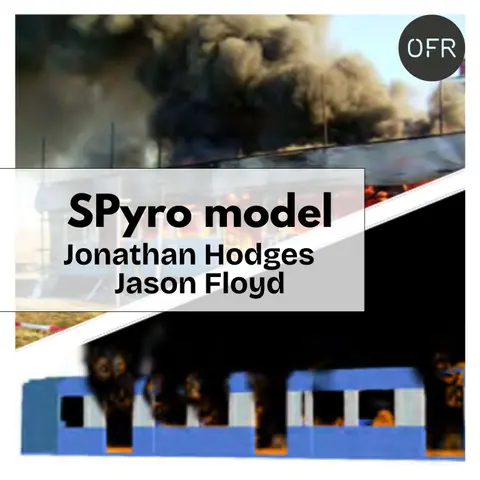
Cover image from a paper: J. Hodges et al., MODELING THE FIRE GROWTH IN A RAILCAR, Interflam 2025
----
The Fire Science Show is produced by the Fire Science Media in collaboration with OFR Consultants. Thank you to the podcast sponsor for their continuous support towards our mission.
00:00 - Why Design Fires Fall Short
03:10 - Sponsor Message From OFR Consultants
04:10 - Meet The S-PYRO Developers
08:30 - Railcar Fires And Ventilation Limits
12:40 - Scaling From Heat Of Gasification
18:20 - The Missing Piece Flame Heat Flux
24:40 - Digital Cone Modeling And Lookup Tables
30:20 - How FDS Chooses The Right Curve
34:40 - Thickness Scaling And Thermal Regimes
38:50 - Validating Against Public Cone Databases
45:40 - Where S-PYRO Struggles In Practice
48:55 - Railcars Reconstructions And Suppression Insight
51:30 - Getting Started Data Inputs And Repos
52:45 - Closing Takeaways And What’s Next
Why Design Fires Fall Short
Wojciech WegrzynskiHello, everybody. Welcome to the Fire Science Show. I hope that for all practicing fire safety engineers, it is clear that when we're modeling fires, what we typically do in our designs is to model the consequences of fires and, you know, the fire-fire part is something that we hide within the design fire concept. We just prescribe it. It goes as it is. Uh, nevertheless, uh, it has always been a dream to increase that realism and bring some of the fire modeling into fire modeling, if I may. And, uh, a lot of approaches were practiced or are practiced around the world. Some people have, design fires that trigger by ignition temperatures. Some people would go to pyrolysis models, et cetera. it's not easy. It's, it's one of the hardest things to do, and, uh, let's say the, the final boss of fire safety engineering for me But I must say, on the horizon, we start getting more and more interesting applications and, uh, of course, we're talking about one of them today, one that is really, really promising And one that was recently recognized with the SFP Jack Bono Award for Engineering Communications for the, for the paper that introduced it. Uh, so yeah, today's guests are Jason Floyd and Jonathan Hodges, both from UL RI, and both are developers of a model, model called S-PYRO. Uh, S-PYRO is already a part of FDS. Uh, they are both, active members of the FDS development team, and the model is already there. All the cases are already on your computer if you, if you have FDS installed. So, the l- least friction you can have to, to try s- out something new. S-PYRO is a model that, in short words, takes a few cone calorimetry experiments on the material that you are modeling, and then is able to figure out, uh, the heat flux that is in your simulation. How does that relate to the heat flux, the material seen in the cone experiments, and pick the correct response measured in the cone to the conditions that are in your compartment, targeting your fuel. Uh, it's not, a complete mechanistic physical model of pyrolysis that explains how things burn, but it's a really great fit to a very popular, uh, apparatus that a lot of fire engineers have access to. Data is available, which therefore makes it really approachable way to, to enter the world of, predictive fire modeling. And many people told me it, it kind of works. So I've invited Jason, I've invited Jonathan, and here we go discussing S-PYRO, and I hope you will enjoy this one.
Sponsor Message From OFR Consultants
Wojciech WegrzynskiThe Fire Science Show podcast is brought to you in collaboration with OFR Consultants, a multi-award-winning independent consultancy dedicated to addressing fire safety challenges. OFR is the UK's leading fire risk consultancy that this year celebrates its 10th anniversary. As experts in fire engineering, they are fully committed to delivering preeminent expertise to protect people, property, and the environment. With over 30 chartered engineers and a team of fire researchers at their core, they continually explore the challenges that fire creates for their clients and society so that the best research, experience, and diligence can be applied for effective tailored solutions. In 2026, OFR will grow its team once again and is keen to hear from industry professionals who want to collaborate on fire safety features this year. Get in touch at ofrconsultants.com. And now back to the episode
Meet The S-PYRO Developers
Wojciech WegrzynskiHello everybody. Welcome to the "Fire Science" show. I am joined today by Jason Floyd from ULRI. Hey, Jason. and Jonathan Hodges also from ULRI. Hey, hey, Jonathan.
Jonathan HodgesHello everyone
Wojciech WegrzynskiWhat brings you here?
Jason FloydWell, you invited us.
Wojciech WegrzynskiJust kidding, of course. Uh, what brings you here is pyrolysis approach, uh, that is introduced into FDS called ASPYRO, and I've actually, not very long ago, I've met with a high-profile member of our community, and that high-profile member was very, uh, had some very kind words about this approach, uh, that, he used words, "It kind of works." And I'm, like, really, really curious because it's, it's very promising. And J- Jonathan, you, you've been in the podcast before. We've talked about the differences between fire spread modeling and, and, and, effects of fire modeling. I think it's a... If someone has missed that conversation, it's probably w- worth, revisiting that. I think, ASPYRO is a huge step to fire spread modeling. So I'm all in to hear about, development of this model, the history, and the promise that it, brings us. and, and what's the future steps. Let's maybe start with history. Jonathan, would you like to start?
Jonathan HodgesUh, sure. So implementation that, we had put together and, presented back at IFSS in, Uh, 2023, that, version came about from some research that we were doing in the private sector in fire growth modeling of railcars.
Wojciech WegrzynskiHmm.
Jonathan Hodgesa federal agency in the United States, and we were trying to understand, uh, what the fire hazard is in these large vehicles with, complex materials. You have linings that can melt and fall down. You can get a flashover environment or a
Wojciech WegrzynskiCompartment size vehicles
Jonathan Hodgescompartment-sized vehicles like rail, you know, railcars, things like that. And so one of the problems you run into with the existing empirical models out there for railcar fire spread is you kinda have to assume a traveling fire behavior. You have to assume the heat flux that you get to a surface and maybe use different cone data for different surfaces. and there wasn't really a lot of validation on that. And we had seen this, self-similarity behavior in cone calorimeter experiments where you change the heat flux on the surface. Uh, if you raise it higher, then it burns faster. If you lower it, then it burns slower. And we were trying to understand how we could, build on what people had done in the past with these empirical models, to develop an approach to just a physically based scaling method. So we could even extrapolate if you're at, like 200 kilowatt per meter squared in a post-flashover entirely flaming compartment. and so that was the, the general premise where we wanted to go initially. And, uh, Jason and I were working together on, FDS, uh, work, at the time, And I had started to kinda hack this in with devices and controls. There were very messy input files that you would, you would never be able to do practically. and then, Jason, said it would be pretty easy to just implement it in FDS, the initial formulation. And so he put it in and that started the process of us, uh, going through and validating the model for different scenarios.
Wojciech Wegrzynskiat the time, what was the Well, it was not that far ago. It was like, uh, you said the paper was 2023. It's linked in the show notes, by the way, if anyone's wondering. Uh, alternatives did you have? Okay, you, you could have a traveling fire with prescribed burners that trigger at some point in FDS. What, what, what else are people using to kind of mimic that behavior?
Jason FloydI mean, essentially, you either you know, you can ignite grid cell at a time by specifying an ignition temperature and then just saying follow this
Wojciech Wegrzynskiheat
Jason Floydrelease rate ramp.
Wojciech WegrzynskiMhm.
Jason Floydyou know, you have the approach of you could, have some solid obstruction where you a device just looking for, any-- whatever the peak temperature is, and then once you reach that, you turn on vents over the entire obstruction rather than spreading fire over the surface of the obstruction, you know. Or you have the approach of attempting to define, detailed kinetics for the material
Wojciech WegrzynskiAnd if you had to give me a bound of what a failed simulation with that approach looks like, because if you just put, you know, a heat release rate curve and thermal, uh, temperature condition to ignite, you can have a very flash-overy fire in not very flash-overy conditions, to be honest, right?
Jonathan HodgesSo a big problem in The-- rail
Railcar Fires And Ventilation Limits
Jonathan Hodgesones in particular is ventilation. If you are considering just like a single car, um, the local heat fluxes, once you become ventilation limited, drop quite a bit. And so if you don't consider that change in the local heat flux, you end up with very high heat release rates. and so if you, you know, in the limit that you've ignited everything on the whole rail car, if you're just following a prescribed curve without any scaling, you're gonna be predicting, you know, thirty, sixty megawatts, something huge on the rail car. but if you don't have The-- ventilation to support that, the local heat transfer drops quite a bit once you get ventilation limited. so that's, part of why we were looking at it
Wojciech WegrzynskiA-a-and how about like very high-level detailed pyrolysis models like Gpyro, for example? You can couple Gpyro with FDS. Would that work?
Jason Floydthe challenge with, with the, with the kinetics at this point, I mean, one of the big challenges is just our ability to accurately predict that heat transfer to the surface when it's burning. Um, and so you can, with detailed kinetics models, get in like bad feedback situations, right? You get
Wojciech WegrzynskiMhm.
Jason Floydtransfer, the surface temperature goes up, the reaction rate goes up, more heat trans- you know, or, or vice versa, not enough heat transfer, and you just don't get the burning rate, that, that you have. And so one of the things that sort of interests us with the idea of S Pyro is that, you know, we're only doing heat transfer up until the point of the time to ignition. and then after it's just scaling you know, measurement from a cone. So we sort of decoupled, that feedback mechanism to some extent. We are still relying on the heat flux prediction to the surface to scale the cone, but not in the same sense as the temperature, know, exponential in an Arrhenius rate, you know, with kinetics
Wojciech WegrzynskiAnd, and another thing that is, that's interesting in those, uh, with those models, like, uh, the source of data because, like, you would like to base these models on, on, on, on small tests, heat of combustion, thermogravimetric analysis. Cone is interesting, but still cone is 10 by 10 sample. That's the size of a cell in FDS. H- How, how accurately you can capture all of the phenomena at this scale, right? I mean, that, that's some- that's a question that I've always asked myself
Jason FloydYeah, and I think that's one, you know, limitation of this approach, you know, is you're, you're relying on something like a cone and, it's a sample that's sort of transitioning from being something very small scale, more laminar to something, you know, very, you know, more representative of large scale real world objects. I mean, you know, maybe, maybe ideally, you know, something slightly larger in, in sample size, you know, be better when you're talking about fire spread over large objects. Uh, but at the moment,
Wojciech WegrzynskiMhm.
Jason Floydthe cone is, you know, something pretty readily available and relatively inexpensive to, you know, run, run tests on. It's pretty easy to get someone to run a cone test on a sample, more so than, you know, for most, you know, engineering groups than something like a TGA
Jonathan HodgesSomething we, we haven't really talked about in any of the papers on this yet that I think is a nice benefit as well is that terms of whether the assumed burning behavior breaks down, that's something that can be tested pretty easily with your cone data by testing at, you know, 20, 50, 75 kilowatt per meter squared, and you can see how well for a specific material, uh, the scaling approach is working. And s- uh, particularly for, um, you know, composites and, materials with a lot of, uh, fire resistance, you... As particularly at the lower heat fluxes, you might start to see the breakdown of that self-similarity, but it's something that you can observe just in the test data. and if you're gonna do 50, it's not that much harder to also do 25 and 75.
Wojciech WegrzynskiAbsolutely. Okay, uh, I, I think we reached the point where we should introduce the scaling, uh, approach, uh, to the listeners. so so Jonathan, we've heard about the limitations of the models and then the struggles with the railway. Uh, what was the idea in your, in your head about how, how you could like, um, create a better engineering prediction tool, uh, And, couple it with FDS?
Jonathan HodgesYeah, so the original development is based on the concept of heat of gasification. Um, so
Scaling From Heat Of Gasification
Jonathan Hodgesthat is, uh, you have the, the mass flux, the material, uh, can be calculated based on the net heat flux absorbed into the surface and the heat of gasification of the material. And So that's something that you can calculate in cone data and things like that. Um, it's not truly a fundamental property of the material because it, there are things that vary, uh, within your geometry and your test, um, as well as, you know, for example, uh, like the backing material, depending on where you're drawing your control volume, uh, that might affect the answer you get out there as well. so that was the, the general premise. So basically, if you take the equation for your heat release rate with your mass flux times your heat of combustion and your equation for the net heat flux into the surface with the mass flux and the heat of gasification, you can rearrange, uh, your equations to get a relationship between the, heat release rate per unit area, heat of combustion, And the heat of gasification. And so then we make an assumption that that heat of gasification doesn't vary, and that allows you to scale up and down based on that exposed heat, the net heat transfer into the surface
Wojciech WegrzynskiAnd what's actually scaled? Is, is it the fuel production that is scaled, uh, some properties of the fuel that you're scaling?
Jonathan Hodgesthere's two pieces to the scaling. Uh, so the first is scaling the heat release rate up and down, so that would be the mass flux of the the surface, mass loss rate of the surface. uh, but because if you are increasing your burning rate, that. means you're consuming more of the material over time, so then you also have to scale time, uh, down, So you have to compact, uh, the, curve. So if you burn more, you have to burn for less duration. and what we did with S-Firo is do that on a local uh, time marching as you go
Wojciech WegrzynskiOkej
Jonathan Hodgescurve
Wojciech WegrzynskiThe, so, so it's, it's kind of trying to put a conservation of mass back into the, into the model as it burns down
Jonathan HodgesAnd, uh, Jason talked about this a little bit earlier, the like, one of the big complexities of trying to do this and where some of the approaches broke down historically was the flame heat flux. Uh, and so that, because the heat flux in the cone, if you have it set at 50, um, that's the right number for the first, um, you know, 300 seconds or 150 seconds or however long it takes to ignite. But then once you have a self-sustained flame, you get additional, radiation and convection from the flame down to the surface. And so if you were just scaling based on your cone exposure, you're undercounting how much of that net heat transfer is going into the surface. And so our original... went through a few different models of trying to estimate, uh, that flame heat flux. Uh, there's a study by Orloff and de Rice with a, a fruit scaling of
Wojciech WegrzynskiOf, of course there is.
Jonathan HodgesYeah.
Wojciech WegrzynskiYeah
Jonathan Hodgeswith that one and calculated the heat flux to the surface, and then found some data that a few different groups had measured in a cone just putting a water-cooled gauge. So we'd use those, and you get something on the order of 15 to 25 is a pretty typical number. so we kind of initially started with just taking the reference heat or taking the exposure heat flux and then adding 20 or 25 to it and then using that as our reference heat flux for scaling
Wojciech WegrzynskiI, I mean, there, there's a huge brilliance to that and, and we'll dig into this deeper. I'll, I'll just try to pick up to the listeners who, who may be not that, you know, familiar with the, with the kinetics or pyrolysis. Like, what Jason is saying that once the material starts burning, it suddenly sees not just the fire environment which radiates on it, but the flame it generates itself, you know? And you have suddenly two sources of heat kind of heating the material and both are important. And I, I think we don't have great knowledge to tell h- which one is, is decisive one at which point of time. Maybe we have, maybe I'm wrong, but, but I, I find it quite challenging to, to be able to, account for both because you cannot just add them, right? Or, or you're just adding them
Jason FloydSo in, in FDS, FDS is predicting that combination, you know, whatever the room fluxes that reach the sample plus, you know, whatever the flame is doing, that's being predicted in FDS. And the challenge, you know, as Jonathan was talking about with the-- cone data is that the cone, we know what the cone was set to. and
Wojciech WegrzynskiYeah
Jason Floydthe sample starts burning, you know, we don't necessarily know the flame heat flux. We don't know how much the flame is absorbing some of that cone flux because there's soot and, you know, participating media in, in the, in the flame. so so the original model where we just had this sort of very simple flame heat flux, model, you know? there was the recognition that, well, you know, okay, if you've got different materials, different soot yields or different radiated fractions, you know, how do we... You know, how does the user know what the sets of, the flame heat flux, you know? And there wasn't really any concrete guidance that could be given. And it's not easy to measure this in a cone test because really, you know, at the moment, the only
Wojciech WegrzynskiNo
Jason Floydyou know, if you really measured this is like you cut out a little bit of your sample and you put it in the heat flux gauge or something like this. Now you've kind of changed the test, and you can't do that in a lot of locations. so we decided that well, you know, why not do some, you know, fairly high-resolution FDS simulations of a cone?
Wojciech WegrzynskiAll right
Jason Floydyou know, we'll prescribe a fuel mass flux from FDS with some fuel composition, you know, some heat of combustion, some soot yield, some radiated fraction, and let's see what's the flame heat flux we get. How much of the cone flux still penetrates the sample, you know, and to, to reach the surface of the cone. So we did a very large matrix of varying, the heat of combustion. And when we varied the heat of combustion, we varied
The Missing Piece Flame Heat Flux
Jason Floydthe fuel chemistry. So if we had a heat of combustion of like, you know, 40 or 50 megajoules per kilogram, we had a fuel chemistry that was like, you know, CH2, right? Some kind of hydrocarbon like, you know, chemistry. And as we started then moving down towards like, you know, heat of combustion of like 20, you get, you know, throw in some oxygen, you're, you're getting now more into like, wood or alcohols, you know, where, where, you know, you've now got some oxygen in the fuel. So trying to keep the fuel, chemistry reasonable for the, for the heat of combustion, and then we can run a simulation with just the cone and no burning rate, a simulation with the flame but no cone, And then a simulation with both. And between those three, you can then figure out, okay, what's the flame heat flux much of the cone is being, absorbed. And that all goes into this huge lookup table. So when the user specifies the fuel, can then look up, based on the current burning rate, that's happening, you know, what's the flame heat flux and what's the, the cone... the fraction of the cone that's absorbed so that we can get that what we call the reference flux for the cone, you know, the actual heat flux the sample saw during the cone test. that's what we use to compare against the FDS predicted heat
Wojciech WegrzynskiNie.
Jason Floydscale, um-
Wojciech WegrzynskiHe-he-here comes the engineering part of the name of the model. Engineering approach, beautiful. I, I appreciate that that a lot. I mean, when you started explaining that you took cone, my first initial thought, but wait a second, cone is like kind of self-adapting system as well because cone makes sure to, to expose your sample to 50 kilowatts no matter what sample it's doing. So it has some loops that, change the, change the intensity based on measured values. But I understand that now creating kind of a digital twin of a cone, you are able to study those effects independently and compare what happens without a cone, with a cone, and kind of isolate this, this particular material response in a way, playing with it
Jonathan HodgesAnd, uh, one of the things that I think is still an open question that I'd, I'd like to see someone look at at some point, you know, in the cone, the, the self-adapting piece you mentioned, you can only turn the heater on and off, right? You can't cool it. I do have this question. You know, you got your heating coil, and you get-- you're measuring your temperature typically kind of on the backside of it somewhere, and you use that to maintain. But if you have a particularly very thick sample that's running for, you know, 10, 15 minutes where it's burning, uh, once it-- the flames are there, are you heating the coils and getting the coils to be higher than the set point? Um, 'cause then that would...
Wojciech WegrzynskiOkej
Jonathan Hodgesfrom the co- uh, coil would then be higher, as well. Um, so that's something that we're not really considering in our current model. but it's, maybe it's not a big issue. It, I think it'd be a very hard thing to measure. but it's something that I've thought about as well.
Wojciech Wegrzynskiit it is a really valid question, you know, because, uh, this kind of feedback setting is so critical for the combustion processes, you know? Uh, but perhaps here, like what Jason said with, uh, with the, digital twin model of the cone and and having a good pyrolysis solver with the right kinetics, uh, at this scale, maybe this could work, you know, a millimeter mesh, uh, model, et cetera. May- maybe that, that, that's a, way to actually isolate this again or just, you know, you have a cone, just go and test it. Um, okay, uh, Le-le-let's move forward. Um, so this, um, from the me-mechanics point of view, Jason, you mentioned lookup tables. So h-how does e-exactly the model figure out what is the correct, heat release rate per unit area or mass flux rate? I, I guess it's m-m-m-mass flux of the fuel. What, what's the correct mass flux of the fuel for the given exposure that, I have in, in my model?
Jason Floydso the, the user, uh, you know, their input file, you know, they give, materials to specific heat conductivity and ignition temperature, and then they can
Wojciech WegrzynskiYes?
Jason Floydone or more ramps representing time versus heat release rate per unit area from a cone. In each one of those ramps, they can say, what was the cone heat flux for that ramp? so FDS, you know, reads in that, that ramp and then marches along the ramp using the fuel definition. And at each point along the ramp says, "Okay, here's what the heat release rate per unit area at this time." Can use a lookup table to get what the reference flux is. And so it builds up-- it builds a new curve, which is the reference flux over time. so we, have the reference flux over time and the, and the burning rate over time. And so now we can, build a, a curve, which integrated flux over time versus the integrated mass loss over time. and that's what we use to scale. Um, so in, in FDS, we predict, you know, an incident heat flux in FDS, we integrate that flux over time, find that integrated time point on, you know, the, the curve from the cone, and then based on what the FDS predicted flux is versus the actual reference flux values at that point, we can pick, you know, which of the cone curves whose reference flux at that time bound, you know, the FDS flux and then can interpolate, be-between those two. And, you know, then we, we look at, okay, now what's the-- that interpolated integrated mass loss, and we compare it. to the prior time step integrated mass loss, and then, you know, that delta becomes the burning rate.
Wojciech WegrzynskiAnd, and where does come the mass conservation? You just track how much mass has burned and compare it with the user-provided information or?
Jason Floydcan arise in, in a, in a couple of ways. One is, I mean, if you actually have all your cone curves go to zero, and they all
Wojciech WegrzynskiJa
Jason Floydnominally the same total energy release, you know, then at some point all the interpolation goes to zero and
Wojciech Wegrzynskiall right
Jason Floydcurves burn out. but, but the other way you can also sort of enforce mass conservation is, you know, in, in FPS you can, specify for, you know, the obstruction, what's the full density so that as, you know, multiple cells are, are burning, you know, from an object, it'll, know, just remove that cell when you reach that full density. and so I mean, actually I, I think, you know, with this fSpyro model, because, you know, you never get quite exactly the same total energy release in all your different cone tests
Digital Cone Modeling And Lookup Tables
Jason Floydbecause, you know, the sample thickness is never perfectly the same, you know, in, in tests. Um, you know, so I, I think it is good, you know, to sort of not necessarily go to zero on your cone curves, but go, you know, most of the way through the test, but leave, you know, a little bit there so that way just this numerical slop means you actually can burn away your material and you don't up having like a microgram sitting in a grid cell for, you know, your simulation
Wojciech Wegrzynskibut does this mean that the cone data should be the material at the, the same thickness as in the FTS? Or is there a way that I can, I don't know, test my spruce for three millimeters and use five millimeters, uh, in a spiral?
Jason Floydalso, um, implement a, a thickness scaling, And, it's, a similar process to, the flux scaling. You can specify sets of curves multiple thicknesses with multiple fluxes. So you can sort of have this matrix, you know, of, of, of thickness and, and, and flux that you specify, will, you know, interpolate between the, thicknesses and it, you know, will, will extrapolate as well. And the scaling is similar, you know, that if you have, a thicker material, it's, it's basically if you're, if you're, if you're modeling a thicker material, then you test it. Essentially, it's stretching time out preserving, you know, that release rate so you get the right integral of, of, of mass underneath. but I think it's obviously, you know, some caution with that, and you wouldn't want to test sample and then, you know, try and extrapolate up to, like, 50 millimeters. I mean, that would be, be too much. But if you tested,
Wojciech WegrzynskiPeople would never do, people would never do that, Jason. Not
Jason Floydnever, I know people never do
Wojciech Wegrzynskinot in Fire Science
Jason Floydbut but it's nice, but I think if you're, you know, if you're, similar in, thickness, you know that you are extrapolating,
Wojciech WegrzynskiMm.
Jason Floydthe, danger of extrapolation, right? You know, it's sort of be, be careful. But, you know, I think the interpolation works well. but, you know, they talk the extrapolation, you know, be, be, careful with, you know, the further, the further you're extrapolating, the less you can expect, the results to be
Wojciech Wegrzynskiby asking this question, I've triggered a switch from the first paper to the recent one that was published last year in, uh, Fire Technology. jackpot award. Congratulations, guys. Uh, amazing effort. Very, very well deserved. Uh, highly competitive. Uh, I'm jealous now. Honestly jealous. Congratula- I I'm, I'm so happy for you, you know? that's definitely a paper that, that deserves it. Um, but this new work had to be triggered by some thought process and limitations and, and stuff that you find out, and now I would like to hear about them. So after 2023, IFSS, the first implementation of Vespiro, what was the further direction of, of building o- on the previous success of the model? What were the bottlenecks and, and how did you choose to respond to them?
Jason Floydthe main model, I mean, so the main, the main issues were, you know, the original model had this fixed flame flux sort of concept, where without really a good way to give users guidance on what that should be for a specific fuel. Uh, so that led to, you know, the effort I described earlier of trying to determine from modeling what that, what that flux should be. Um, and then there were, you know, of course, once you re- release the model that, you know, had some limited, interpolation ability, of course, people were asking, "Well, you know, can we do something for thickness or..." and also just some, some of the numerics of how we were doing sort of the original implementation could have, needed, needed some adjusting to better map the reference flux, you know, from the cone to what was being predicted in FBF. So that led to this much more extensive work, um, and also, you know, had us look at, a more extensive library of, validation, examples, to include with it which I think really sort of helps, give the approach, a much better feel for exactly what it can And can't do
Jonathan HodgesI was gonna add on that, um, when I was presenting this at IFSS, in 2023, it was, pretty well-received, but there were a lot of questions about, "Okay, well, how do you get the flame heat flux? How do you, how can you interpolate if you have multiple curves?" And, the different thicknesses, like you should be able to use data from multiple... And so there were a lot of questions, uh, about that, during the session that were, pretty difficult questions. Uh, it led to additional development and thoughts. So that's kind of-- the idea started growing during the conference and I, Jason and I talked about it a little bit, and I just put pen to paper and, was looking at, Fourier number and Bi number and seeing if we could come up with a way to scale the thickness naturally using our dimensionless groups. And So actually by The, end of the conference and just the flight back, um, we had a initial formulation on the thickness scaling, uh, just using the non-dimensional numbers. but then it took a little bit longer to get data that we could use for validating. And then the, the other changes with the, the flame heat flux and the interpolation, uh, were things that came about, a little bit later, after, uh, Jason looked at the implementation and came up with the, the approach on the interpolation scheme
Wojciech WegrzynskiOkay, uh, l-l-let's stay for the thickness scaling for a second. you? mentioned Biot number. W-what's the importance of, of materials being thermally thin or thick, uh, in the, in this case, and how big was the challenge for the original Aspiro and how the new one handles it?
Jonathan HodgesSo the, main thing on the the Biot number is particularly if you are changing between thermally thin and, thermally thick, um, then you're losing that self-similarity. uh, so if you're already thermally thick and then you're re- you're increasing your thickness beyond that, then the scaling works pretty well. But if you to your example earlier of a three millimeter and, then extrapolating that up to 50 millimeter, that's probably gonna be changing between thermally thin and thermally thick, and so that self-similarity
How FDS Chooses The Right Curve
Jonathan Hodgesisn't gonna hold anymore
Wojciech WegrzynskiAnd, how does that translate to real world, cases? when it becomes important? Was it important in the railway settings? I, I think you'll be working mostly with upholstered, materials, so, so not a big deal. But I, I assume when you scale it to the real world examples, that can become more and more important
Jonathan HodgesI would say in woods where if you have like a thin panel versus a, an actual slab of wood, you're gonna be ma- having that transition between thermally thin and thermally thick. I would say for most realistic materials, you're probably operating in the thermally thick regime. but that's gonna be, you know, dependent on the properties
Wojciech Wegrzynskilet's move to the, interpolation you mentioned, and the interpolation rules were also improved in the in the next version. So h-how this, have improved o-over the development?
Jason FloydThe big change was shifting to interpolating based on, the integrated flux and burning rate, and then using that change in integrated burning rate to go back to, the heat release rate per, per unit area. before we were scaling more directly just on the heat release rate per unit area out of the, the cone curve, and that led just to some challenges in interpolating and syncing up times between, you know, the different, uh, you know, cone curves at, at different fluxes. But expressing everything in terms of integrated flux and integrated mass loss makes it easier to, to map all those into sort of a consistent reference frame to let you do the interpolation.
Wojciech WegrzynskiAnd perhaps for the, final part of, the interview, we could move to the validation and, and real world, perspective, uh, for, for the solver. So can you tell me about the, the, how was the initial one validated? There's a mention of a large, uh, cone database in in the paper, and, uh, later on how, how it was extended to, to some larger samples. Let, let's start with the cone ones.
Jason FloydYeah, so we sort of, yeah, you know, h-hunted around for, data sets we could find, you know, for, for the cone. So there's, you know, our buildingmaterials, you know, .fsr.org database largely put together by Mark McKinnon. Uh, US Forest Service had some wood products that had been tested. Um, ALTO had a small database. RISE had a number of materials that they had tested with the, you know, results, you know, available online. And then I think FAA also had some materials that they had tested. Um, so, you know, we looked for, you know, as many materials as we could find. We also, made an effort to try and find materials that were tested at different thicknesses, which doesn't happen very often, but, uh, we, we did find, some tests with that. Uh, and I think all total it was on the order of 100-something materials From the seven databases or, sets of materials that were tested. and so for each material, you know, we made sure that it had more than one flux. And so for validation, you know, for example, we had a material that's tested at 25, 50 and 75, we would use FSIRO to predict the 25 using just the 50 and 75, and then predict the 50 just using the 25 and 75, and then just predict the 75 using the 25 and 50. And similar for different thicknesses, we would, drop one thickness from the, database and predict that using the remaining, thicknesses. And then in, the, in the, validation effort, we classified materials into types, so like plastic materials, wood type materials, uh, composite materials, and then sort of the catchall other category for things that didn't seem to fit neatly. and for each of those, we looked a couple different things, um, to get some validation metrics. One was, right, in a typical cone test, uh, you've, you've got, you know, a pretty large sharp peak at the start of the test. so we looked at, you know, are we getting that, peak burning rate correct and are we getting the time at which that peak burning rate occurs correct as we scale? and then we also looked at, a lot of times, you know, the second peak later on as, as the sample burns out and you're, you're starting to see the, influence of the insulating backing. Uh, and so we also looked at are we getting that peak, you know, arrival time and, burning rate correct. Um, and those, uh, you know, is what we were basing our validation metrics on for the, the cone test. Um, and those were then all, you know, plotted out, categorized by the different categories of materials.
Jonathan HodgesSo a big, uh, a big thing we wanted to do with the validation of the Cohen Scale was we wanted as many data points as we could, because we wanted
Wojciech WegrzynskiMhm.
Jonathan Hodgesknow where is this working, where is this not working,
Thickness Scaling And Thermal Regimes
Jonathan Hodgesand we wanted to have data to support that uh, to put in the publication so that we could really highlight the you know, where you can use it And where you can't. and so we, we took a, a wide net in trying to find as much data as we could to work with And and we tried to be as honest as we could in each of the papers on the the known limitations of the model, um, so that when practitioners go to use it, they're, they're aware, of what we can't do. like we started the conversation today with fire effects versus fire growth modeling, and so we're really pushing into fire growth modeling. uh, we wanted to, make sure that people were aware of, uh, the limitations
Jason FloydYeah. One of the nice things about this approach is, you know, once you have a set of cone data, you know, basically by sort of like by visual inspection of your, you know, the cone data, you have at different fluxes, you can, you can get a pretty good idea as to whether or not you think S-pyro will work reasonably well. If you look at the cone curves and you can picture in your mind, stretching and squeezing one curve to fit on top of another curve, and you, and you think that looks... And you just in your mind, you're like, "Yeah, okay, I can see how that would work." Yeah, then S-pyro is probably going to do okay. But if you look at the curves and, like, they're just completely different at the different heat fluxes like you get sometimes for, fiber composite, reinforced composite materials because they do delamination and other weird things during, during tests. I mean, you know, then okay, yeah, maybe you're gonna have some more challenges, you know, in applying S-pyro to, you know, something that's not self-similar between the cone tests
Wojciech WegrzynskiH-h-how about material like timber or wood cribs? H-h-how successful i-is it w-w-with that types of, fuels?
Jason FloydSo the, I mean, one of the challenges with, with wood and F-SPIRO is, I mean, typically in a cone test, right, you, you stop when there's no flame, but, you know, the wood potentially still have, you know, charring that's, that's going on, you know, in, in the wood material. so I think with F-SPIRO, when you're in terms of that, flame spread and you still got flaming combustion of the wood, um, but you're still consuming the virgin material and you don't have a lot of contribution from char, uh, you know, that's a, you know, regime in, in your, in your simulation where F-SPIRO should do well. But if you get-- now you're getting to the really long time where you just have a pile of embers that are, you know, char oxidation, you know, happening. That's, you know, not something that F-SPIRO is really going to do for you, because that's, you know, generally you still have... The cone data doesn't tend to include that, that, you know, portion of the, of the wood burning.
Wojciech WegrzynskiAnd for complex items, I mean be-because obviously we're talking here about scaling based on material properties. Uh, what about like complex items like, uh, a couch or, a chair even, where you have, let's say, the same material but the different orientations, uh, also against each other, like, uh, at, at an item scale? Uh, ha-have you had any-- And I know, uh, ULRI has a great furniture colorimetry database, so have you had any chance with that one?
Jason Floydyeah. I mean, early on I, I played a little bit with, with some of the, the, the couch, items, uh, with, with, with the, with the early first version of that's the Best Pyro. but haven't gone back to really, you know, try with, you know, the, with the, the furniture samples that, we, we have. Uh, one of the challenges with some of those was just trying to understand exactly what the construction of the furniture was for, uh, for a specific, Uh, test that we had, you know, some calorimetry, uh, data on. one, one of the challenges you do get with like, especially a a upholstered furniture you know, is polyurethane starts dripping, you know, eventually you get, you know, the pool fire beneath the sofa. Um, so again, you know, you sort of get, I think the, some of that initial spread over the cushions. I do wanna, you know, try, we do have plans to model that, but you know, time. you know, model that initial flame spread, but I think that late in test period as you know, things are really starting to collapse and drip and the frame going apart is gonna be challenging, for us Pyro to, to handle. But I think, you know, that initial spread and, and, and peak
Wojciech WegrzynskiJonathan, have you, have you attempted, uh, any funny simulations with it, Uh,
Jonathan HodgesUh, yeah, I have. And there's-- I think Jason characterized it pretty well there. Even for layered materials, as long as they stay in place, it seems to do pretty well.
Validating Against Public Cone Databases
Jonathan Hodgeslayered materials where you have, uh, so in rail a- and even in, uh, some high-rises and stuff, you'll see like, uh, sandwich composites where you have like, you know, a face sheet of like, uh, a metal and then you have a wood or a polymer inside it. And those tend to not be so good, I think mainly because the emissivity of the, the face sheet is very different than the, the inner material. but for layered materials like your fabric on top of like a cushion, uh, foam or something, seems to do pretty well as long as it stays in place. we did some room corner tests, uh, ISO 9705, uh, dial tests and, one of the problems you run into when you're ru- running those types of tests is you, you've got your fasteners and you, you attach your liners and you have polymers, um, they can get loosened as they start to deform and they just fall to a pool on the ground. not be melted, it just, the, your fastener is detached and they fall on the ground and then you're not capturing that in the model. And so if you're trying to predict the full-scale behavior, it, Similar to the, the melting and getting the, the droplets below the couch that Jason mentioned is you're not capturing that physics in what you're modeling. So complex materials have those different types of issues
Wojciech WegrzynskiUh, and how about the flame radiation again? Because, uh, you've previously kind of solved the problem of, uh, self, uh, uh, self-feedbacks from the material. But here, let's say you have a chair, ar- armchair. You may have the same material surrounding one space from four sides. So now there's four of them contributing. Like, uh, uh, do you capture that or, or, or this kind of caps out at some point where the flame is thick enough and it's the only contributor anymore, and the item doesn't see the environment any- uh, an- anymore?
Jason Floydyeah, I mean, if your, if your environment is optically thick enough, you're only gonna see some short distance away from the, the surface. in that case, I think we would expect, you know, reasonable prediction of the, the radiative flux, uh, to the sample, because then things like angles and whatnot don't matter if it's just a local region that's, you know, of high temperature gas that's, that's driving, uh, the sample.
Jonathan HodgesFDS will predict the surface emission as well. So if you do have, uh, those surface and they're heating in FDS, uh, that will be predicted. if that means if you have pyrolyzing surfaces though, you also now the heat of vaporization is something that matters because you want to cap how hot the surface is getting, so you need to be extracting heat from that local surface. I would say particularly something like pallets and wood cribs are going to be very challenging just because you, you know, you got this flame going through your, your wood crib or your pallet and you're heating all of the wood surfaces, And then they're all participating in that radiation. And so to Jason's point earlier about the kinetics and having that detailed, feedback loop between the surface temperature and the heat flux and how that makes the kinetics approaches less stable, now you're reproducing that in the complex geometry with S-PYRO because you've got that local emission from the surfaces that's gonna be mattering a lot. Um, so I think those are gonna be challenging. It... I think we could probably come up with a way to do it, but, um, it's just gonna be more sensitive
Wojciech WegrzynskiAll right. And now to bring you back to where It, all started, the railway car. Did you have the chance to apply it, in the railway cars? W- was it an improvement?
Jonathan Hodgesdefinitely was. Uh, so the... If you look at the paper from Interflam last year where I was, uh, modeling railcar, uh, a railcar that was tested in Germany, uh, by BCL, um, they... We used SPYRO for scaling the lining materials, the, the hard seats that generally stayed in place. So we used it for all the different materials there, and we were able to match their experimental data, uh, pretty well, um, under the limitations that we prescribe, the window failure as well as... It was an aluminum railcar, so you had the ceiling melting as we estimated how, how quickly the ceiling was melting in different places from infrared video they had. Um, prescribed all that in the model. so we decoupled the ventilation impact from that. Uh, but, yeah, the, the heat release rate and the, the overall mass loss from the whole railcar aligned pretty well with what they captured experimentally.
Wojciech WegrzynskiYy.
Jonathan Hodgesthat was, pretty exciting. we did some surrogate railcars at quarter scale and half scale as well, um, with some of the Department of Transportation work. and we were able to use SPYRO alongside, uh, some sensitivity analysis on the, uh, extinction models, uh, since they were quite underventilated And we buried the ventilation in those surrogate railcars. so with that, we were able to understand the impact of how we were modeling flame extinction on that local e-flux as well. Uh, but I don't think that report's been made public, uh, yet,
Wojciech WegrzynskiHmm.
Jonathan Hodgeshopefully it'll come out,
Wojciech Wegrzynskiand any, uh, further uses for, for the model now in ULRI that, that you're working on? Maybe you can share something
Jason Floydand I use the, uh, S-PYRO approach for... We, we, you know, sometimes help fire service do reconstructions of, uh, you know, fire scenes where firefighters have, have been injured or there've been fatalities and used, uh, S-PYRO in the, uh, you know, for modeling the, a row home in Baltimore, uh, that had, you know, wood paneled walls and, and furniture. Um, just trying to sort of them understand how the fire was moving through the house and, you know, how that led to, you know, fuel-rich conditions in some areas. M- And then also looking at, you know, potentially, you know, sort of first order cut at what y- what certain types of suppression approaches might have done. because right, with S-PYRO, if you have water cooling in the surface, you know, that heat's being removed and, burning rate drops off. But not, not like a... full prediction, but you know, like some sort of, you know, first order at least sort of indication of, you know, you know, some level of, of effectiveness for, you know, suppression, uh, techniques. And so that, that's definitely very helpful in presenting sort of a, a a more real picture to them than just prescribing or, you know, having prescribed fire spread, you know, through a structure
Wojciech WegrzynskiFantastic. I mean, uh, I appreciate this, this, uh, development really, really a lot. I, I think it's, it's, uh, one of the coolest things that, that appeared on the radar in the recent years. And, and, yeah, y- like y- you both know, I, I'm usually using, uh, Ansys for everything, but, uh, I mean, the... seeing tools like that uh, make me want to switch my environment and, uh, I really, really hate numerical instabilities and Cartesian meshes, so it's very I'm very immovable in the space of, uh, numerical modeling, yet this,
Where S-PYRO Struggles In Practice
Wojciech Wegrzynskiuh, what, what you've just described in this podcast is something that actually, uh, yeah, makes ma- makes me excited for the future and makes me want to try it out very, very much so. So thanks for that. Uh, h- how easy is it for y- to use for a, uh for a user who's never tried it? Like, you've mentioned before the process, but perhaps we could, we could reiterate, like where, where do people start with it?
Jason FloydI, I think for most people it's gonna be fairly easy. I think a lot of users are already familiar with defining, you know, uh, you know, a, a material in FDS for heat
Wojciech WegrzynskiMhm
Jason Floydwhere you have a specific heat and the, and the conductivity and the density And, you know, the additional information you need to, you know, specify is, an ignition temperature.
Wojciech WegrzynskiAll right. Where do you take that from?
Jason Floydignition temperature, I mean, you, you can-- So, I mean, there are-- You can use things like maybe like, you know, where Bruskus has his ignition handbook, which, you know, you get some insights as what ignition
Wojciech WegrzynskiRight?
Jason Floydyou can also, model your cone test with, with FDS, right? Do, do a simple 1D model of the cone test, then, you know, see, you know, what the surface temperature
Wojciech WegrzynskiWas a dream.
Jason FloydFDS predicts, you know, when, when, ignition
Wojciech WegrzynskiRight?
Jason Floydand, you know, use that as, as, uh, getting an estimated ignition temperature. Um, so there's, there's, uh, so that's a piece of data you have to specify. Um, and then you also Just have to give the cone data. a lot of times, you data you can either, right, if you've got a plot you can, points off a plot or if you have the CSV file or you just have to... Well, again, you know, I think users are familiar with, you know, time-dependent ramps as an input in FDS and it has
Wojciech WegrzynskiAll right. But, but, uh, but, but by i- is there any structured format that it's gonna take or it's just, you know, normal, FDS RAM and I could go away with three points?
Jason FloydJust a normal, you know, FPS ramp time versus the burning rate. And then also you have to tell FPS what was the cone flux for that, ramp. and then so obviously, I mean, if you only put three points for a cone ramp, I mean, maybe, you know, I'm not gonna expect great results, but, uh, you know. But, but, it's, yeah, it, it's a-- I think the, the basic inputs that are being used are, are things users are already fairly familiar with, so it's not a lot of extra, lift
Wojciech WegrzynskiI-if I'm an engineer and I don't have an access to cone, where do I go for cone data that I could put in?
Jason FloydUm, so I mean, there are, um, and the, the papers do reference the databases we use, um, and with, the, the web links that were in ex-in existence at the time. Um, so those are all, those are all public, databases that were available. there's also, you know, many papers in the peer-reviewed literature or other technical reports that might have plots of cone data. Um, and in this day and age, you know, AI is really good if you give it a, if you give it a, a plot from a paper of converting that to a, you know, a CSV file. that's always an option as well. Or, or you know, if you're a funded project, I mean, you know, cone tests or commodity tests, there are, there are companies that'll run a cone test for you for not a lot of money. So if you are, commercial firm working on a commercial project, that might be something that's in your budget for, your, your specific material if you can't locate it
Jonathan HodgesUh, another thing to keep in mind is all the input files for the materials and the, FDS validation guide, they're, they're all available there. You can find the input files. There's also a repo. So the way that's structured in the validation
Railcars Reconstructions And Suppression Insight
Jonathan Hodgesguide, there's a script that clones another repo that's just the materials one, and that's a repo that I've got that has, sub-repos for the different, uh, repositories where I was pulling data at the commit levels. There's scripts for pre-processing all of those. Um, and there's also a script in there for optimization on the surface temperatures. So if you provided a link to all the data that you have, it'll generate FDS input files, run them, and estimate the ignition temperature. so there's some toolkits there that probably need a little bit better documentation. but, you don't necessarily have to recreate the wheel for, for doing these things as well
Wojciech Wegrzynskiwell uh, well, the beauty of the, of the current times is if you are not very fit into that, your friend Claude can do it for you. And, uh, the GitHub repository link is also in the show notes, so I think everyone, um, is welcome to try it out. I understand correctly that it, it kind of is a part of FDS now, so it, it's just there if you have FDS on your computer, right?
Jason FloydYeah, it's been in there for since, yeah. I mean, since the article was published, it's been in the last few releases, so it's there
Wojciech WegrzynskiBeautiful. So if you have no i-- if you had no idea, you've just discovered a thing that you already have access to, and you're very welcome to try. There's, uh, very little friction between you and, uh, trying the new world of, uh, predictive fire modeling. And I, I can just hope, you know, that, uh, I, I understand there are challenges and technical issues and, and, you know, scientific issues, uh, a-and the thing has to, to grow. But, uh, it's a beautiful step forward, and I absolutely understand why this is an award-winning, uh, piece of work right now. So, uh, o-once again, congratulations, guys.
Jason Floydyou. Thank you very much, and
Wojciech Wegrzynskiyou're, you're always welcome, uh, back in my show. Thanks, thanks for, for coming here and, uh, looking forward to, to new things that YulArise cooking, and I know you guys are cooking a lot.
Jason Floydthanks for having us back on your show
Wojciech WegrzynskiAnd that's it. I, you know, I'm not really an FDS user daily, so a lot of those things are kind of new to me, but I found them tremendously interesting, and we had a brief chat after the podcast with Jonathan, and we, we'll likely try to implement Aspiro with, uh, some custom functions to ANSYS. It's-- I think it's gonna be magnificent. So, uh, I already got something for myself in this podcast episode. Did you, did you get something out of it? I really hope so. Uh, modeling fire growth is, is a dream. That's,
Getting Started Data Inputs And Repos
Wojciech Wegrzynskithat's the Holy Grail of fire modeling, and, uh, we're moving and moving towards that. Developments like Aspiro are magnificent steps. Yes, there are materials that are tough for it, uh, configurations that are tough for it, melting, collapsing materials, extremely complex materials, uh, materials that change shape, uh, when exposed to fires. But we will get there. We-we're, we're getting there, and we will absolutely get there. Um, one final congratulations to Jonathan and Jason for the Jack Bonneau Award. That's really a big award. It's, it's not easy to get one. I never got one. I would like to get one, one day maybe. I have to write better papers, and it's very difficult to compete with people, uh, like, like those two. But anyway, congratulations, guys. Amazing development. Uh, community I'm sure is gonna benefit from Aspiro. It's out there. Go play with it. And, uh, have a great week. And if you're looking for more fire science in your next Wednesday, well, you know where to come. Thanks for being here with me. Cheers. Bye.


